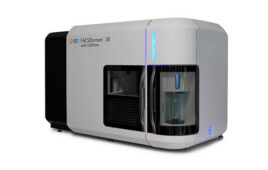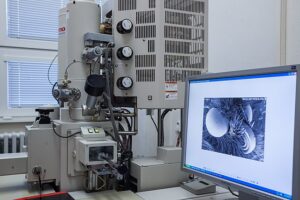
Scanning electron microscope at J. Heyrovsky Institute of Physical Chemistry of the Czech Academy of Sciences; Prague, Czechia (2020) via Wikimedia Commons.
In Manhattan, $500,000 buys a nice studio apartment. In rural Ohio, it can buy a mid-range four-bedroom house with land. The New York Times has made a franchise out of this kind of real-estate comparison, showing examples of what you could buy with a given budget. The electron microscopy market works much the same way: at the half-million mark, a procurement officer could equip a teaching lab with a bank of benchtop scanning electron microscopes (SEMs), buy a single field-emission instrument that resolves nanostructures, or purchase an entry-level transmission electron microscope capable of imaging crystal lattices at sub-nanometer resolution. Using federal obligation data from USAspending.gov, European public procurement notices from the EU’s Tenders Electronic Daily (TED) database, NSF grant records, university core facility rate schedules and used-equipment marketplace listings, we mapped what the $500,000 tier actually has looked like in recent years, what agencies have paid on both sides of the Atlantic, and what the same instruments cost on the secondary market. A note on pricing: These figures come from public procurement records, not list prices. U.S. awards often bundle the instrument with installation, training, warranties and accessories in varying combinations. European TED notices vary in detail. In the clearest apples-to-apples comparison we found, the same Hitachi HT7800 class of 120 kV TEM appears in federal records at $410,000 in an apparent instrument-only purchase and $677,000 in a turnkey NIH package. A service wrap can move the effective price significantly. Think of these as fully-loaded procurement costs with a lot of variables rather than stripped-down and predictable sticker prices. It is also worth noting that procurement records in this analysis span several years. The Bureau of Labor Statistics’ Producer Price Index for laboratory analytical instruments (WPU118603) rose approximately 23% between January 2020 and February 2026, meaning older awards may understate current market pricing.
The instruments at a glance
| The fleet | The mid-tier | The deep look | The outlier | The compact | |
|---|---|---|---|---|---|
| Category | Benchtop SEM fleet | Mid-range FE-SEM | Entry-level TEM | Benchtop TEM | Compact multi-mode TEM |
| Typical unit cost | $80K–$250K | $300K–$650K | $400K–$700K | $80K–$150K (est., not verified in procurement data) | Not independently verified |
| Units for $500K | 2–6 | 1 | 1 | 3–4 | TBD |
| Resolution class | 2–20 nm | Sub-nanometer | Sub-nanometer class; suitable for lattice imaging | 1.2 nm TEM (5 kV) | 1.0 nm TEM (25 kV) |
| Facility needs | Benchtop, standard electrical outlet | Floor-standing, vibration/temp control | Floor-standing, dedicated room | Benchtop, standard electrical outlet | Compact floor unit, standard electrical outlet |
| Key vendors | Thermo Fisher (Phenom), JEOL, Hitachi | JEOL, Zeiss, Tescan, Hitachi, Thermo Fisher | Hitachi (HT7800), Thermo Fisher | Delong Instruments (LVEM5) | Delong Instruments (LVEM25E) |
The fleet: Benchtop SEMs: $80K–$250K each
Multiple desktop-sized scanning electron microscopes that plug into a standard electrical outlet and are designed for accessibility. The Department of the Interior obligated approximately $250,000 each for Thermo Fisher Phenom XL G2 units in 2023 [140D0423P0204], the high end of the category. Drop to a standard Phenom ProX or comparable JEOL tabletop model and per-unit costs fall to $80K–$150K, meaning $500K outfits a multi-station teaching or QC lab. At the other end, the U.S. Mint paid $118,000 for a JEOL NeoScope III [2091JE23P00013], while the USGS paid $243,000 for a JEOL JSM-IT800 demo unit [140G0225P0137]. Who this is for: Undergraduate teaching labs, industrial QA/QC, geology departments processing hundreds of samples. The tradeoff: Benchtop SEMs top out around 2 nm with a field emission source or under 10 nm with CeB₆. No cryo capability. Analytical options are typically more limited than in full-size FE-SEMs, often centered on EDS rather than broader integrated workflows such as advanced EBSD. You’re buying accessibility, not frontier capability.
Mid-range field emission SEM: $300K–$650K
A floor-standing SEM with a Schottky or cold field emission gun, sub-nanometer resolution and serious analytical integration: EDS for elemental analysis, EBSD for crystal mapping and multiple imaging modes. This is the most active price bracket in federal procurement. Recent awards include $516,000 for a JEOL FE-SEM at NASA Glenn [80TECH24PA002], $504,000 for a Zeiss unit at DHS [70US0924C70092624], $448,000 for a Tescan at Interior [140G0324P0291], and $655,000 for a Tescan MIRA4 at NIST [1333ND24PNB640282]. European pricing tracks closely. The University of Helsinki awarded €773,000 (about $803,000) for a Zeiss GeminiSEM 460 with Volutome in 2024, which represents a high-end configuration with automated serial block-face imaging. German universities awarded FE-SEMs in the €420K–€498K range (Koblenz-Landau, KIT). Friedrich-Schiller-Universität Jena stands out: its tender explicitly allowed refurbished equipment alongside new, with an awarded value of €224,000 (about $263,000). At $500K, you’re choosing between several vendors, including Thermo Fisher, JEOL, Zeiss, Hitachi and Tescan, and that competition shows in the pricing.
Entry-level TEM: $400K–$700K
Transmission Electron Microscope Display Window showing the Shadow of a tissue slice on the fluorescence grid. Photo taken during an workshop at USIC department of Burdwan University. Item hosted on Wikimedia Commons.
A transmission electron microscope fires electrons through a very thin sample (typically under 100 nm), revealing internal structure, spanning crystal lattices, biological ultrastructure and nanoparticle morphology, at resolutions a scanning instrument can’t reach. The tradeoff: harder sample preparation and a more demanding facility. The 120 kV TEM, particularly the Hitachi HT7800, is the notable product in this tier. The University of Texas Rio Grande Valley purchased one through a $585,000 NSF MRI grant [NSF 2320556], with $410,000 appearing as the instrument obligation in USAspending [12305B19P0130]. NIH paid $677,000 for a comparable Hitachi package in 2024 [75N93024P01216], bundled with installation and service. Together, these bracket a realistic $410K–$680K range for a 120 kV TEM depending on bundling. On the used market, previous-generation TEMs offer steep discounts, but current-generation listings are rare, and buyers should treat secondary-market TEM purchases with more caution than used SEMs given the complexity of alignment and maintenance.
The outlier: Benchtop TEM (LVEM5)
Delong Instruments’ LVEM5 is marketed by the company as the world’s only benchtop transmission electron microscope: a 134-pound, desk-sized instrument that operates at 5 kV, offers TEM, SEM, STEM and electron diffraction modes, and plugs into a standard electrical outlet. It achieves 1.2 nm TEM resolution with a Schottky field emission gun, and its low accelerating voltage produces naturally high contrast in unstained biological and polymer samples. Due to lack of procurement data, we’ve estimated the price at $150K–$250K, which would put two to three units within a $500K budget, though these instruments do not appear in the public procurement records reviewed for this story. The company describes it as its entry-level system, most commonly installed for imaging nanoparticulate or 2D materials, for use in academia for teaching, or for bringing TEM capability in-house on a budget.
The compact: Multi-mode TEM (LVEM25E)
Delong’s LVEM25E is a compact TEM that Delong America positions as a direct replacement for a 120 kV instrument such as the Hitachi HT7800 in biological applications, where its 1.0 nm resolution represents the information limit for biological samples. It should not be conflated with the entry-level LVEM5. The LVEM25E (which replaces the earlier LVEM25) operates at 10, 15 and 25 kV with a Schottky field emission gun and offers seven imaging and analytical modes: TEM, SEM, STEM, dark field, HAADF, electron diffraction and EDS. Like other instruments in the LVEM line, it requires only a standard 120 V outlet with no chillers, gas supply or other dedicated facilities, and its low accelerating voltage provides superior contrast for low-Z materials. At roughly 600 pounds and 1.45 meters tall, the LVEM25E is compact by electron microscopy standards but is not a benchtop instrument. Due to lack of procurement data, we’ve estimated the price at approximately $400,000, placing it in the same bracket as a 120 kV TEM, though we did not identify the LVEM25E in U.S. federal procurement records reviewed for this article.
What $500K won’t buy
A cryo-EM platform, which remains well above the $500K tier in public procurement — though lower-entry systems such as Thermo Fisher’s Tundra have been publicly marketed below $1.5 million, high-end cryo-EM setups still routinely exceed $2 million. A FIB-SEM for cross-sectional milling ($600K–$1M+) and an aberration-corrected anything ($1–2 million just for the corrector) are similarly out of reach. These price floors hold across procurement systems: the University of Naples awarded €1.7 million for a cryo-TEM in 2025, Cardiff University awarded £2.3 million for an aberration-corrected STEM in 2020, and Luleå University of Technology awarded SEK 28 million for a FIB-SEM in 2024.
The bottom line
Five hundred thousand dollars is enough money to make a consequential choice in electron microscopy, but not enough to avoid making one. A benchtop SEM fleet buys accessibility and throughput. A field emission SEM buys nanoscale resolution and analytical depth. A 120 kV TEM buys an entirely different kind of imaging in an instrument class that requires real facility investment. None of these is the “right” choice in the abstract. Each reflects a bet about what your lab needs to see, how many people need to use the instrument, and how much infrastructure you’re willing to build around it. The procurement data, from Washington to Helsinki to Jena, shows that agencies on both sides of the Atlantic are making all of these bets, often at surprisingly similar price points.
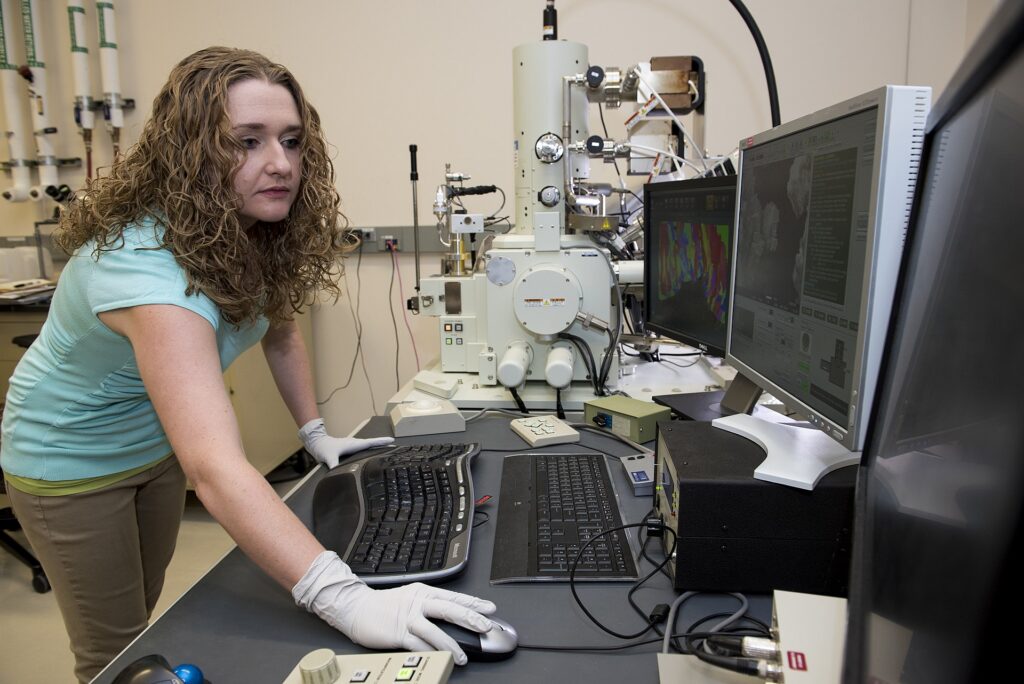
A scientist operates a previous-generation field emission SEM at Pacific Northwest National Laboratory. Current-generation models from JEOL, Zeiss, Tescan and others populate the $300K–$650K bracket discussed in this article. (U.S. Department of Energy/Andrea Starr, Pacific Northwest National Laboratory. Public domain.)
Methodology
Federal procurement figures are total obligations as reported in USAspending.gov, queried via the platform’s public V2 API in March 2026. Award amounts frequently bundle instruments with installation, training, warranties, and accessories; direct instrument-to-instrument comparisons should account for these differences. Department of Defense awards may reflect a 90-day reporting lag per USAspending’s published data notes. European procurement data was sourced from the EU’s Tenders Electronic Daily (TED) database. We searched using CPV codes 38511100 (scanning electron microscopes) and 38511200 (transmission electron microscopes). Award values are reported ex-VAT in the buyer’s local currency; USD conversions use European Central Bank daily reference rates matched to the award date. TED coverage is limited to procurements above EU threshold values (currently €143,000 for central government), so smaller purchases may not appear. NSF MRI program award amounts were verified through NSF’s public Award Search and cross-referenced with university announcements. Used instrument prices are from publicly listed marketplace inventories (LabX.com, microscopeprices.com) and reflect asking prices at time of research, not verified sale prices. Product identification was done by reading each award description and matching against R&D World’s Nexus equipment intelligence database, which tracks 56 electron microscope models across six vendors. Where descriptions were generic, we report only what the record says. Public procurement is not the whole market. Academic institutions buying through framework contracts and industrial buyers negotiating volume pricing may pay different amounts. This analysis shows what governments committed to spend, not what every buyer pays.
Pricing context: Laboratory instrument prices have risen meaningfully during the period covered by these records. The BLS Producer Price Index for laboratory analytical instruments increased roughly 23% from January 2020 to February 2026. Broader reporting on lab procurement budgets, including coverage in Nature and earlier (2024) supply-chain pricing analyses from ZAGENO, supports that trend. Older procurement awards in this dataset thus likely reflect lower prices than what a buyer would pay today.