Research & Development World

  • R&D World Home
  • Topics
    • Aerospace
    • Automotive
    • Biotech
    • Careers
    • Chemistry
    • Environment
    • Energy
    • Life Science
    • Material Science
    • R&D Management
    • Physics
  • Technology
    • 3D Printing
    • A.I./Robotics
    • Software
    • Battery Technology
    • Controlled Environments
      • Cleanrooms
      • Graphene
      • Lasers
      • Regulations/Standards
      • Sensors
    • Imaging
    • Nanotechnology
    • Scientific Computing
      • Big Data
      • HPC/Supercomputing
      • Informatics
      • Security
    • Semiconductors
  • R&D Market Pulse
  • R&D 100
    • 2026 R&D 100 Award Winners
    • 2026 Professional Award Winners
    • 2026 Special Recognition Winners
    • R&D 100 Awards Event
    • R&D 100 Submissions
    • Winner Archive
  • Resources
    • Research Reports
    • Digital Issues
    • Educational Assets
    • Subscribe
    • Video
    • Webinars
    • PharmSci360
    • Content submission guidelines for R&D World
  • Global Funding Forecast
  • Top Labs
  • Advertise
  • SUBSCRIBE

What is a refractometer?

By Paul Heney | April 30, 2021

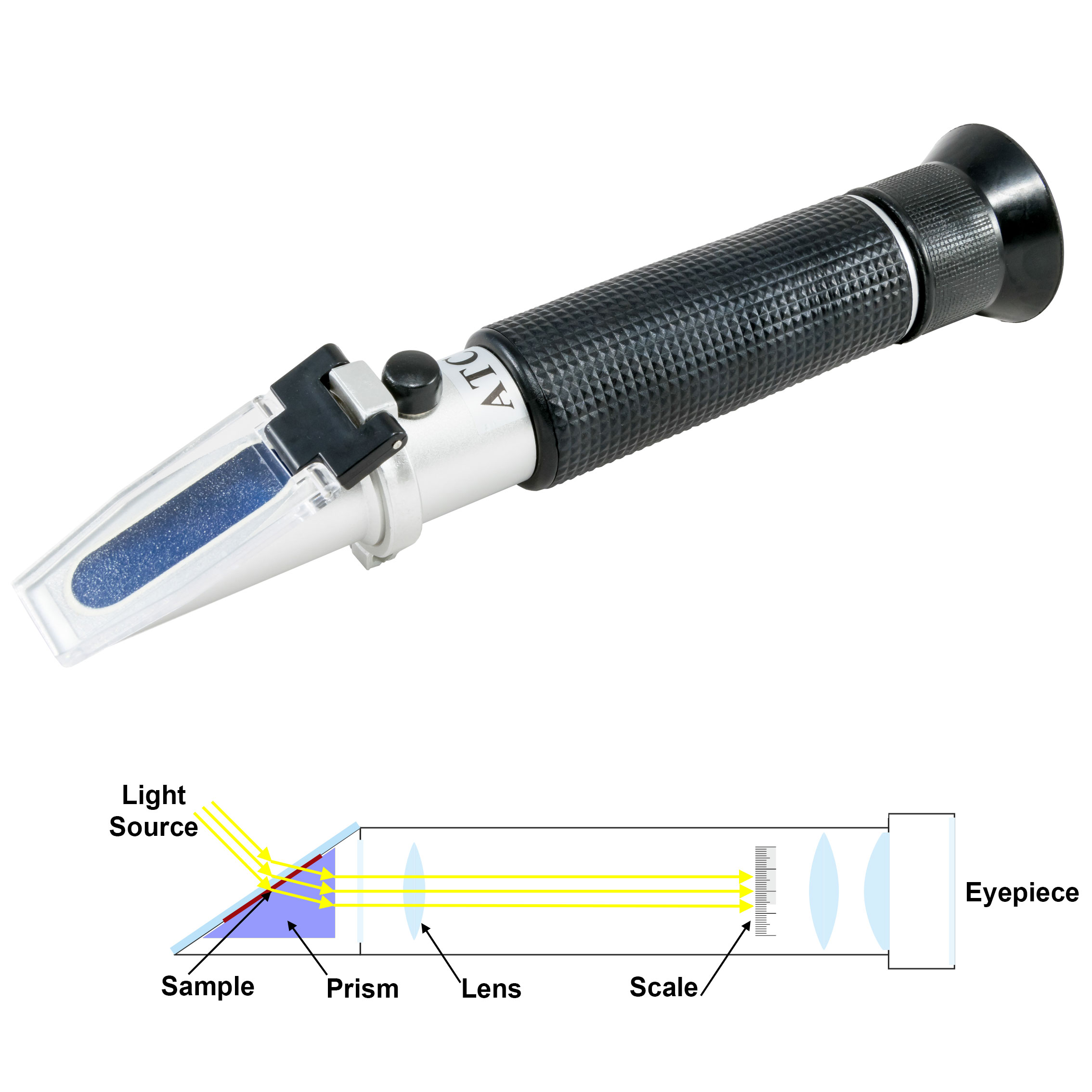
A refractometer measures the index of refraction for a material, which could be a gas, a liquid or a transparent solid such as glass. They achieve this by passing light through the sample and measuring the refraction — the amount that the light bends.

Most commonly, aqueous solutions are measured, providing an indication concentration. Examples measuring aqueous solution concentration include the specific gravity of urine, coolants for engines or machine tools, and the salinity of water in aquariums or aquaponic systems.

Refractive index is dependent on the wavelength of light. A known reference wavelength must, therefore, be used. This is typically provided by filtering daylight or using a narrow-band LED. The temperature of the sample will also affect its refractive index and must therefore be within specified limits to achieve the stated accuracy for a refractometer. The most accurate refractometers used closed-loop control of the sample temperature.

Types of refractometer include:

  • Handheld analogue refractometers are held up to a light source, such as the sun, so that light is directed through the sample, a prism and lenses onto a measurement scale. The angle at which light is totally internally reflected determines the position of a shadow line on the scale, which can then be viewed through an eyepiece.
  • Handheld digital refractometers work in essentially the same way as the traditional analogue refractometers, with a shadow line indicating the angle at which total internal reflection occurs. However, rather than simply holding the refractometer up to the light, an LED light source is normally included. This can improve accuracy by controlling the wavelength more accurately. The eyepiece and glass scale is also replaced by an array of photodiodes, enabling the shadow line to be digitally detected and the relevant measurement result displayed numerically on a screen.
  • Abbe refractometers are bench-top instruments designed for more accurate measurement. They therefore typically include some temperature control of the sample. Abbe refractometers also include an optical arrangement designed to eliminate Abbe error, which can be caused by different viewing angles. Abbe refractometers may be either analogue optical instruments or more typically today, digital instruments.
  • Inline process refractometers continuously measure the refractive index of a fluid as it flows through the sensor.
  • Brix refractometers are calibrated to measure the sugar content of a solution using a scale where 1 degree brix is equal to 1% sucrose by mass. This scale is widely used in the food industry and simple handheld Brix refractometers are used for home
  • Gemstone refractometers are used to indicate the chemical composition of gems. Since some gems have a refractive index which is dependent on the polarization of the light (birefringence), gemstone refractometers may also involve polarization filters.

 

Related Articles Read More >

Schematic of the M2PC lab interior showing rows of Ginkgo Bioworks automated instrument carts for media prep, strain engineering, cell culturing, functional testing, sample prep and phenotyping analysis, linked by automated connectivity
PNNL breaks ground on a 100-instrument autonomous microbe lab that will open to outside researchers in 2029
100 million data points per blood sample: How IMU will profile immunity across 80,000 UK Biobank donors
UK Sovereign AI grant helps fund immune profiling of 80,000 UK Biobank blood samples
Flow cytometer fleets are aging. A new spectral sorter runs around $550,000 to $765,000
rd newsletter
EXPAND YOUR KNOWLEDGE AND STAY CONNECTED
Get the latest info on technologies, trends, and strategies in Research & Development.

R&D World Digital Issues

Fall 2025 issue

Browse the most current issue of R&D World and back issues in an easy to use high quality format. Clip, share and download with the leading R&D magazine today.

R&D 100 Awards
Research & Development World
  • Subscribe to R&D World Magazine
  • Sign up for R&D World’s newsletter
  • Contact Us
  • About Us
  • Drug Discovery & Development
  • Pharmaceutical Processing
  • Global Funding Forecast

Copyright © 2026 Arrowfly LLC. All Rights Reserved. The material on this site may not be reproduced, distributed, transmitted, cached or otherwise used, except with the prior written permission of Arrowfly
Privacy Policy | Advertising | About Us

Search R&D World

  • R&D World Home
  • Topics
    • Aerospace
    • Automotive
    • Biotech
    • Careers
    • Chemistry
    • Environment
    • Energy
    • Life Science
    • Material Science
    • R&D Management
    • Physics
  • Technology
    • 3D Printing
    • A.I./Robotics
    • Software
    • Battery Technology
    • Controlled Environments
      • Cleanrooms
      • Graphene
      • Lasers
      • Regulations/Standards
      • Sensors
    • Imaging
    • Nanotechnology
    • Scientific Computing
      • Big Data
      • HPC/Supercomputing
      • Informatics
      • Security
    • Semiconductors
  • R&D Market Pulse
  • R&D 100
    • 2026 R&D 100 Award Winners
    • 2026 Professional Award Winners
    • 2026 Special Recognition Winners
    • R&D 100 Awards Event
    • R&D 100 Submissions
    • Winner Archive
  • Resources
    • Research Reports
    • Digital Issues
    • Educational Assets
    • Subscribe
    • Video
    • Webinars
    • PharmSci360
    • Content submission guidelines for R&D World
  • Global Funding Forecast
  • Top Labs
  • Advertise
  • SUBSCRIBE