Research & Development World

  • R&D World Home
  • Topics
    • Aerospace
    • Automotive
    • Biotech
    • Careers
    • Chemistry
    • Environment
    • Energy
    • Life Science
    • Material Science
    • R&D Management
    • Physics
  • Technology
    • 3D Printing
    • A.I./Robotics
    • Software
    • Battery Technology
    • Controlled Environments
      • Cleanrooms
      • Graphene
      • Lasers
      • Regulations/Standards
      • Sensors
    • Imaging
    • Nanotechnology
    • Scientific Computing
      • Big Data
      • HPC/Supercomputing
      • Informatics
      • Security
    • Semiconductors
  • R&D Market Pulse
  • R&D 100
    • 2025 R&D 100 Award Winners
    • 2025 Professional Award Winners
    • 2025 Special Recognition Winners
    • R&D 100 Awards Event
    • R&D 100 Submissions
    • Winner Archive
  • Resources
    • Research Reports
    • Digital Issues
    • Educational Assets
    • Subscribe
    • Video
    • Webinars
    • PharmSci360
    • Content submission guidelines for R&D World
  • Global Funding Forecast
  • Top Labs
  • Advertise
  • SUBSCRIBE

Researchers Manipulate Gene Expression Using Light, Create Double-Headed Zebrafish

By Hokkaido University | January 24, 2017

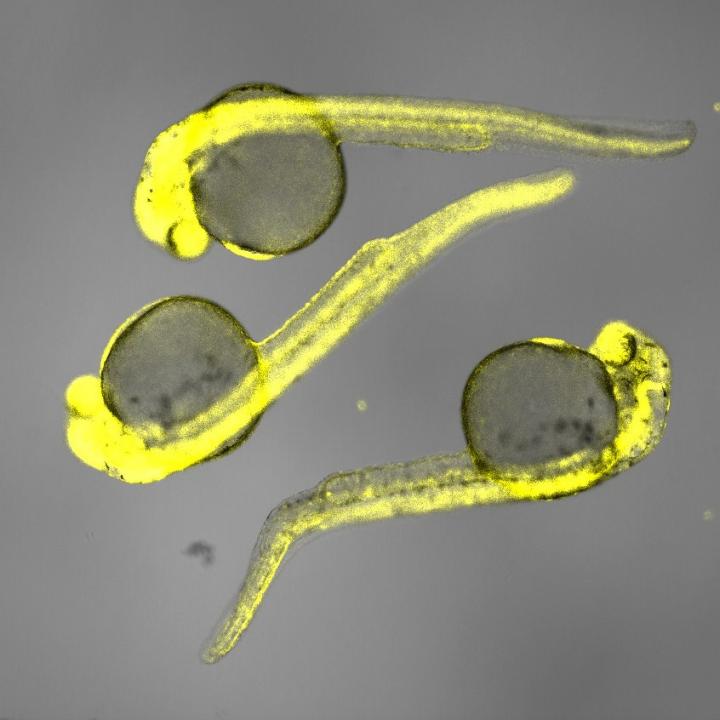
Zebrafish embryos expressing a fluorescent gene after ultraviolet light irradiation. Credit:Ogasawara S., Duration control of protein expression in vivo by light-mediated reversible activation of translation. ACS Chemical Biology, Jan 4, 2017.

A Hokkaido University researcher has successfully developed a method to accurately manipulate gene expression by light illumination and demonstrated its usability by creating double-headed zebrafish.

It has been difficult to freely manipulate the timing and duration of gene expression using existing gene manipulation technologies, which depend on organism’s gene regulating mechanism. In recent years, methods using light to regulate gene expression have been developed, but deemed insufficient to manipulate embryonic development. This is due to a time lag of several hours that occurs from light irradiation to the start/cessation of protein production. Existing photocontrol technologies also require genetic modification, a process that is not only time-consuming but also strictly regulated by the Cartagena Protocol.

Shinzi Ogasawara of Hokkaido University’s Creative Research Institution focused his research on controlling the process of translating messenger RNA (mRNA) to protein, instead of the conventional process of transcribing DNA to mRNA. As the new technology acts on mRNAs, genetic modification is unnecessary. Instead, the mRNAs were modified in such a way that they could bind to “Initiation Factors (IFs)” when irradiated with ultraviolet light which then starts the process of translation; whereas mRNAs were unable to bind to IFs when irradiated with blue light.

To test the new method, fluorescent protein mRNAs were injected into zebrafish embryos, which were then irradiated with blue or ultraviolet light. The research confirmed that the embryos illuminated with ultraviolet light produced fluorescent protein, while those irradiated with blue light showed no existence of fluorescent protein, indicating that no mRNA translation occurred in the process. The research also found that protein production starts several minutes after embryos are irradiated with ultraviolet light and stops several dozens of minutes after blue light irradiation. Ogasawara succeeded in establishing a technology that considerably shortens the time lag between light illumination and protein production.

Furthermore, using this new method, Ogasawara created double-headed zebrafish by accurately controlling the expression duration of squint, a gene that regulates body axis formation.

Ogasawara says “Our method would be particularly useful to accurately manipulate embryonic development, and reveal the importance of the timing and duration of gene expression in biological events. By applying this technology to higher model organisms such as mice, we hope to help clarify the role each gene plays in the development of animals as well as in various diseases”.

Related Articles Read More >

Inside BD’s plan to forecast hospital drug demand with AI while keeping models within bounds
Mayo Clinic backs ViewsML in $4.9M round to advance virtual biomarker staining
How a plant virus could keep astronauts medicated on a trip to Mars
Countable Labs’ CTO Christina Fan on reimagining PCR, one molecule at a time
rd newsletter
EXPAND YOUR KNOWLEDGE AND STAY CONNECTED
Get the latest info on technologies, trends, and strategies in Research & Development.

R&D World Digital Issues

Fall 2025 issue

Browse the most current issue of R&D World and back issues in an easy to use high quality format. Clip, share and download with the leading R&D magazine today.

R&D 100 Awards
Research & Development World
  • Subscribe to R&D World Magazine
  • Sign up for R&D World’s newsletter
  • Contact Us
  • About Us
  • Drug Discovery & Development
  • Pharmaceutical Processing
  • Global Funding Forecast

Copyright © 2026 WTWH Media LLC. All Rights Reserved. The material on this site may not be reproduced, distributed, transmitted, cached or otherwise used, except with the prior written permission of WTWH Media
Privacy Policy | Advertising | About Us

Search R&D World

  • R&D World Home
  • Topics
    • Aerospace
    • Automotive
    • Biotech
    • Careers
    • Chemistry
    • Environment
    • Energy
    • Life Science
    • Material Science
    • R&D Management
    • Physics
  • Technology
    • 3D Printing
    • A.I./Robotics
    • Software
    • Battery Technology
    • Controlled Environments
      • Cleanrooms
      • Graphene
      • Lasers
      • Regulations/Standards
      • Sensors
    • Imaging
    • Nanotechnology
    • Scientific Computing
      • Big Data
      • HPC/Supercomputing
      • Informatics
      • Security
    • Semiconductors
  • R&D Market Pulse
  • R&D 100
    • 2025 R&D 100 Award Winners
    • 2025 Professional Award Winners
    • 2025 Special Recognition Winners
    • R&D 100 Awards Event
    • R&D 100 Submissions
    • Winner Archive
  • Resources
    • Research Reports
    • Digital Issues
    • Educational Assets
    • Subscribe
    • Video
    • Webinars
    • PharmSci360
    • Content submission guidelines for R&D World
  • Global Funding Forecast
  • Top Labs
  • Advertise
  • SUBSCRIBE