Research & Development World

  • R&D World Home
  • Topics
    • Aerospace
    • Automotive
    • Biotech
    • Careers
    • Chemistry
    • Environment
    • Energy
    • Life Science
    • Material Science
    • R&D Management
    • Physics
  • Technology
    • 3D Printing
    • A.I./Robotics
    • Software
    • Battery Technology
    • Controlled Environments
      • Cleanrooms
      • Graphene
      • Lasers
      • Regulations/Standards
      • Sensors
    • Imaging
    • Nanotechnology
    • Scientific Computing
      • Big Data
      • HPC/Supercomputing
      • Informatics
      • Security
    • Semiconductors
  • R&D Market Pulse
  • R&D 100
    • 2025 R&D 100 Award Winners
    • 2025 Professional Award Winners
    • 2025 Special Recognition Winners
    • R&D 100 Awards Event
    • R&D 100 Submissions
    • Winner Archive
  • Resources
    • Research Reports
    • Digital Issues
    • Educational Assets
    • Subscribe
    • Video
    • Webinars
    • PharmSci360
    • Content submission guidelines for R&D World
  • Global Funding Forecast
  • Top Labs
  • Advertise
  • SUBSCRIBE

High-Tech Sensing Illuminates Concrete Stress Testing

By University of Leeds | July 20, 2017

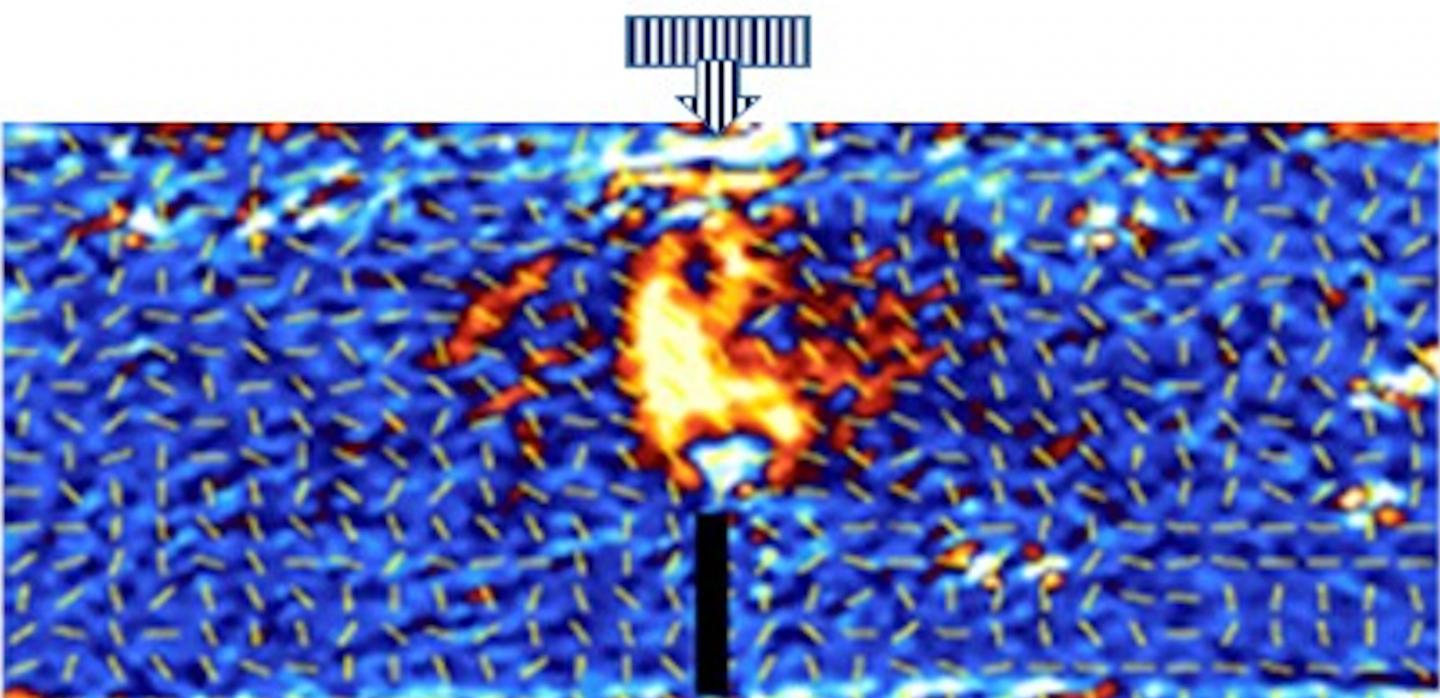
A picture from a photonic camera showing how using the coating can create a candle-like ‘flame’ highlighting shear stress distribution in a sample concrete beam. Source: University of Leeds

Using the principles of light, University of Leeds scientists have discovered a new way to measure the strength of modern forms of concrete – giving industry a better way to understand when it could fracture.

Their approach was based on applying a complex light-refracting coating, designed to display stress positions, to the surface of concrete beam samples.

The epoxy coating is ‘birefringent’ – it has the ability to split light waves in different directions in relation to the amount of stress acting in those directions, and reflecting back to a photonic camera. The camera then takes a picture showing where the stress levels are most extreme before cracks or fractures occur.

While the coating itself is not new, this research project was the first time it had been used to measure shear stress and assess concrete toughness against fractures.

Dr Joseph Antony from the School of Chemical and Process Engineering at the leading Russell Group UK university, who led the study together with researchers at the University of Qatar, said: “There are other methods to measure stress and strain levels in the engineering sector, but we do not believe any of them can measure shear strain directly with high precision, which is most relevant to assess the failure strength of materials.

“The photonic method we developed can directly measure sheer strain, even on opaque materials. Until now, photonic and optical methods of measurement have only been associated with transparent materials.”

The results using the new method compared favourably with conventional methods of stress testing, which have relied on combined experimental and numerical or analytical approaches.

The rise of composite concretes now used extensively in the construction industry prompted the team to look for new ways to study the material’s strength.

Concrete has traditionally been made with cement, gravel and sand but has changed significantly in recent decades. It can now include numerous waste products including plastic pellets, in order to reduce the levels of natural materials used and to recycle waste products.

Dr Antony added: “Our study was aimed at developing a method by which plastic or polymer waste materials, in this case from Qatar, could be used as valuable ingredients in developing new engineering products.

“By working with industries which recycle the waste products into micron sized particles, we had direct insight into how they are used, meaning our study could be much more informed by industry requirements.”

Finding a new way to show industry the precise toughness of these new forms of composite concrete meant there could be more reliance on their use as a building material.

Dr Antony explained how concrete made with waste plastic products had shown superior qualities to traditional ingredients, but his team wanted to ensure it could sustain service loads without fracturing.

He added: “We believe this new photonic or optical approach to fracture testing could be applied not only to develop sustainable manufacturing using materials that would otherwise be discarded as waste, but also in other diverse engineering designs including mechanical, civil, materials, electronics and chemical engineering applications.”

Related Articles Read More >

Researchers develop sawdust-based foam as polystyrene bans force industry to adapt
Researchers develop compostable PLA that potentially could be used for biomedical applications
Elkem Silicones rebrands as Bluestar Silicones after ownership change
How Atomis is using AI simulations to commercialize MOFs
rd newsletter
EXPAND YOUR KNOWLEDGE AND STAY CONNECTED
Get the latest info on technologies, trends, and strategies in Research & Development.

R&D World Digital Issues

Fall 2025 issue

Browse the most current issue of R&D World and back issues in an easy to use high quality format. Clip, share and download with the leading R&D magazine today.

R&D 100 Awards
Research & Development World
  • Subscribe to R&D World Magazine
  • Sign up for R&D World’s newsletter
  • Contact Us
  • About Us
  • Drug Discovery & Development
  • Pharmaceutical Processing
  • Global Funding Forecast

Copyright © 2026 Arrowfly LLC. All Rights Reserved. The material on this site may not be reproduced, distributed, transmitted, cached or otherwise used, except with the prior written permission of Arrowfly
Privacy Policy | Advertising | About Us

Search R&D World

  • R&D World Home
  • Topics
    • Aerospace
    • Automotive
    • Biotech
    • Careers
    • Chemistry
    • Environment
    • Energy
    • Life Science
    • Material Science
    • R&D Management
    • Physics
  • Technology
    • 3D Printing
    • A.I./Robotics
    • Software
    • Battery Technology
    • Controlled Environments
      • Cleanrooms
      • Graphene
      • Lasers
      • Regulations/Standards
      • Sensors
    • Imaging
    • Nanotechnology
    • Scientific Computing
      • Big Data
      • HPC/Supercomputing
      • Informatics
      • Security
    • Semiconductors
  • R&D Market Pulse
  • R&D 100
    • 2025 R&D 100 Award Winners
    • 2025 Professional Award Winners
    • 2025 Special Recognition Winners
    • R&D 100 Awards Event
    • R&D 100 Submissions
    • Winner Archive
  • Resources
    • Research Reports
    • Digital Issues
    • Educational Assets
    • Subscribe
    • Video
    • Webinars
    • PharmSci360
    • Content submission guidelines for R&D World
  • Global Funding Forecast
  • Top Labs
  • Advertise
  • SUBSCRIBE