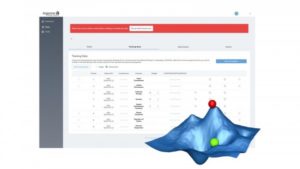
Interface of the BLAST software. Credit: Argonne National Laboratory
Researchers at the U.S. Department of Energy’s (DOE) Argonne National Laboratory, in conjunction with industry partner Sentient Science, are making the discovery and design of new materials — a notoriously time-consuming and costly process — significantly easier through the development of an artificial intelligence-based computer modeling framework.
The research was awarded $150,000 through the DOE’s Technology Commercialization Fund, which was matched by Sentient Science.
The funding allowed scientists at Argonne’s Center for Nanoscale Materials (CNM), a DOE Office of Science User Facility, together with those at Sentient Science, to make materials modeling far more efficient through the creation of a software program called “Bridging Length/Time Scales Atomistic Simulation Toolkit,” or BLAST.
BLAST, which can be used to accelerate discovery and design of new materials for applications from aeronautics to wind turbines, generates real-time 3D analysis and visualization, allowing for a far more comprehensive understanding of materials from atomistic to mesoscopic scale than ever before.
Subramanian Sankaranarayanan, group leader for the Theory and Modeling group within the CNM, part of the DOE’s Office of Basic Energy Science Nanoscale Science Research Center program, said the project, which began five years ago, was initially funded through Argonne’s Laboratory-Directed Research and Development program, which allowed for the creation of the model itself. “The idea is that we want to describe the properties of materials starting at the atomic scale,” Sankaranarayanan said. “This is important because we want to understand how materials evolve over time, whether they are the battery materials in laptops we buy, the construction material in ships we build or the materials used in wind turbines. When their performance goes down, we want to understand when and why this happens so we can improve it, possibly by designing other materials.”
A popular way to understand the materials’ dynamical behavior at the nanoscale is to use molecular dynamics simulations. “Thousands of people run molecular dynamics simulations, but the ability to develop models that accurately describe the underlying interactions between atoms and molecules is often a time consuming and tedious task,” he said.
Sentient Science is an ideal partner because of its interest in hard materials such as metals, oxides and alloys. Its researchers are interested in more fully understanding the relationships between structure, process and properties in steel alloys.
In one example, they hope to understand and predict premature bearing failures in wind turbine gearboxes. Most failures in wind turbine bearings can be attributed to micro-structural alterations that originate at the atomic scale.
“To attain digital representation of materials and component behavior throughout the product lifecycle, the key is an accurate quantitative description of the relationships between processing, microstructures and material properties,” said Harpal Singh, principal scientist at Sentient Science.
Sentient Science (a prognostics company) is interested in the tool as this can be integrated into Sentient Science’s DigitalClone technology suite. Sentient’s DigitalClone is a computational modeling tool that uses high-performance computing to simulate the microstructure of different additively and conventionally manufactured components and their behavior, calculate internal stresses caused by different applied loading conditions, accumulate internal damages resulting in crack nucleation and propagation, and investigate the performance and life analysis. Sentient Science will leverage this technology to model the properties of multi-component alloy materials as an input to the DigitalClone software that predicts the life expectancy of complex mechanical systems in the wind energy, aerospace and rail industries. The addition of Argonne’s multiscale manufacturing design tool will complement Sentient’s DigitalClone technology to provide the capability for users to evaluate material design by manipulating processing conditions and by simultaneous optimization for both reliability and inspectability, an industry first, Harpal Singh said.
Research and development specialists with a knowledge of their desired material can use the BLAST software to develop an optimal model that allows them to perform detailed dynamical calculations and derive properties of interest. “And it will do that not in several years, but in a matter of months, weeks or even days,” Sankaranarayanan said.
In addition to the CNM, two other DOE Office of Science User Facilities at Argonne — the Advanced Photon Source (APS) and the Argonne Leadership Computing Facility (ALCF) — will generate large amounts of data that the team will use to optimize its software.
The ultra-bright X-ray beams of the APS will reveal the molecular and atomic structures of the target materials.
Supercomputers at the ALCF, the CNM and other high-performance computing resources at Argonne’s Laboratory Computing Resource Center can produce the highly accurate but computationally expensive quantum calculations that provide similar insights about the nanoscale interactions of the target systems.
For more information, visit energy.gov/science.