Research & Development World

  • R&D World Home
  • Topics
    • Aerospace
    • Automotive
    • Biotech
    • Careers
    • Chemistry
    • Environment
    • Energy
    • Life Science
    • Material Science
    • R&D Management
    • Physics
  • Technology
    • 3D Printing
    • A.I./Robotics
    • Software
    • Battery Technology
    • Controlled Environments
      • Cleanrooms
      • Graphene
      • Lasers
      • Regulations/Standards
      • Sensors
    • Imaging
    • Nanotechnology
    • Scientific Computing
      • Big Data
      • HPC/Supercomputing
      • Informatics
      • Security
    • Semiconductors
  • R&D Market Pulse
  • R&D 100
    • 2025 R&D 100 Award Winners
    • 2025 Professional Award Winners
    • 2025 Special Recognition Winners
    • R&D 100 Awards Event
    • R&D 100 Submissions
    • Winner Archive
  • Resources
    • Research Reports
    • Digital Issues
    • Educational Assets
    • R&D Index
    • Subscribe
    • Video
    • Webinars
    • Content submission guidelines for R&D World
  • Global Funding Forecast
  • Top Labs
  • Advertise
  • SUBSCRIBE

Engineered mice with human telomeres could hold anti-aging clues

By Brian Buntz | February 21, 2025

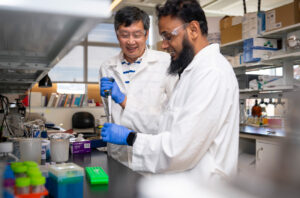
Jiyue Zhu and a student work in the laboratory.


Jiyue Zhu and a student work in the lab [Photo from WSU].

Washington State University scientists have reported an advance in anti-aging research by creating what they call “the first mouse model with truly humanized telomeres,” as reported in Nature Communications. Telomeres—protective chromosome caps—naturally shorten with each cell division, eventually contributing to cellular aging or death. While traditional lab mice have exceptionally long telomeres and readily express the telomerase enzyme in adult tissues, this new genetically engineered strain mirrors human telomere biology more closely. “Our paper demonstrates that they exhibit human-like telomeres. Now, we aim to observe how these mice age,” said lead investigator and WSU Professor Jiyue Zhu.

Our paper demonstrates that they exhibit human-like telomeres. Now, we aim to observe how these mice age.

–Lead investigator and WSU Professor Jiyue Zhu

Telomerase, the enzyme that helps preserve telomeres, is generally quiet in human adult tissues, forcing cells to contend with the inevitability of telomere exhaustion. But in normal mice, telomerase remains active, meaning their cells don’t experience this same gradual aging process. “In humans, telomerase expression is restricted to a small number of organs,” Zhu and colleagues write in the journal article. This contrast has often limited the usefulness of mice in modeling human age-related diseases—a challenge that this new mouse model aims to address.

In the study’s abstract, the authors explain that they replaced key non-coding sequences of the mouse telomerase gene with human counterparts, creating a strain “that closely mimics human TERT regulation” in adult tissues other than gonads and thymus. They found that generations of these mice stabilized at telomere lengths of about 10–12 kilobases—much shorter than the 50 kilobases typical of wild-type mice—yet still maintained normal body weight and cell health.

By replacing key regulatory sequences in the mouse telomerase gene with human counterparts, Zhu’s team produced so-called “HuT” mice. In repeated generations, these animals exhibited shortened telomeres that “stabilized at about 10–12 kb,” similar to the ranges seen in humans. Despite having less telomerase activity, these mice remained healthy through early adulthood. Researchers say the next step is to observe whether this shortened telomere setpoint prompts an accelerated aging process under stress—such as inflammation or increased cell turnover—or might open new therapeutic windows in cancer research.

In the long run, the findings could pave the way for advances in drug discovery, specifically for anti-aging therapies and cancer treatments. By more closely simulating human telomere biology, these mice could aid in uncovering how short telomeres influence diseases ranging from immune disorders to melanoma. According to Zhu, “Mice are similar to humans in terms of organ structure, genes, and genetic makeup,” but these HuT mice take that resemblance a step further, promising crucial insights into how—and perhaps whether—scientists can one day potentially influence the aging clock.

Related Articles Read More >

Who’s building in pharma, and who would be spared from 100% tariffs, if enacted
2025 R&D layoffs tracker: hardware and chips lead the year’s biggest cuts while biopharma pares pipelines
Skin’s built-in “stretch sensor” helps tissue grow in mouse study
Meissner launches rotary impeller mixing solutions (RMS) portfolio for biocontainer mixing
rd newsletter
EXPAND YOUR KNOWLEDGE AND STAY CONNECTED
Get the latest info on technologies, trends, and strategies in Research & Development.
RD 25 Power Index

R&D World Digital Issues

Fall 2025 issue

Browse the most current issue of R&D World and back issues in an easy to use high quality format. Clip, share and download with the leading R&D magazine today.

Research & Development World
  • Subscribe to R&D World Magazine
  • Sign up for R&D World’s newsletter
  • Contact Us
  • About Us
  • Drug Discovery & Development
  • Pharmaceutical Processing
  • Global Funding Forecast

Copyright © 2025 WTWH Media LLC. All Rights Reserved. The material on this site may not be reproduced, distributed, transmitted, cached or otherwise used, except with the prior written permission of WTWH Media
Privacy Policy | Advertising | About Us

Search R&D World

  • R&D World Home
  • Topics
    • Aerospace
    • Automotive
    • Biotech
    • Careers
    • Chemistry
    • Environment
    • Energy
    • Life Science
    • Material Science
    • R&D Management
    • Physics
  • Technology
    • 3D Printing
    • A.I./Robotics
    • Software
    • Battery Technology
    • Controlled Environments
      • Cleanrooms
      • Graphene
      • Lasers
      • Regulations/Standards
      • Sensors
    • Imaging
    • Nanotechnology
    • Scientific Computing
      • Big Data
      • HPC/Supercomputing
      • Informatics
      • Security
    • Semiconductors
  • R&D Market Pulse
  • R&D 100
    • 2025 R&D 100 Award Winners
    • 2025 Professional Award Winners
    • 2025 Special Recognition Winners
    • R&D 100 Awards Event
    • R&D 100 Submissions
    • Winner Archive
  • Resources
    • Research Reports
    • Digital Issues
    • Educational Assets
    • R&D Index
    • Subscribe
    • Video
    • Webinars
    • Content submission guidelines for R&D World
  • Global Funding Forecast
  • Top Labs
  • Advertise
  • SUBSCRIBE