Astronomers are improving the resolution of NASA’s James Webb Space Telescope (JWST) space observatory using a non-redundant Aperture Masking Interferometer. They published their findings in Publications of the Astronomical Society of Australia.
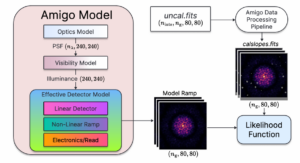
High level flow diagram of the AMIGO model and pipeline, showing the input and output product and shapes passed between each modular component. Credit: Desdoigts L, Pope B, Charles M, et al.
The JWST features a non-redundant Aperture Masking Interferometer (AMI) within its Near Infrared Imager and Slitless Spectrograph (NIRISS). This provides magnitudes more precise than any previous interferometric experiment.
However, AMI was stretching the NIRISS infrared detectors beyond their capabilities, leading to charge-migration effects. This migration degraded the pattern and limited the telescope’s resolution, distorting the shape of bright point sources.
Additionally, the mask metrology, the precise measurement of the metal disk used to create the interference, was inaccurate. These factors combined to prevent AMI from effectively recovering structures at high contrasts, meaning it could not image small objects located close to bright stars.
The AMIGO framework: a differentiable digital twin of NIRISS
To solve these problems, researchers invented the Aperture Masking Interferometry Generative Observations (AMIGO) technique.
AMIGO is an end-to-end differentiable digital twin built on the JAX framework and ∂LUX optical modeling package, which uses automatic differentiation to compute machine-precise derivatives via the chain rule.
Instead of attempting to reverse distortions, the technique starts with an estimate of the astronomical scene and uses a digital twin of the telescope’s optics and electronics to generate an image. This allows for the joint optimization of the astronomical scene and the instrumental state simultaneously.
AMIGO uses an embedded neural sub-module to specifically capture and mitigate non-linear charge redistribution effects. The model then compares its simulated output with the real NIRISS data and adjusts parameters until the images match.
Unlike traditional models that rely on finite differences, AMIGO computes machine-precise derivatives by programmatically applying the chain rule to every step of the physics chain.
Validating AMIGO
AMIGO was validated through several high-profile astronomical reconstructions, exceeding the performance of previously published techniques.
AMIGO successfully detected the inner substellar companions HD 206893 c and HD 206893 B, achieving contrasts approaching 10 magnitudes at a separation of 100 milliarcseconds.
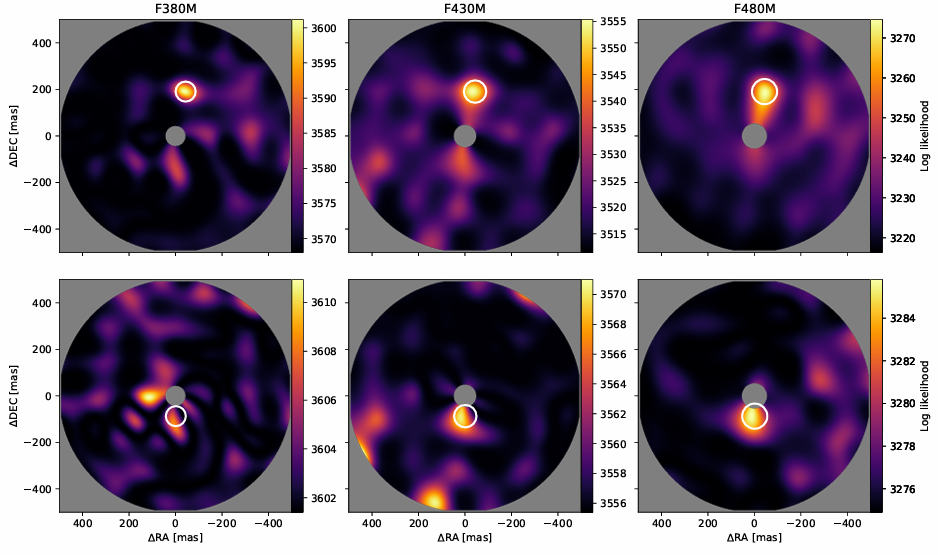
The top two panels shows the marginalised log-likelihood surface as a function of companion offset in ∆RA and ∆DEC, revealing a strong and consistent peak in all filters. The top row shows the detection maps for the full data, with the GRAVITY prediction for the B companion shown as a white circle. The middle row shows the detection map after the best-fit B companions has been subtracted from the data, revealing the inner c companion being consistently detected in all three filters, with the GRAVITY prediction overlaid with a white circle. The peaks in each filter for both companions can be seen matching the expected positions. The greyed central region denotes the IWA masked by the interferometric null. Credit: Desdoigts L, Pope B, Charles M, et al.
The model also revealed volcanic hot spots on Jupiter’s moon, Io, imaged dust sculpted by stellar pairs and zoomed into the heart of a distant galaxy to reveal a spiraling jet of material emanating from a black hole.
AMIGO enables high-contrast characterization within the previously ‘forbidden’ inner working angles of traditional coronagraphs (<2λ/D), providing direct photons for atmospheric analysis.
Practical recommendations for JWST proposals
The researchers offered several suggestions for best practices for researchers writing JWST proposals to use with AMIGO. They suggest that researchers use a five-point sub-pixel dither pattern to decouple pixel-level miscalibrations from scientific signals.
They also suggest maximizing the number of groups per integration and keeping pixel well depths below 50% to stay within the regime where the current BFE calibration is most accurate. They stated that calibrator and science targets should be observed to similar well depth and have similar brightness.