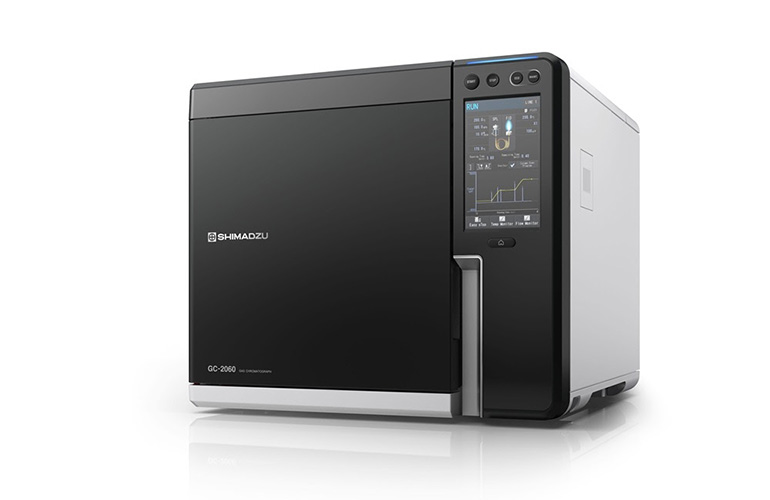
The Nexis GC-2060 offers advanced detector technology and a versatile five-mode multi-mode injection unit in a compact footprint.
The Japanese analytical and measuring instruments specialist Shimadzu launched in April the Nexis GC-2060, a flagship gas chromatograph that consolidates five injection modes and a multimode FID into the same footprint as its predecessor. The GC-2060 is the designated successor to Shimadzu’s widely installed GC-2030, and the design priorities go beyond improved detection limits. “By enabling the GC to be positioned closer to the sample source, it eliminates issues such as air contamination during gas sample transport,” said Yoshiro Hiramatsu, GC/GCMS product liaison at Shimadzu Scientific Instruments.

Yoshiro Hiramatsu
The multimode FID addresses both gas infrastructure and sample handling as well as detection chemistry. Hiramatsu said Hy/Air mode “allows users to leverage existing gas utilities while significantly reducing running costs,” including by switching the FID makeup gas from helium to air. Hy/Ox mode, by contrast, is aimed at customers without established gas infrastructure and at workflows where the instrument can be moved closer to the sample source. The company uses the GC-2030 as the benchmark for its reported 20% FID sensitivity gain and 1.0 pgC/sec minimum detection limit.
Shimadzu is also positioning the GC-2060 as a consolidation platform. Its multimode injection unit supports split/splitless, programmable temperature vaporization, direct injection, large-volume injection and thermal desorption/extraction in a single module. Hiramatsu said “basically, no changes are required,” although users still need to select the appropriate injection-port liner for the analysis mode, and standalone thermal desorption tube analysis requires a column-adapter update.
The redesigned TCD uses single-filament technology and improves detection limits by 25%, according to the company. Hiramatsu declined to discuss the underlying engineering details, citing the proprietary nature of the design, but said Shimadzu testing showed improvements in baseline stability, drift and startup time, while filament lifespan “remains comparable to conventional models.”
Hiramatsu said the company will continue offering the GC-2030 until the GC-2060 is compatible with all options, including Shimadzu’s sulfur chemiluminescence detector. Sulfur chemiluminescence is a workhorse in petrochemical and environmental labs, and customers running those workflows will need to stay on the GC-2030 for now. The GC-2060 is currently available for sale in North America.