Waters has been expanding and repositioning its mass spectrometry portfolio around the growing analytical challenges of large, heterogeneous and structurally complex drug modalities, molecules that increasingly resist full characterization by any single platform. At ASMS 2026, the company presented three complementary systems that together address this reality: the Xevo MRT P10 high-throughput discovery platform, the Cyclic IMS P20 structural-omics system and the Xevo CDMS charge-detection tool for the heaviest particles.
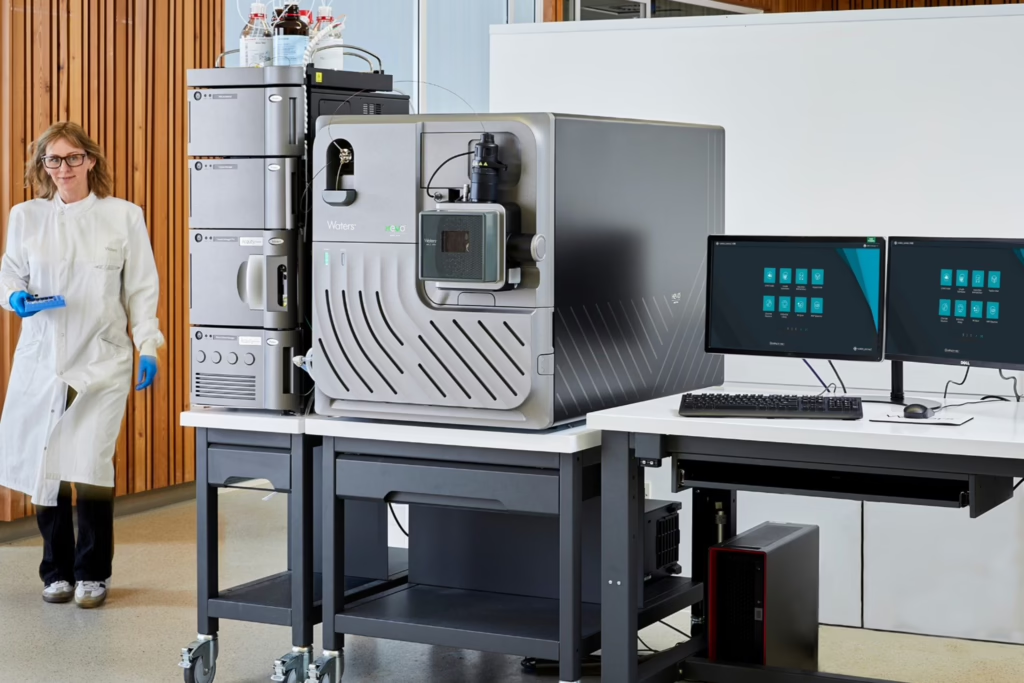
Xevo MRT P10
Xevo MRT P10 extends benchtop multi-omics into proteomics
The Xevo MRT P10, a benchtop high-resolution quadrupole time-of-flight system, is the high-throughput discovery platform built to run proteomics, lipidomics, and metabolomics fast enough for large studies. It succeeds the first-generation Xevo MRT, which Waters launched at ASMS 2024. “The previous instrument was targeted primarily at small molecules, metabolomics, and lipidomics,” said James Hallam, vice president and general manager of LC-MS at Waters Analytical Sciences. “With this one we can run proteomic workflows and get really good proteome coverage … hence multi-omics, all within a compact benchtop footprint.”
Waters claims up to 20x greater MS/MS sensitivity over the first-generation instrument, acquisition rates of 100 Hz in MS and 200 Hz in MS/MS that it bills as the fastest among benchtop HRMS systems, and up to 40% more lipid identifications than a leading alternative platform. Full specifications are available on the product page.
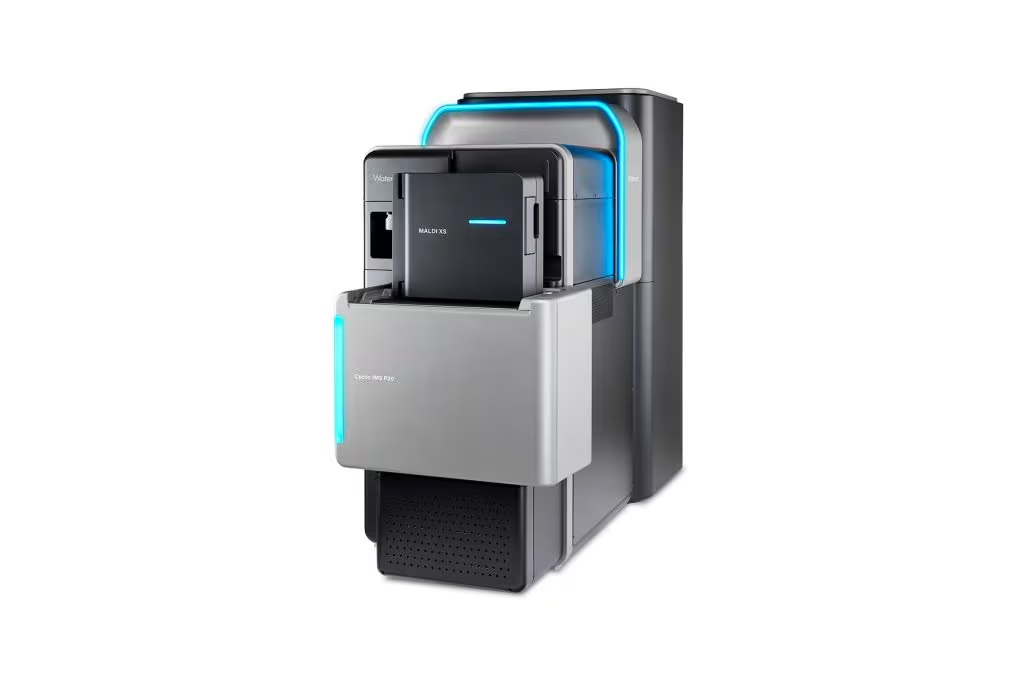
Cyclic IMS P20
Cyclic IMS P20 probes how proteins fold and assemble
Where the MRT P10 fits on a lab bench, the Cyclic IMS P20 is a larger floor-standing instrument, and the added bulk buys a different kind of reach. It is a structural-omics system, adding multipass ion mobility that separates molecules by shape so researchers can probe how proteins fold and assemble. The device is “more of a structural tool,” Hallam said, “helping us understand protein structure and giving us capability you can’t get from any other instrument.”
The Cyclic IMS P20 follows in the footsteps of the SELECT SERIES Cyclic IMS, which launched in 2019. The IMS P20 offers “significantly improved sensitivity that lets us get a much deeper understanding of biology and deeper characterization,” Hallam said.
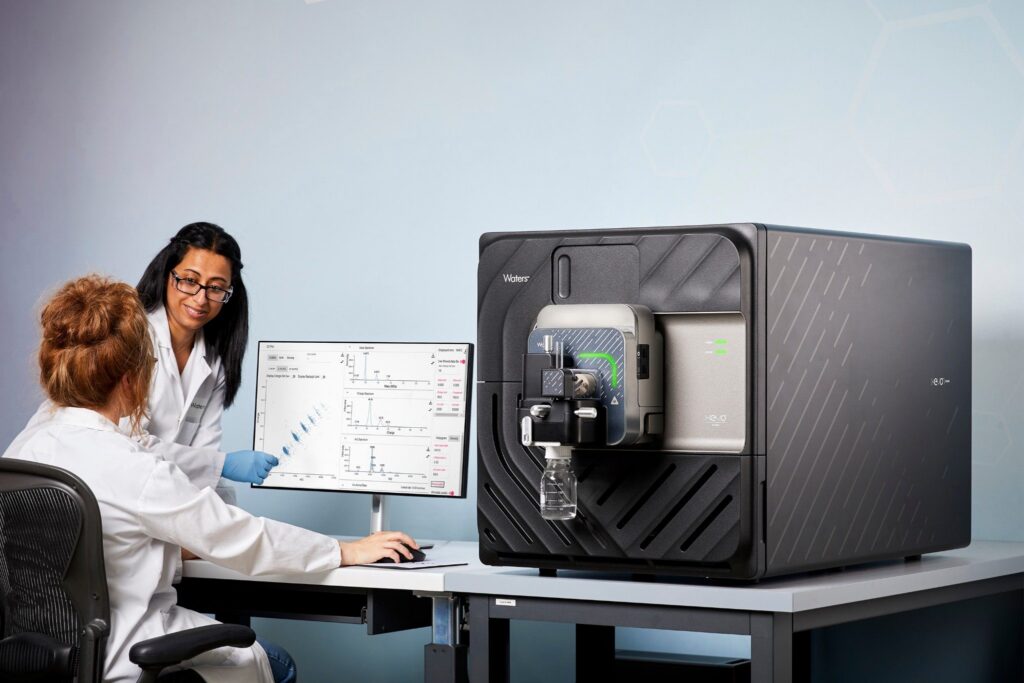
Xevo CDMS
Xevo CDMS weighs intact viral vectors one ion at a time

Steve McDonald
The Xevo CDMS returns to a benchtop scale yet reaches the heaviest targets of the three, weighing individual ions to measure intact viral vectors and large assemblies that conventional mass spectrometry struggles to resolve. It does so by a different route entirely. The previous option, said Steve McDonald, senior director and CDMS program lead, was analytical ultracentrifugation. “Being able to take just a few microliters and get the same information in 10 minutes rather than running samples overnight … means I can have real-time insights into the characterization of my product.”
The underlying technology had an assist from outside Waters: an electrostatic linear ion trap, developed by Distinguished Professors Martin Jarrold and David Clemmer at Indiana University and commercialized through their spinout, Megadalton Solutions, which measures each ion’s mass-to-charge ratio and charge at once to derive a true mass without the deconvolution or digestion conventional high-mass MS requires.
The three systems chain from multi-omics to megadaltons
The Waters executives describe the three instruments as forming a connected analytical chain that labs can use in stages. “From the multi-omics at the bottom, then Cyclic carrying on into larger domains and characterization of proteins, and then CDMS taking off from there into things that were never possible before,” said McDonald. Hallam noted that while a full combination is often ideal, the right mix depends on the scientific question a lab is trying to answer and its available budget. In practice, a lab focused on genetic medicines or complex biologics might start with high-throughput screening and multiomics on the Xevo MRT P10, move to the Cyclic IMS P20 for deeper structural and spatial characterization of proteins and complexes, and escalate to the Xevo CDMS when targets become so large or heterogeneous that conventional mass spectrometry can no longer resolve them.
While the products are complementary, “it’s a little early to say they’re investing in all three at once, because these are big purchases, and CDMS has only been out for a relatively short period, and the two new ones have only just launched,” Hallam said. “We’re absolutely hoping we’ll be able to sell three at a time, but I think it’s more a case of adding to a setup.” He pointed to Kostas Thalassinos of UCL, who already runs a Cyclic IMS and a Xevo MRT and is weighing CDMS: “He has Cyclic and he has Xevo MRT, and he’s very interested in CDMS as well.”

James Hallam
Hallam said all three instruments resonated with attendees at ASMS. The Xevo CDMS has drawn strong interest since its earlier launch, backed at the show by a run of posters and additional scientific data. For the Xevo MRT, he said the added sensitivity has settled the question that trailed the first-generation system: “the question we always got at first, ‘can it do proteomics?’, has a clear answer: yes, it performs extremely well and can do a lot of good proteomics experiments,” Hallam said. The Cyclic IMS P20, he added, offers a geometry that yields ion-mobility and structural information not available on other platforms.



Tell Us What You Think!
You must be logged in to post a comment.