[Adobe Stock]
Japan has the most companies in the 250
Still, Japan has the most companies in the IFI Global 250 at 75. Meanwhile, India, the most populated country on earth, is conspicuously absent from the list. Close behind Japan though is China with 72 organizations: seven of them in the top 10. The U.S. trails at 45. No U.S. firm enters the top 10 of IFI CLAIMS’ Global 250 for 2025.
In addition to State Grid, other Chinese infrastructure giants like China National Petroleum outpace some tech heavyweights such as IBM in active patents, in the ranking.
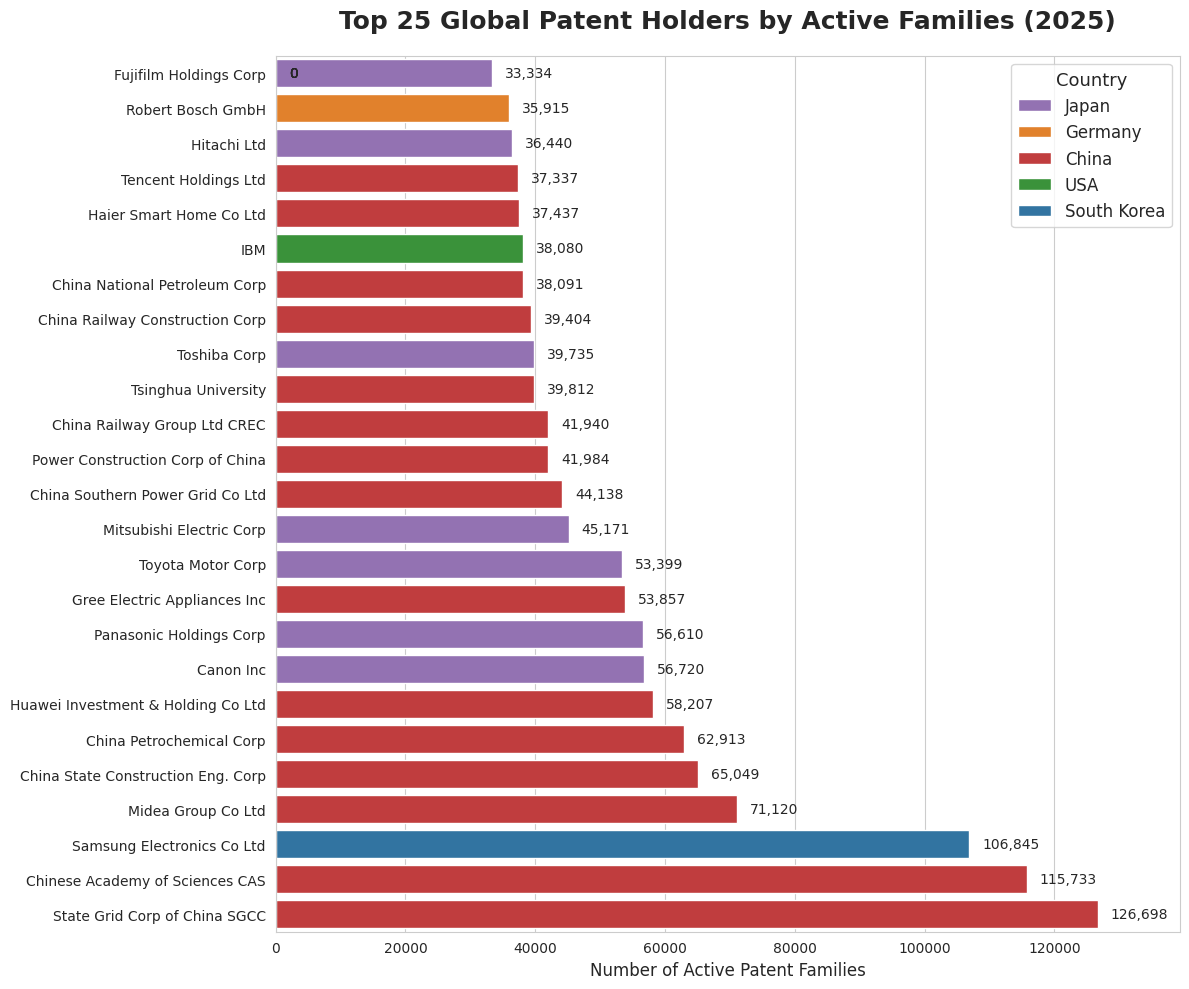
The ranking is riddled with more matchups that defy traditional tech hierarchies. For instance, China National Tobacco Corp. holds more active patents than Microsoft. Meanwhile, another construction giant, China State Construction and Engineering Corp., boasts a larger portfolio than digital communications leader Huawei. This accumulation of intellectual property means the highest-ranking U.S. company, IBM at #20, now controls a portfolio less than a third the size of the global leader.
Such counterintuitive rankings highlight China’s strategic emphasis on patent accumulation, often in non-tech sectors, with State Grid Corp. boasting 126,698 active patent families. That’s far ahead of Samsung’s 106,845, while China National Petroleum edges IBM by a mere 11 families at 38,091 to 38,080, according to IFI’s data snapshot from July 12, 2025.
A look at how Western firms stack up
U.S. highlights inside the Top‑100 (from the IFI list): IBM #20 (38,080), Microsoft #32 (30,074), Qualcomm #34 (29,097), RTX #37 (26,640), Intel #45 (22,674), Alphabet #42 (23,776) and Apple #43 (23,432). Note that Alphabet holds 344 more active families than Apple. Elsewhere: Ford #59, Amazon #78, Honeywell #80, GM #83, Broadcom #92, Medtronic #93, Johnson & Johnson #95, Boeing #97.
Europe’s leaders in the Top‑100 include Robert Bosch #24 and Siemens #36, with Nokia, Ericsson, Philips, Safran and Groupe SEB also in the mix, reflecting diversified but less top‑heavy portfolios than Asia’s infrastructure giants.
A potential driver for China’s dramatic rise: Beijing’s policy of offering significant government subsidies to companies for filing patents both at home and abroad. This strategic incentive, which may have inflated portfolio sizes with less emphasis on commercial viability, is reportedly set to end this year. The shift could signal a future focus on higher-quality inventions over sheer volume.
The IFI methodology itself explains some of these surprising results. Unlike annual grant tallies, the Global 250 consolidates all active patent families under an ultimate owner, providing a snapshot of a company’s total accumulated intellectual property. For investors and analysts, this ranking offers a clearer view of the intangible assets that often remain hidden on a balance sheet.