
Adobe
The pharmaceutical industry operates in a universe where the inverse of Moore’s Law holds true. In a seminal 2012 paper, investment analyst and researcher Jack Scannell coined the term “Eroom’s Law” to explain the reality that drug development tends to get dramatically more expensive over long stretches of time. While Eroom’s Law is not usually framed as a procurement story, part of it is. And equipment procurement in pharma R&D is one place where that cost story is clear. Specs, quotes, site surveys, capital approvals, contractor bids, room renovations, vendor build times and installation all stack up between a purchase order and a working instrument. As the cost of discovering drugs keeps climbing, approval timelines keep stretching and stakeholders keep demanding ROI on every new mass spec suite, microscope fleet, automation line or single high-end analytical tool. The pressure rises further as inflation has driven the price of lab equipment up more than 20% since 2020.
At the simpler end of the spectrum, procurement can still look like ecommerce: single-channel pipettes and mini vortex mixers often carry public list prices online. But the farther a purchase moves toward custom build-out, workflow integration and validation, the less it looks like catalog buying and the more it looks like systems engineering.
The bespoke procurement problem
Cryo-electron microscopy shows this pattern in one of its more extreme forms. Jeff Lengyel, director of life science TEMs at Thermo Fisher Scientific, says some pharma customers spend nine months to a year renovating a space before the microscope can be installed. Some prospective buyers, he said, never get that far because they cannot find a viable room or justify the permitting and build-out. In some cases, by the time the tool is built, delivered, installed and brought online, “you may not be doing drug discovery for a year and a half.”
Cryo-EM is an edge case, but it makes the procurement pattern legible: as tools become more space-intensive, integration-heavy and validation-heavy, the purchase stops being a catalog transaction and becomes an operational redesign.
Jason Kelly, CEO of Ginkgo Bioworks, rejects the usual framing of AI replacing bench scientists and makes the opposite argument: drug discovery still requires human judgment, and the opportunity is to automate around that judgment rather than eliminate it. The procurement question, in his telling, has shifted from whether to buy automation to whether the automation a company buys is usable by the scientists who already understand the biology. Older lab robotics required programming expertise, which meant the scientist doing the experiment and the person operating the automation were often different people. “You don’t have to code,” he says, “to make the robots do the protocol you want.”
That is the everyday pain point. “Scientists grab a pipette, walk around the lab, bring their samples to any one of 30 different devices, and as long as they read the manual they can use it.” It is the decentralized procurement reality every lab director recognizes: every PI buys what they need, no central asset strategy, no utilization tracking, devices that do not talk to each other because they were never bought as a system. Kelly is also explicit that the binding constraint is lab space itself. “That’s really the big cost, you’re using up your lab space.” CFOs and procurement leads who think in $/instrument should also be thinking in $/sq-ft of utilized bench.
A similar quandry shows up in data. In a 2025 interview, the scientific data and AI company Tetrascience estimated that a typical top-25 pharma has roughly 150,000 disparate data silos, with more than 10 million industry-wide. Ken Fountain, a VP of Scientific Applications there, said some instruments are not even networked: data still moves on USB sticks.
In a 2025 Deloitte survey of 104 biopharma R&D executives, 80% said their organizations plan to sustain or increase lab-modernization investment. But only 37% said they use quantitative metrics to track ROI, 31% described their labs as still digitally siloed and just 11% said they had reached a predictive state. This is not just one vendor’s sales pitch. Across the sector, companies are buying ahead of proof and modernizing on top of incomplete digital foundations.
From isolated instruments to Lego blocks
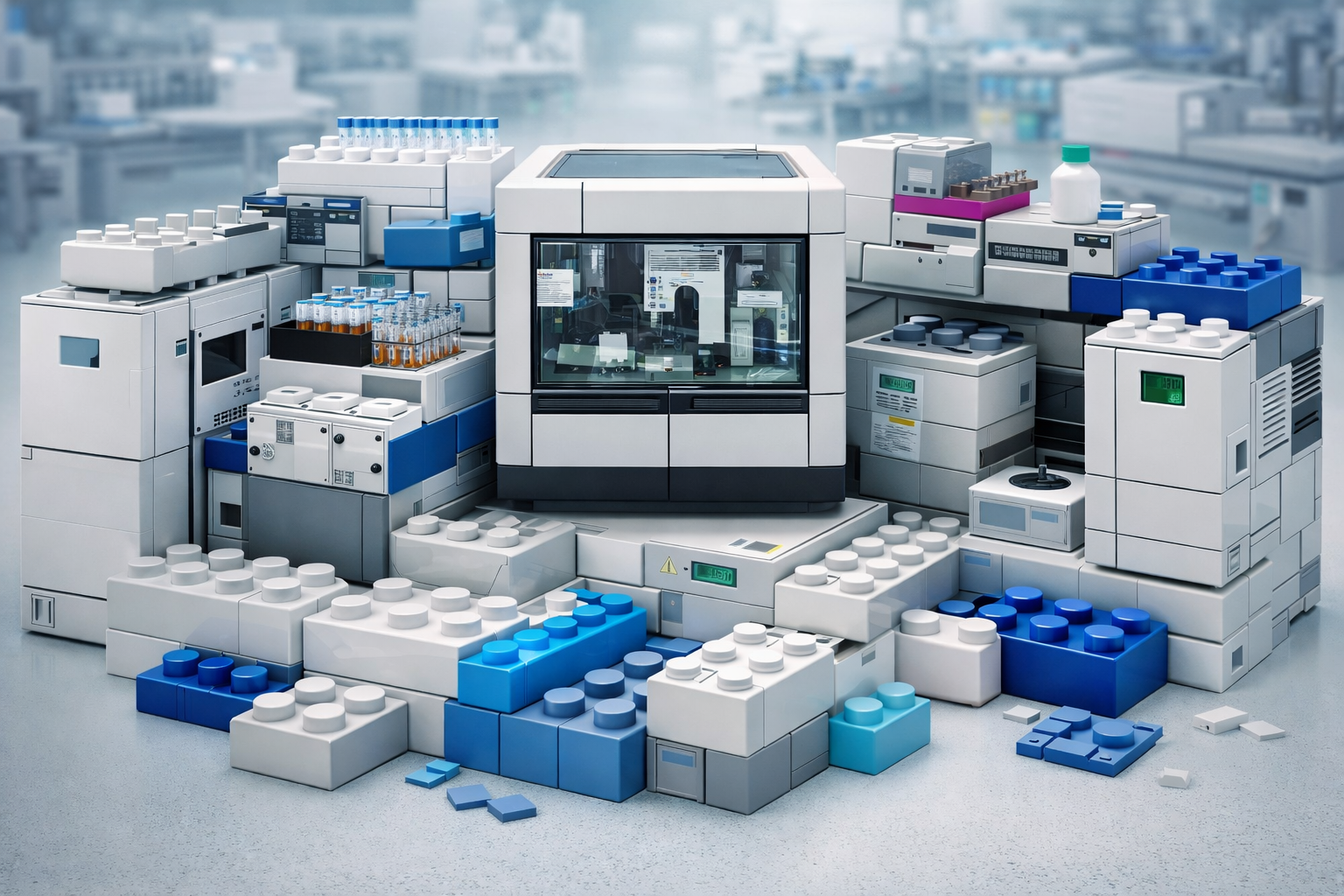
Kelly’s answer to that sprawl is the Lego-block argument. “Each robot is built around a device… once it’s in that form, it becomes a Lego block that can be added to any other devices to make an integrated system easily.” This is the asset-strategy shift: stop buying isolated instruments and start buying standardized nodes that compose. It is the same move the data-center industry made when racks became the unit instead of servers.
The model is not just for pharma. Strateos and Emerald Cloud Lab market remote labs across biotech and academia, while Opentrons pushes modular automation down to the benchtop. But pharma R&D is where the procurement logic is easiest to see because instruments are expensive, validation-heavy and space constrained.
Ginkgo’s current pitch to pharma, “Build Your Own Lab” plus a cloud layer, packages this thesis as a product. Tetrascience applies similar composable logic one layer down, building reusable schemas and ontologies across customers rather than bespoke integrations for each pharma company. Fountain, describing Tetrascience’s approach in that 2025 interview, reached for Kelly’s exact metaphor unprompted: “the same Lego blocks, the same platform.”
From the subway to the self-driving cab
Viewed more broadly, autonomous-lab vendors are competing on service model as much as on hardware. High-throughput screening is a fixed-route service: high reliability, narrow menu, like a subway route. Autonomous labs are aiming for something closer to on-demand service: a broader menu, more variability and, eventually, hundreds of protocols, more akin to a Waymo car than a train line. Procurement teams already evaluate vendors on that axis: service breadth, service reliability and cost.
The same “buying more of the same is not buying what works” logic shows up on the data side. At Flagship Pioneering’s 2026 AI Summit in March, Seemay Chou of Arcadia Science argued that scaling RNA-Seq, the workhorse assay behind a large share of biological AI training data, is hitting diminishing returns: the bottleneck is modality coverage rather than volume.
Digital procurement
The AI tools sitting closest to scientists are starting to do procurement-shaped work: comparing reagents, surfacing suppliers and costing out routes. Whether they can do it reliably is the open question. General-purpose chatbots can still invent vendors and fabricate spec sheets with the same fluency they use on real ones, which makes them unsafe near a purchase order.
The strongest evidence for that future may come less from general-purpose chatbots than from chemistry-specific systems already sitting close to the buy decision. CAS SciFinder, probably the most procurement-adjacent of the major chemistry platforms, has been pushing in exactly that direction: natural-language search that can move from properties and spectra to suppliers and price, plus AI-enhanced retrosynthesis and plan optimization detailed in its August 2025 update. Reaxys plays a similar role as a curated reaction and substance database, and its Predictive Retrosynthesis tooling is explicit about helping chemists compare alternative starting materials, routes and conditions. The important distinction is that these systems are grounded in structured chemistry data. Elicit is useful for extracting and comparing findings across large paper sets, but a 2025 Cochrane evaluation found its search sensitivity averaged 39.5% versus 94.5% for traditional searches. For a procurement reader, that is not a small caveat. The cost of getting a reagent table wrong is not a bad memo. It is a failed experiment.