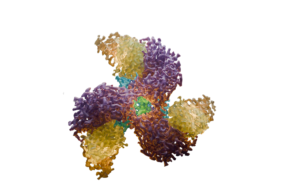
Cryo-EM reconstruction of a protein complex, illustrating near-atomic structural detail enabled by modern 200 kV cryo-TEM systems. Image from Thermo Fisher Scientific’s Glacios 3 brochure.
Cryo-electron microscopy has helped illuminate the molecular architecture behind some of the most commercially important therapies of the past decade. Cryo-EM helped guide the development of Pfizer-BioNTech’s Comirnaty COVID-19 vaccine, for instance, which at its peak in 2022 drove $37.8 billion for Pfizer alone. Separately, cryo-EM helped shed light on how the megablockbusters tirzepatide (Lilly) and semaglutide (Novo Nordisk) interact with their target receptors. The technology has also helped clarify the structural basis of the immune response to the RSV vaccine candidate.
“Cryo-EM really enables analysis of biomedically important targets that are typically intractable by other methodologies,” says Jeff Lengyel, Ph.D., director of product marketing focused on life science TEMs at Thermo Fisher Scientific. “It’s really become the key enabler for structure-based drug design.”
Why in-house adoption has been hard
For biotech and pharmaceutical companies that lease space, bringing cryo-EM in-house has often meant taking on a drawn-out facilities project before a single experiment can begin. Lengyel said researchers commonly spend nine months to a year renovating rooms because high-powered electron microscopes are acutely sensitive to vibration, electromagnetic interference, temperature shifts, and acoustics. Historically, that has often required extensive site preparation, specialized mitigation, and, ideally, basement placement.
That burden can be especially difficult for pharma tenants. Lengyel said some biotech and pharmaceutical companies are often renting or leasing space, which can make room renovations especially challenging. He said higher-floor installations can further limit what teams can do to prepare a site because “you can’t do things like dig trenches.” Lengyel said the instrument itself typically takes about nine months to a year to build while customers renovate the room in parallel. In some cases, the overall process of purchase, site preparation, delivery and installation can stretch to roughly a year and a half before teams are doing drug-discovery work in-house. “It’s a very long process, and in the context of a pharmaceutical company, it’s [historically been] quite challenging.”
Glacios 3: READY, smaller footprint, upper-floor fit
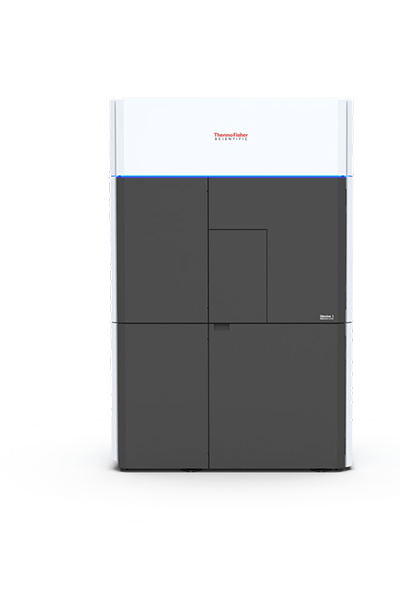
Thermo Fisher Scientific’s Glacios 3 Cryo-TEM, a 200 kV cryo-electron microscope designed to reduce installation constraints and expand access to high-resolution structural biology.
Thermo Fisher’s answer is the Glacios 3 Cryo-TEM, launched in late March. Thermo says the 200 kV system combines the Glacios platform’s latest optical and software upgrades with a built-in environmental mitigation package called the READY System. In a brochure example, the company says the instrument produced a 1.9-angstrom aldolase structure from 8,925 images collected in 12 hours.
According to Thermo Fisher’s brochure, the READY System combines five layers of acoustic and thermal insulation with optional active vibration dampeners in the system base and optional built-in electromagnetic interference sensors with active suppression directly within the instrument frame. Thermo Fisher says that package would have eliminated the need for facility renovations at 80% to 95% of sites the company surveyed for electron microscopy installations over the past decade.
Thermo says the Glacios 3 is 22% smaller than the largest previous Glacios configuration and can fit rooms with standard U.S. ceiling heights of 2.7 meters, or about 8.9 feet, thanks to an integrated telescopic hoist rather than the external maintenance hoist older systems required. Lengyel said Thermo also adopted bladder-based anti-vibration technology better suited to softer, higher-floor building structures than piezoelectric systems that push against hard floors. For some pharmaceutical customers, that combination could remove a major adoption barrier altogether. “It actually did inhibit some cryo-EM adoption by some companies,” he said of the previous room-preparation burden.
Designed for easier operation and training
While the READY System removes physical barriers, Thermo Fisher is also pitching the Glacios 3 as easier to operate. AI-powered software can guide decisions, screen samples, automate complex tasks, and reduce the guesswork in cryo-EM setup. It also says a new optical model can configure illumination parameters in a single click, making setup faster and easier, especially for less experienced users. “A key aspect of this is: how do we make the instrument more intelligent: where the instrument aligns itself, sets up a lot of data collection parameters?” Lengyel said. “We really are trying to lower the threshold of actually operating cryo-EM,”
AI is also helping on the ease of use front. Lengyel said Thermo typically provides on-site training through application scientists and engineers, often PhD-level cryo-EM specialists. The company generally trains a main instrument user along with additional lab researchers involved in structure-based drug design, an approach meant to shorten the learning curve as more groups bring cryo-EM in-house. “Classically, there were a lot of manual steps when you set up data collection parameters for cryo-EM,” Lengyel explained. “And now, with AI, you can actually train the instruments to find where to collect data, and it can collect series of data… and say, ‘This is the optimal data collection.'” Ultimately, the goal is to let researchers focus on the biology rather than fighting the hardware. “We really are trying to lower the threshold of actually operating cryo-EM, so you can more focus on the experiment of purifying your protein, freezing your sample than doing the post process,” he said.
Shortening the loop from structure to decision
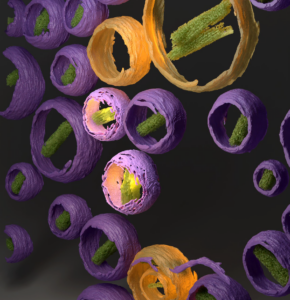
Liposome-encapsulated doxorubicin imaged with 200 kV cryo-electron tomography.
Once a sample is vitrified and loaded onto the Glacios 3’s 12-position autoloader, on-the-fly reconstruction software can provide immediate feedback on data quality. Thermo says its software stack can support unsupervised grid screening, unattended multi-grid sessions, and embedded CryoSPARC Live-based preliminary 3D model generation during acquisition. Lengyel said that kind of earlier structural feedback can shorten the med-chem loop by helping teams evaluate compounds and iterate sooner.
Lengyel described cryo-EM and AI prediction tools as complementary parts of a closed loop. AI tools like Google DeepMind’s AlphaFold and similar structure prediction systems can help with construct design and other early steps, he said, but cryo-EM still provides the experimentally resolved structures needed to compare prediction against reality. “You may have a general overall shape that’s the same, but as far as the amino acid level, there can be a lot of variation in the exact position,” he said.