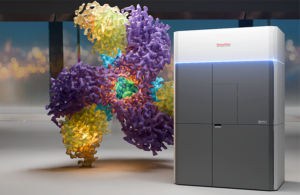
Cryo-EM of HIV envelope protein guides vaccine development (EMBD-48286)
Thermo Fisher Scientific today launched the Glacios 3 Cryo-TEM, the third generation of its 200 kV cryogenic transmission electron microscope platform. The headline feature is the READY System, an integrated suite of technologies designed to mitigate vibrations, acoustic noise, electromagnetic interference and temperature fluctuations well enough that the instrument can be installed in a broader range of laboratory spaces. Thermo Fisher says the Cryo-TEM can be installed in rooms as small as 4.2 x 3.8 m with standard U.S. ceiling heights without the extensive facility renovations that cryo-EM has traditionally demanded.
Cryo-EM installations have traditionally required significant facility renovations. Think acoustic shielding, magnetic shielding, vibration isolation, HVAC upgrades. All of those items can add substantial cost on top of the instrument itself. According to Thermo, the READY System “would have eliminated the need for facility renovations at 80–95% of sites previously surveyed by Thermo Fisher Scientific for electron microscopy installations over the last decade.”
Beyond the READY System, the Glacios 3 adds AI-powered workflows through Smart EPU Software for single particle analysis and a CryoTomo Software Suite for cryo-electron tomography, along with a vacuum capsule for contamination-free sample transfer between Autoloader-equipped cryo-TEM systems.
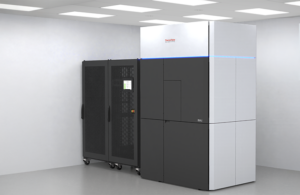
A shot of the Glacios 3 as shown in a spec sheet document.
The Glacios 3 sits in the middle of Thermo Fisher’s three-tier cryo-EM portfolio. The Tundra, a 100 kV system launched around 2020, serves as an entry point compact enough for standard labs. The Krios 5, a 300 kV flagship launched in April 2025 with up to 25% higher throughput than its predecessors, remains the instrument of choice for atomic-resolution work. The Glacios 3 occupies the middle ground: it supports single particle analysis, cryo-ET, and micro-electron diffraction, yet is positioned to reach institutions that can’t justify the cost or infrastructure demands of a Krios.
Earlier this month, the company opened a Cryo-EM Drug Discovery Center in South San Francisco, offering pharmaceutical and biotech companies shared access to cryo-EM instrumentation and expertise: a CRO-style model aimed at companies that aren’t ready to own an instrument outright.