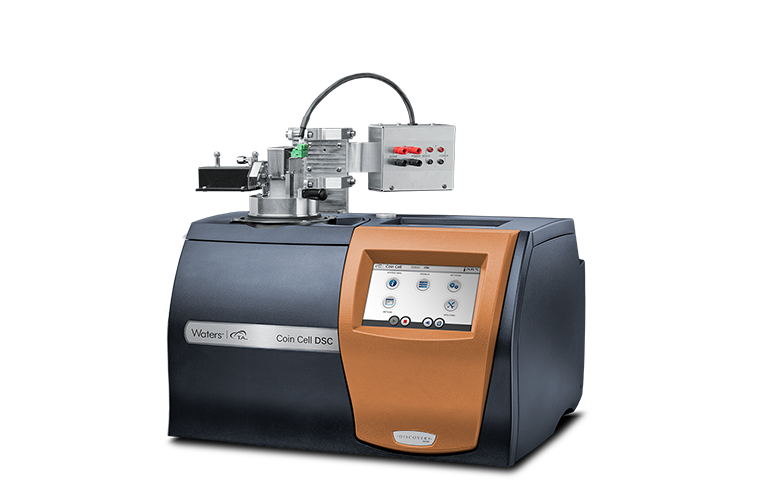
The Waters TA Instruments Coin Cell DSC, launched June 9, 2026, with shipments expected to begin in August. The instrument scans fully assembled coin cells from -80 °C to 600 °C while capturing evolved gas data. (Credit: Waters Corp.)
Waters Corp. (NYSE: WAT) has launched a differential scanning calorimeter built to test fully assembled coin cells, eliminating the cell teardown step that has long made DSC-based battery safety work slow and destructive. The Waters TA Instruments Coin Cell Differential Scanning Calorimeter (DSC) scans fully assembled coin cells from -80 °C to 600 °C while tracking evolved gas, with optional electrochemical connections available depending on configuration. In short, the unit aims to pull battery safety screening earlier in development than accelerating rate calorimetry allows. The company announced the TA Instruments Coin Cell DSC on June 9, with orders open now and shipments expected to begin in August 2026.
Conventional DSC analysis of battery materials typically requires disassembling cells in a glovebox and harvesting electrode or electrolyte samples into crucibles, a process that consumes time and alters the sample state the measurement is meant to capture. Waters says its whole-cell capsule design cuts average sample preparation time by more than 90% while preserving sample integrity, a figure the company attributes to an internal study comparing six users on each workflow.
The instrument measures heat flow from an intact coin cell across a temperature range of -80 °C to 600 °C while simultaneously capturing evolved gas data. Optional electrochemical connections, supporting voltage monitoring, battery cycling or potentiostat input depending on configuration, let researchers correlate thermal events with electrochemical behavior, which Waters says enables earlier insight into thermal runaway and battery failure. The system can also couple to mass spectrometry, FTIR or GC-MS instruments for direct analysis of off-gas composition.
“Simultaneously capturing thermal, evolved gas and electrochemical data is not only faster, but also correlates data from the same sample for more exacting insights earlier in development,” said Yu Cheng, vice president of research and development and product solutions for Waters’ Materials Sciences division, in a statement.
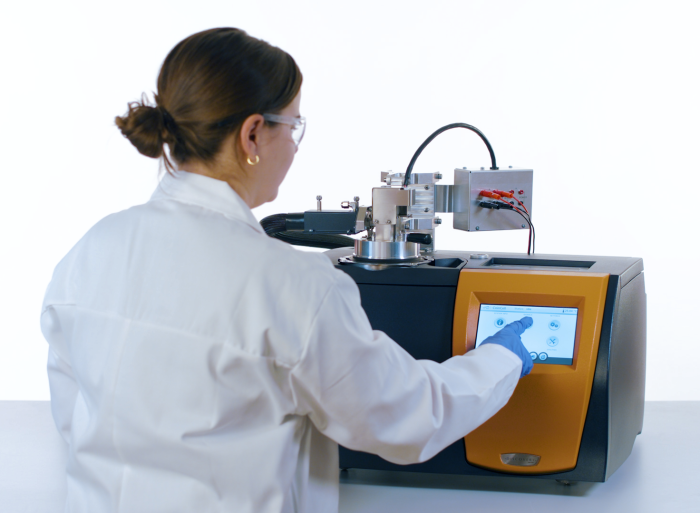
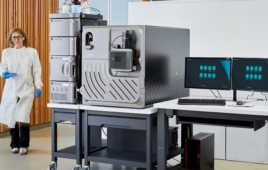
A researcher operates the Waters TA Instruments Coin Cell DSC. The instrument’s coin-cell capsule assembly sits atop the DSC furnace, with the electrochemical analysis module visible at upper right. (Credit: Waters Corp.)
Waters describes the system as the only commercially available DSC offering this multidimensional data capture, based on an internal review of 26 DSC models conducted in May. A separate footnote in the announcement, citing an internal review of three DSC models capable of testing intact coin cells, suggests other instruments can accept whole cells even if they lack the combined gas and electrochemical measurement. The “industry-leading” temperature range claim likewise rests on internal comparisons rather than independent benchmarking.
Intact-cell calorimetry itself is not new territory. Tian-Calvet calorimeters such as Setaram’s C80 and MS80 have long measured heat generation from whole coin and cylindrical cells, and isothermal microcalorimetry, including TA Instruments’ own TAM line, is an established technique for tracking parasitic heat flow and self-discharge in assembled cells. Those approaches, however, generally operate isothermally or near ambient conditions during cycling. A scanning instrument that drives an intact cell up to 600 °C while logging gas evolution targets a different regime: the decomposition and abuse chemistry that precedes thermal runaway.
ARC remains the workhorse for thermal runaway characterization, but it is typically deployed late in development and requires larger cell formats, specialized facilities and long experiment times. Coin cells, by contrast, are the default format for early-stage screening of new chemistries, from silicon-rich anodes to sodium-ion and solid-state candidates.
Shirley Meng, a professor at the University of Chicago’s Pritzker School of Molecular Engineering and director of the Energy Storage Research Alliance, said in the announcement that the battery industry “has long needed a solution that bridges the gap between materials thermal analysis and full-cell DSC testing.”
The launch is the second instrument release this year from Waters’ Materials Sciences division, which the company formed as one of four divisions after completing its combination with BD’s Biosciences and Diagnostic Solutions businesses in February. The division, anchored by the TA Instruments brand, launched the ARES-G3 rheometer at Pittcon in March and has named batteries, electronics and pharmaceuticals as its core application markets.