Research & Development World

  • R&D World Home
  • Topics
    • Aerospace
    • Automotive
    • Biotech
    • Careers
    • Chemistry
    • Environment
    • Energy
    • Life Science
    • Material Science
    • R&D Management
    • Physics
  • Technology
    • 3D Printing
    • A.I./Robotics
    • Software
    • Battery Technology
    • Controlled Environments
      • Cleanrooms
      • Graphene
      • Lasers
      • Regulations/Standards
      • Sensors
    • Imaging
    • Nanotechnology
    • Scientific Computing
      • Big Data
      • HPC/Supercomputing
      • Informatics
      • Security
    • Semiconductors
  • R&D Market Pulse
  • R&D 100
    • 2025 R&D 100 Award Winners
    • 2025 Professional Award Winners
    • 2025 Special Recognition Winners
    • R&D 100 Awards Event
    • R&D 100 Submissions
    • Winner Archive
  • Resources
    • Research Reports
    • Digital Issues
    • Educational Assets
    • R&D Index
    • Subscribe
    • Video
    • Webinars
    • Content submission guidelines for R&D World
  • Global Funding Forecast
  • Top Labs
  • Advertise
  • SUBSCRIBE

Big Energy Savings For Tiny Machines

By Simon Fraser University | May 22, 2019

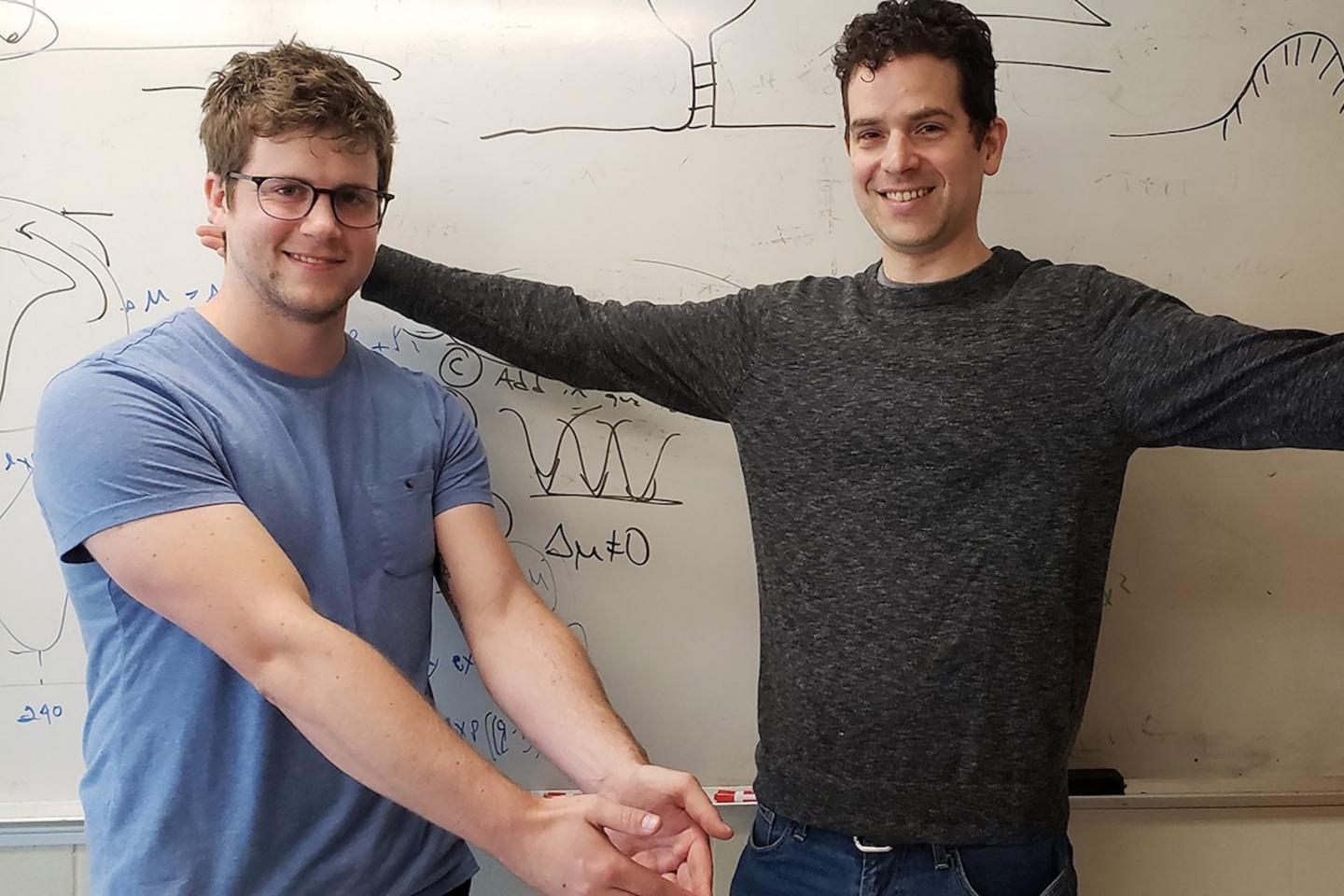
Simon Fraser University physics graduate student Steven Large, left, and professor David Sivak model the folded and unfolded states of a DNA hairpin. Credit: SFU

Inside all of us are trillions of tiny molecular nanomachines that perform a variety of tasks necessary to keep us alive.

In a ground-breaking study, a team led by SFU physics professor David Sivak demonstrated for the first time a strategy for manipulating these machines to maximize efficiency and conserve energy. The breakthrough could have ramifications across a number of fields, including creating more efficient computer chips and solar cells for energy generation.

Nanomachines are small, really small — a few billionths of a meter wide, in fact. They’re also fast and capable of performing intricate tasks: everything from moving materials around a cell, building and breaking down molecules, and processing and expressing genetic information.

The machines can perform these tasks while consuming remarkably little energy, so a theory that predicts energetic efficiency helps us understand how these microscopic machines function and what goes wrong when they break down, Sivak says.

In the lab, Sivak’s experimental collaborators manipulated a DNA hairpin, whose folding and unfolding mimics the mechanical motion of more complicated molecular machines. As predicted by Sivak’s theory, they found that maximum efficiency and minimal energy loss occurred if they pulled rapidly on the hairpin when it was folded but slowly when it was on the verge of unfolding.

Steven Large, an SFU physics graduate student and co-first author on the paper, explains that DNA hairpins (and nanomachines) are so tiny and floppy that they are constantly jostled by violent collisions with surrounding molecules.

“Letting the jostling unfold the hairpin for you is an energy and time saver,” Large says.

Sivak thinks the next step is to apply the theory to learn how to drive a molecular machine through its operational cycle, while reducing the energy required to do that.

So, what is the benefit from making nanomachines more efficient? Sivak says that potential applications could be game-changing in a variety of areas.

“Uses could include designing more efficient computer chips and computer memory (reducing power requirements and the heat they emit), making better renewable energy materials for processes like artificial photosynthesis (increasing the energy harvested from the Sun) and improving the autonomy of biomolecular machines for biotech applications like drug delivery.”

The study was published in Proceedings of the National Academy of Sciences.
Related Articles Read More >

R&D 100 winner LLNL achieves 1,000x speed boost in 3D nanofabrication
CEA-Leti achieves 400°C CMOS fabrication milestone for 3D chip stacking
The 2025 R&D 100 Finalists are here
New nanotechnology method increases microalgae biofuel yield by 300%
rd newsletter
EXPAND YOUR KNOWLEDGE AND STAY CONNECTED
Get the latest info on technologies, trends, and strategies in Research & Development.
RD 25 Power Index

R&D World Digital Issues

Fall 2025 issue

Browse the most current issue of R&D World and back issues in an easy to use high quality format. Clip, share and download with the leading R&D magazine today.

R&D 100 Awards
Research & Development World
  • Subscribe to R&D World Magazine
  • Sign up for R&D World’s newsletter
  • Contact Us
  • About Us
  • Drug Discovery & Development
  • Pharmaceutical Processing
  • Global Funding Forecast

Copyright © 2026 WTWH Media LLC. All Rights Reserved. The material on this site may not be reproduced, distributed, transmitted, cached or otherwise used, except with the prior written permission of WTWH Media
Privacy Policy | Advertising | About Us

Search R&D World

  • R&D World Home
  • Topics
    • Aerospace
    • Automotive
    • Biotech
    • Careers
    • Chemistry
    • Environment
    • Energy
    • Life Science
    • Material Science
    • R&D Management
    • Physics
  • Technology
    • 3D Printing
    • A.I./Robotics
    • Software
    • Battery Technology
    • Controlled Environments
      • Cleanrooms
      • Graphene
      • Lasers
      • Regulations/Standards
      • Sensors
    • Imaging
    • Nanotechnology
    • Scientific Computing
      • Big Data
      • HPC/Supercomputing
      • Informatics
      • Security
    • Semiconductors
  • R&D Market Pulse
  • R&D 100
    • 2025 R&D 100 Award Winners
    • 2025 Professional Award Winners
    • 2025 Special Recognition Winners
    • R&D 100 Awards Event
    • R&D 100 Submissions
    • Winner Archive
  • Resources
    • Research Reports
    • Digital Issues
    • Educational Assets
    • R&D Index
    • Subscribe
    • Video
    • Webinars
    • Content submission guidelines for R&D World
  • Global Funding Forecast
  • Top Labs
  • Advertise
  • SUBSCRIBE