Research & Development World

  • R&D World Home
  • Topics
    • Aerospace
    • Automotive
    • Biotech
    • Careers
    • Chemistry
    • Environment
    • Energy
    • Life Science
    • Material Science
    • R&D Management
    • Physics
  • Technology
    • 3D Printing
    • A.I./Robotics
    • Software
    • Battery Technology
    • Controlled Environments
      • Cleanrooms
      • Graphene
      • Lasers
      • Regulations/Standards
      • Sensors
    • Imaging
    • Nanotechnology
    • Scientific Computing
      • Big Data
      • HPC/Supercomputing
      • Informatics
      • Security
    • Semiconductors
  • R&D Market Pulse
  • R&D 100
    • 2025 R&D 100 Award Winners
    • 2025 Professional Award Winners
    • 2025 Special Recognition Winners
    • R&D 100 Awards Event
    • R&D 100 Submissions
    • Winner Archive
  • Resources
    • Research Reports
    • Digital Issues
    • Educational Assets
    • R&D Index
    • Subscribe
    • Video
    • Webinars
    • Content submission guidelines for R&D World
  • Global Funding Forecast
  • Top Labs
  • Advertise
  • SUBSCRIBE

Breakthrough Antimalarial Drug Delivery System Using Mesoporous Silica Nanoparticles

By Kumamoto University | March 23, 2018

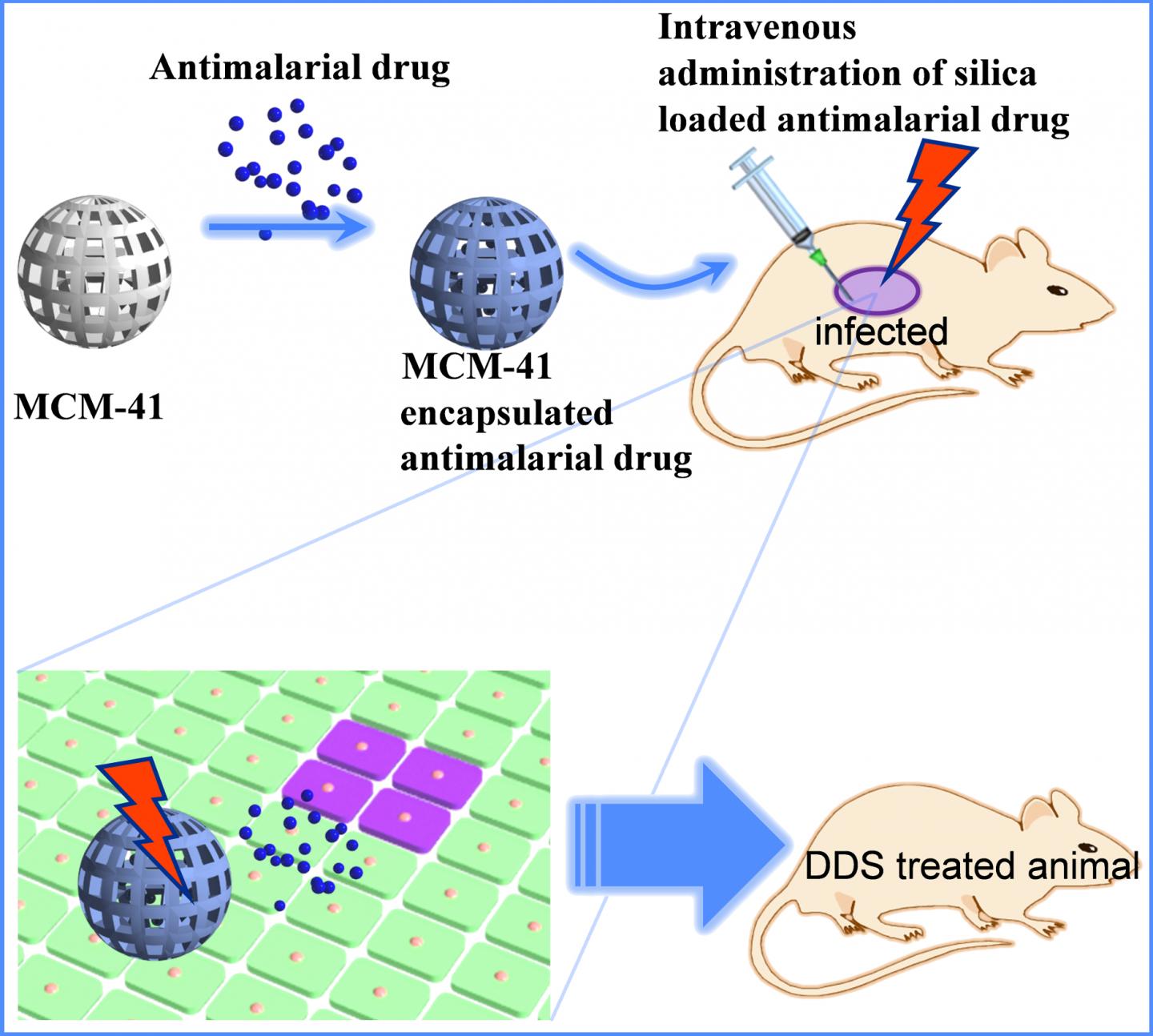
Kumamoto University researchers found that using MCM-41 as a drug delivery system for malaria treatment produced a highly efficient treatment in animals. Clinical trials are planned in the near future. Credit: Shinya Hayami

Drug delivery systems (DDSs) control when and how much drugs are delivered to the body. Numerous DDS studies have been conducted but most have focused on treatments for cancer. New research from Kumamoto University uses a DDS to treat malaria.

The existing treatment for malaria is taken orally and has three main problems: (1) most antimalarial drugs are broken down in the stomach, (2) the drugs have strong side effects, and (3) the medicine stays in the body for only a short time. These issues resulted in malaria treatments that were not particularly effective.

MCM-41 is a porous silica material with a pore size of 2-30 nm. It can incorporate drugs into its pores, which makes it a useful material for DDS applications. A research group headed by Prof. Shinya Hayami from Kumamoto University, Japan believed that MCM-41 could be used as DDS for antimalarial drugs. To test their theory, they created a new DDS by combining the antimalarial drugs Artesunate and Quinine with MCT-41 and performed in vitro and in vivo experiments. They found:


  • (1) The release time of the antimalarial medicine became very long, one week or longer, which was an improvement from the standard medication time.


    (2) Compared to ingesting Artesunate or Quinine, the new DDS increased treatment efficiency by 20 and 240 times respectively in animal experiments. (As defined in this study, the therapeutic efficiency is 50% of the effective dose (ED50), and is used as an index of drug strength. The smaller the value of ED50, the greater the action of the drug. In other words, if an effect is obtained with a small amount of a drug, the treatment efficiency is high.)

    (3) MCM-41 itself is non-toxic and inactive. A DDS using MCM-41 is expected to have very weak side effects.

“Using this DDS for antimalarial drugs has introduced a new possibility for highly efficient malaria treatment for the first time,” said Professor Shinya Hayami. “We expect that it will be put to practical use in areas where malaria treatment is still necessary. Now, we are planning to develop clinical trials for antimalarial drugs as well as new DDSs for other drugs, like anti-HIV medications.”


Related Articles Read More >

Drones help diagnose deadly whale viruses 
Drowning in variants? Mount Sinai tool adds phenotype filter
Oral Wegovy approval charts a new course for blockbuster drug development
Los Alamos’ R&D 100-winning EpiEarth platform helps predict the global outbreaks early
rd newsletter
EXPAND YOUR KNOWLEDGE AND STAY CONNECTED
Get the latest info on technologies, trends, and strategies in Research & Development.
RD 25 Power Index

R&D World Digital Issues

Fall 2025 issue

Browse the most current issue of R&D World and back issues in an easy to use high quality format. Clip, share and download with the leading R&D magazine today.

R&D 100 Awards
Research & Development World
  • Subscribe to R&D World Magazine
  • Sign up for R&D World’s newsletter
  • Contact Us
  • About Us
  • Drug Discovery & Development
  • Pharmaceutical Processing
  • Global Funding Forecast

Copyright © 2026 WTWH Media LLC. All Rights Reserved. The material on this site may not be reproduced, distributed, transmitted, cached or otherwise used, except with the prior written permission of WTWH Media
Privacy Policy | Advertising | About Us

Search R&D World

  • R&D World Home
  • Topics
    • Aerospace
    • Automotive
    • Biotech
    • Careers
    • Chemistry
    • Environment
    • Energy
    • Life Science
    • Material Science
    • R&D Management
    • Physics
  • Technology
    • 3D Printing
    • A.I./Robotics
    • Software
    • Battery Technology
    • Controlled Environments
      • Cleanrooms
      • Graphene
      • Lasers
      • Regulations/Standards
      • Sensors
    • Imaging
    • Nanotechnology
    • Scientific Computing
      • Big Data
      • HPC/Supercomputing
      • Informatics
      • Security
    • Semiconductors
  • R&D Market Pulse
  • R&D 100
    • 2025 R&D 100 Award Winners
    • 2025 Professional Award Winners
    • 2025 Special Recognition Winners
    • R&D 100 Awards Event
    • R&D 100 Submissions
    • Winner Archive
  • Resources
    • Research Reports
    • Digital Issues
    • Educational Assets
    • R&D Index
    • Subscribe
    • Video
    • Webinars
    • Content submission guidelines for R&D World
  • Global Funding Forecast
  • Top Labs
  • Advertise
  • SUBSCRIBE