Research & Development World

  • R&D World Home
  • Topics
    • Aerospace
    • Automotive
    • Biotech
    • Careers
    • Chemistry
    • Environment
    • Energy
    • Life Science
    • Material Science
    • R&D Management
    • Physics
  • Technology
    • 3D Printing
    • A.I./Robotics
    • Software
    • Battery Technology
    • Controlled Environments
      • Cleanrooms
      • Graphene
      • Lasers
      • Regulations/Standards
      • Sensors
    • Imaging
    • Nanotechnology
    • Scientific Computing
      • Big Data
      • HPC/Supercomputing
      • Informatics
      • Security
    • Semiconductors
  • R&D Market Pulse
  • R&D 100
    • 2025 R&D 100 Award Winners
    • 2025 Professional Award Winners
    • 2025 Special Recognition Winners
    • R&D 100 Awards Event
    • R&D 100 Submissions
    • Winner Archive
  • Resources
    • Research Reports
    • Digital Issues
    • Educational Assets
    • Subscribe
    • Video
    • Webinars
    • PharmSci360
    • Content submission guidelines for R&D World
  • Global Funding Forecast
  • Top Labs
  • Advertise
  • SUBSCRIBE

Butterfly Wings Inspire New Solar Technologies

By Australian National University | May 17, 2017

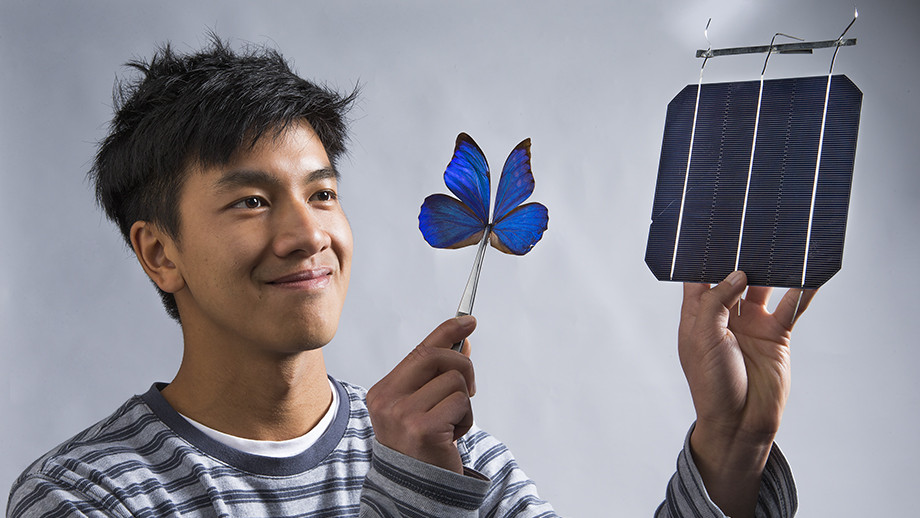
Co-researcher Kevin Le from ANU with a blue Morpho butterfly and a solar cell. Image: Stuart Hay, ANU

Engineers have invented tiny structures inspired by butterfly wings that open the door to new solar cell technologies and other applications requiring precise manipulation of light.

The inspiration comes from the blue Morpho Didius butterfly, which has wings with tiny cone-shaped nanostructures that scatter light to create a striking blue iridescence, and could lead to other innovations such as stealth and architectural applications.

Lead researcher Dr. Niraj Lal from the Australian National University Research School of Engineering says the team made similar structures at the nanoscale and applied the same principles in the butterfly wing phenomenon to finely control the direction of light in experiments.

“There’s a whole bunch of potential new applications using our light-control technique, including next-generation solar cell, architectural and stealth technologies,” says Lal.

He said scientists can greatly improve the efficiency of solar cells with effective light management.

“Techniques to finely control the scattering, reflection and absorption of different colors of light are being used in the next generation of very high-efficiency solar panels,” he says. “Being able to make light go exactly where you want it to go has proven to be tricky up until now.”

Lal says the aim was to absorb all of the blue, green and ultraviolet colors of sunlight in the perovskite layer of a solar cell, and all of the red, orange and yellow light in the silicon layer — known as a tandem solar cell with double-decker layers.

Researchers at the ANU surpassed silicon efficiency records with such a cell last month.

He says the technique could one day be used to make opaque objects transparent to certain colors, and vice versa, as part of new stealth applications.

“We were surprised by how well our tiny cone-shaped structures worked to direct different colors of light where we wanted them to go,” Lal says.

He says the technique could also be used in architecture to control how much light and heat passed through windows.

“Using our approach, a window could be designed to be transparent to some colors non-see through and matt textured for others — so there are very cool potential applications in architecture,” Lal says.   

The technique was very scalable and did not require expensive technology, he says.

“These intricate nanostructures grow and assemble themselves — it’s not by precise control with a tiny laser or electrons,” Lal says.

The research paper is published in ACS Photonics, with co-authors Kevin Le, Andrew Thomson, Maureen Brauers, Tom White, and Kylie Catchpole.

Source: Australian National University

Related Articles Read More >

As U.S. power demand surges, Brookhaven taps AWS in aim to drive 20-100x faster power grid decision-making with GridSearch AI
DOE announces first selections for nuclear energy DOME program
Five key trends that defined the show floor at Interphex 2026 
NANO Nuclear could have a reactor on the Moon by 2030 CEO says
rd newsletter
EXPAND YOUR KNOWLEDGE AND STAY CONNECTED
Get the latest info on technologies, trends, and strategies in Research & Development.

R&D World Digital Issues

Fall 2025 issue

Browse the most current issue of R&D World and back issues in an easy to use high quality format. Clip, share and download with the leading R&D magazine today.

R&D 100 Awards
Research & Development World
  • Subscribe to R&D World Magazine
  • Sign up for R&D World’s newsletter
  • Contact Us
  • About Us
  • Drug Discovery & Development
  • Pharmaceutical Processing
  • Global Funding Forecast

Copyright © 2026 Arrowfly LLC. All Rights Reserved. The material on this site may not be reproduced, distributed, transmitted, cached or otherwise used, except with the prior written permission of Arrowfly
Privacy Policy | Advertising | About Us

Search R&D World

  • R&D World Home
  • Topics
    • Aerospace
    • Automotive
    • Biotech
    • Careers
    • Chemistry
    • Environment
    • Energy
    • Life Science
    • Material Science
    • R&D Management
    • Physics
  • Technology
    • 3D Printing
    • A.I./Robotics
    • Software
    • Battery Technology
    • Controlled Environments
      • Cleanrooms
      • Graphene
      • Lasers
      • Regulations/Standards
      • Sensors
    • Imaging
    • Nanotechnology
    • Scientific Computing
      • Big Data
      • HPC/Supercomputing
      • Informatics
      • Security
    • Semiconductors
  • R&D Market Pulse
  • R&D 100
    • 2025 R&D 100 Award Winners
    • 2025 Professional Award Winners
    • 2025 Special Recognition Winners
    • R&D 100 Awards Event
    • R&D 100 Submissions
    • Winner Archive
  • Resources
    • Research Reports
    • Digital Issues
    • Educational Assets
    • Subscribe
    • Video
    • Webinars
    • PharmSci360
    • Content submission guidelines for R&D World
  • Global Funding Forecast
  • Top Labs
  • Advertise
  • SUBSCRIBE