Research & Development World

  • R&D World Home
  • Topics
    • Aerospace
    • Automotive
    • Biotech
    • Careers
    • Chemistry
    • Environment
    • Energy
    • Life Science
    • Material Science
    • R&D Management
    • Physics
  • Technology
    • 3D Printing
    • A.I./Robotics
    • Software
    • Battery Technology
    • Controlled Environments
      • Cleanrooms
      • Graphene
      • Lasers
      • Regulations/Standards
      • Sensors
    • Imaging
    • Nanotechnology
    • Scientific Computing
      • Big Data
      • HPC/Supercomputing
      • Informatics
      • Security
    • Semiconductors
  • R&D Market Pulse
  • R&D 100
    • 2025 R&D 100 Award Winners
    • 2025 Professional Award Winners
    • 2025 Special Recognition Winners
    • R&D 100 Awards Event
    • R&D 100 Submissions
    • Winner Archive
  • Resources
    • Research Reports
    • Digital Issues
    • Educational Assets
    • R&D Index
    • Subscribe
    • Video
    • Webinars
    • Content submission guidelines for R&D World
  • Global Funding Forecast
  • Top Labs
  • Advertise
  • SUBSCRIBE

Clear as Mud: Desiccation Cracks Help Reveal the Shape of Water on Mars

By Geological Society of America | April 20, 2018

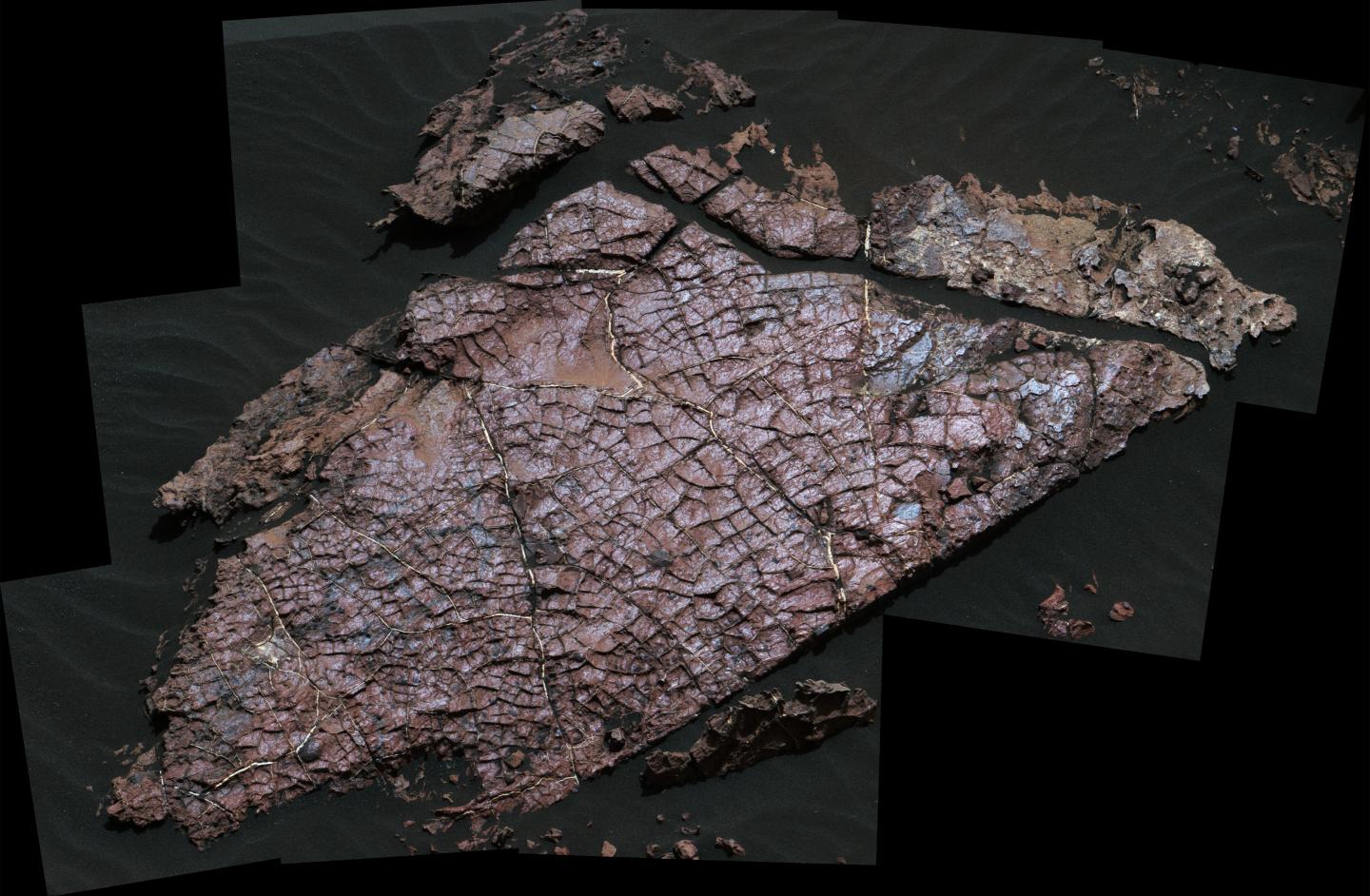
Curiosity Mastcam image of the Old Soaker rock slab taken on Sol 1555. The red-toned bed is covered by ridges that are the remnants of sediment that filled cracks that formed in drying lake in Gale Crater some ~3.5 billion years ago. The slab is about 80 cm across. Credit: NASA.

As Curiosity rover marches across Mars, the red planet’s watery past comes into clearer focus.

In early 2017 scientists announced the discovery of possible desiccation cracks in Gale Crater, which was filled by lakes 3.5 billion years ago. Now, a new study has confirmed that these features are indeed desiccation cracks, and reveals fresh details about Mars’ ancient climate.

“We are now confident that these are mudcracks,” explains lead author Nathaniel Stein, a geologist at the California Institute of Technology in Pasadena. Since desiccation mudcracks form only where wet sediment is exposed to air, their position closer to the center of the ancient lake bed rather than the edge also suggests that lake levels rose and fell dramatically over time.

“The mudcracks show that the lakes in Gale Crater had gone through the same type of cycles that we see on Earth,” says Stein. The study was published in Geology online ahead of print on 16 April 2018.

The researchers focused on a coffee table-sized slab of rock nicknamed “Old Soaker.” Old Soaker is crisscrossed with polygons identical in appearance to desiccation features on Earth. The team took a close physical and chemical look at those polygons using Curiosity’s Mastcam, Mars Hand Lens Imager, ChemCam Laser Induced Breakdown Spectrometer (LIBS), and Alpha-Particle X-Ray Spectrometer (APXS).

That close look proved that the polygons — confined to a single layer of rock and with sediment filling the cracks between them — formed from exposure to air, rather than other mechanisms such as thermal or hydraulic fracturing. And although scientists have known almost since the moment Curiosity landed in 2012 that Gale Crater once contained lakes, explains Stein, “the mudcracks are exciting because they add context to our understanding of this ancient lacustrine system.”

“We are capturing a moment in time,” he adds. “This research is just a chapter in a story that Curiosity has been building since the beginning of its mission.”

Related Articles Read More >

The Milky Way is glowing: these scientists think dark matter may be the cause
Reusable rocket startup raises $510 million
2025 R&D layoffs tracker: hardware and chips lead the year’s biggest cuts while biopharma pares pipelines
Sonar Screen For Submarines And Ships. Radar Sonar With Object On Map. Futuristic HUD Navigation monitor
Pentagon places big bets on frontier AI, quantum sensing and next-gen avionics in nearly $3 billion in defense technology contracts 
rd newsletter
EXPAND YOUR KNOWLEDGE AND STAY CONNECTED
Get the latest info on technologies, trends, and strategies in Research & Development.
RD 25 Power Index

R&D World Digital Issues

Fall 2024 issue

Browse the most current issue of R&D World and back issues in an easy to use high quality format. Clip, share and download with the leading R&D magazine today.

Research & Development World
  • Subscribe to R&D World Magazine
  • Sign up for R&D World’s newsletter
  • Contact Us
  • About Us
  • Drug Discovery & Development
  • Pharmaceutical Processing
  • Global Funding Forecast

Copyright © 2025 WTWH Media LLC. All Rights Reserved. The material on this site may not be reproduced, distributed, transmitted, cached or otherwise used, except with the prior written permission of WTWH Media
Privacy Policy | Advertising | About Us

Search R&D World

  • R&D World Home
  • Topics
    • Aerospace
    • Automotive
    • Biotech
    • Careers
    • Chemistry
    • Environment
    • Energy
    • Life Science
    • Material Science
    • R&D Management
    • Physics
  • Technology
    • 3D Printing
    • A.I./Robotics
    • Software
    • Battery Technology
    • Controlled Environments
      • Cleanrooms
      • Graphene
      • Lasers
      • Regulations/Standards
      • Sensors
    • Imaging
    • Nanotechnology
    • Scientific Computing
      • Big Data
      • HPC/Supercomputing
      • Informatics
      • Security
    • Semiconductors
  • R&D Market Pulse
  • R&D 100
    • 2025 R&D 100 Award Winners
    • 2025 Professional Award Winners
    • 2025 Special Recognition Winners
    • R&D 100 Awards Event
    • R&D 100 Submissions
    • Winner Archive
  • Resources
    • Research Reports
    • Digital Issues
    • Educational Assets
    • R&D Index
    • Subscribe
    • Video
    • Webinars
    • Content submission guidelines for R&D World
  • Global Funding Forecast
  • Top Labs
  • Advertise
  • SUBSCRIBE