Research & Development World

  • R&D World Home
  • Topics
    • Aerospace
    • Automotive
    • Biotech
    • Careers
    • Chemistry
    • Environment
    • Energy
    • Life Science
    • Material Science
    • R&D Management
    • Physics
  • Technology
    • 3D Printing
    • A.I./Robotics
    • Software
    • Battery Technology
    • Controlled Environments
      • Cleanrooms
      • Graphene
      • Lasers
      • Regulations/Standards
      • Sensors
    • Imaging
    • Nanotechnology
    • Scientific Computing
      • Big Data
      • HPC/Supercomputing
      • Informatics
      • Security
    • Semiconductors
  • R&D Market Pulse
  • R&D 100
    • 2025 R&D 100 Award Winners
    • 2025 Professional Award Winners
    • 2025 Special Recognition Winners
    • R&D 100 Awards Event
    • R&D 100 Submissions
    • Winner Archive
  • Resources
    • Research Reports
    • Digital Issues
    • Educational Assets
    • Subscribe
    • Video
    • Webinars
    • PharmSci360
    • Content submission guidelines for R&D World
  • Global Funding Forecast
  • Top Labs
  • Advertise
  • SUBSCRIBE

Closing the Carbon Loop

By University of Pittsburgh | December 8, 2016

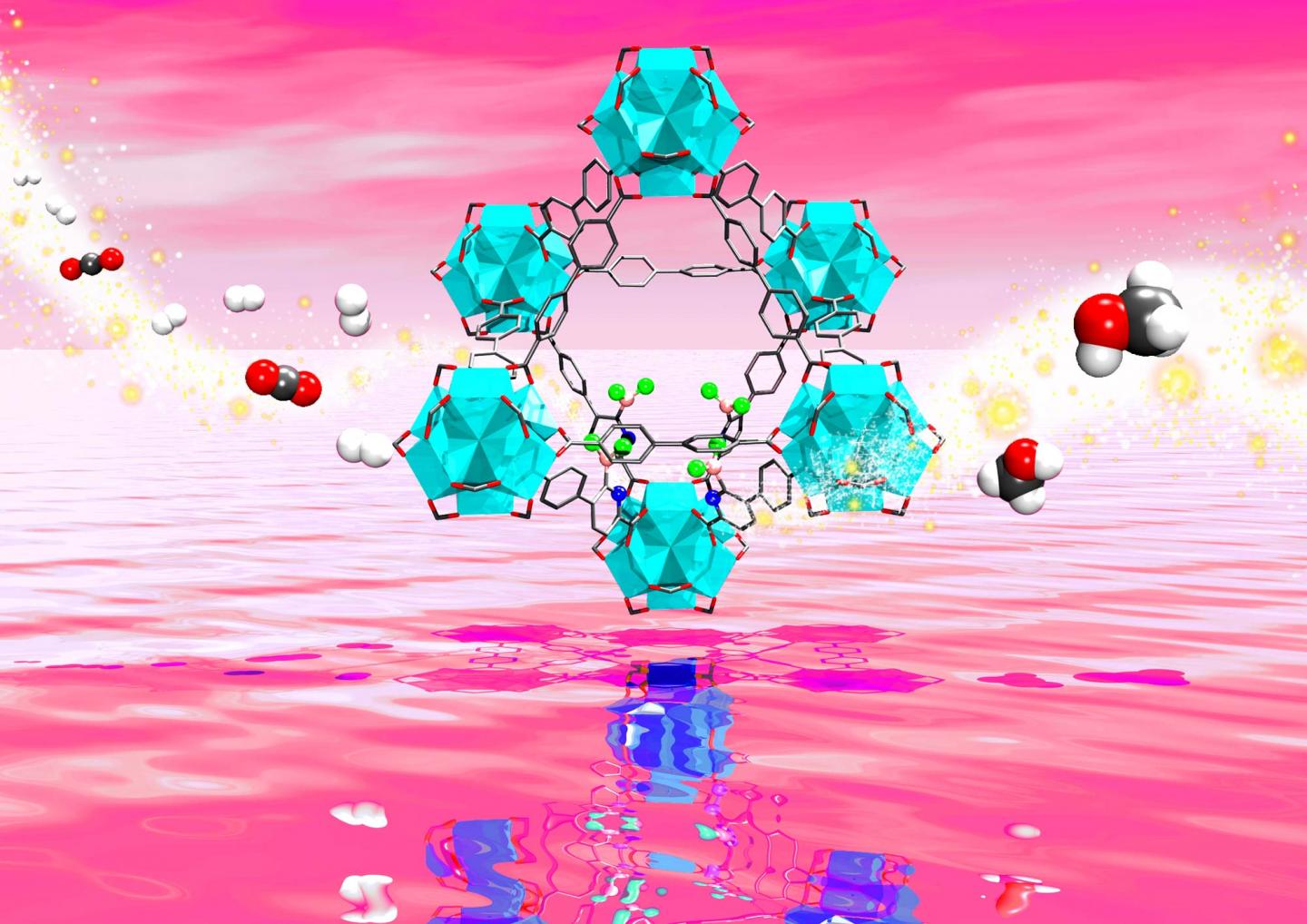
This is an artist’s conception of a catalyst (light blue and gray framework) capable of capturing CO2 (red and gray molecules on left side) and, along with hydrogen (white molecules) converting it to methanol (red, gray and white molecules on the right). Source: Karl Johnson

Research at the University of Pittsburgh’s Swanson School of Engineering focused on developing a new catalyst that would lead to large-scale implementation of capture and conversion of carbon dioxide (CO2) was recently published in the Royal Society of Chemistry journal Catalysis Science & Technology.

Principal investigator is Karl Johnson, the William Kepler Whiteford Professor in the Swanson School’s Department of Chemical & Petroleum Engineering. Postdoctoral associate Jingyun Ye is lead author. The article “Catalytic Hydrogenation of CO2 to Methanol in a Lewis Pair Functionalized MOF” (DOI: 10.1039/C6CY01245K), is featured on the cover of Catalysis Science & Technology (vol. 6, no. 24) and builds upon Dr. Johnson’s previous research that identified the two main factors for determining the optimal catalyst for turning atmospheric CO2 into liquid fuel. The research was conducted using computational resources at the University’s Center for Simulation and Modeling.

Karl Johnson CST cover image”Capture and conversion of CO2 to methanol has the potential to solve two problems at once – reducing net carbon dioxide emissions while generating cleaner fuels,” Dr. Johnson explained. “Currently, however, it is a complex and expensive process that is not economically feasible. Because of this, we wanted to simplify the catalytic process as much as possible to create a sustainable and cost-effective method for converting CO2 to fuel – essentially to reduce the number of steps involved from several to one.”

Johnson and Ye focused on computationally designing a catalyst capable of producing methanol from CO2 and H2 utilizing metal organic frameworks (MOFs), which potentially provide pathway for a single-process unit for carbon capture and conversion. The MOFs could dramatically reduce the cost of carbon capture and conversion, bringing the potential of CO2 as a viable feedstock for fuels closer to reality.

“Methanol synthesis has been extensively studied because methanol can work in existing systems such as engines and fuel cells, and can be easily transported and stored. Methanol is also a starting point for producing many other useful chemicals,” Dr. Johnson said. “This new MOF catalyst could provide the key to close the carbon loop and generate fuel from CO2, analogously to how a plant converts carbon dioxide to hydrocarbons.”


Related Articles Read More >

Researchers develop method to convert factory emissions to fuel feedstock without purification 
WHOI’s Alvin returns to sea with an autonomous vehicle that can explore down to 11,000 meters 
No propulsion, no problem: How CYGNSS’s solar panels will enable deorbit without propulsion 
Researchers develop sawdust-based foam as polystyrene bans force industry to adapt
rd newsletter
EXPAND YOUR KNOWLEDGE AND STAY CONNECTED
Get the latest info on technologies, trends, and strategies in Research & Development.

R&D World Digital Issues

Fall 2025 issue

Browse the most current issue of R&D World and back issues in an easy to use high quality format. Clip, share and download with the leading R&D magazine today.

R&D 100 Awards
Research & Development World
  • Subscribe to R&D World Magazine
  • Sign up for R&D World’s newsletter
  • Contact Us
  • About Us
  • Drug Discovery & Development
  • Pharmaceutical Processing
  • Global Funding Forecast

Copyright © 2026 Arrowfly LLC. All Rights Reserved. The material on this site may not be reproduced, distributed, transmitted, cached or otherwise used, except with the prior written permission of Arrowfly
Privacy Policy | Advertising | About Us

Search R&D World

  • R&D World Home
  • Topics
    • Aerospace
    • Automotive
    • Biotech
    • Careers
    • Chemistry
    • Environment
    • Energy
    • Life Science
    • Material Science
    • R&D Management
    • Physics
  • Technology
    • 3D Printing
    • A.I./Robotics
    • Software
    • Battery Technology
    • Controlled Environments
      • Cleanrooms
      • Graphene
      • Lasers
      • Regulations/Standards
      • Sensors
    • Imaging
    • Nanotechnology
    • Scientific Computing
      • Big Data
      • HPC/Supercomputing
      • Informatics
      • Security
    • Semiconductors
  • R&D Market Pulse
  • R&D 100
    • 2025 R&D 100 Award Winners
    • 2025 Professional Award Winners
    • 2025 Special Recognition Winners
    • R&D 100 Awards Event
    • R&D 100 Submissions
    • Winner Archive
  • Resources
    • Research Reports
    • Digital Issues
    • Educational Assets
    • Subscribe
    • Video
    • Webinars
    • PharmSci360
    • Content submission guidelines for R&D World
  • Global Funding Forecast
  • Top Labs
  • Advertise
  • SUBSCRIBE