Researchers from Harbin Institute of Technology and Stanford University have discovered that the cockroach Blaptica dubia can degrade polystyrene microplastics at rates an order of magnitude higher than previously known insect species, and they’ve decoded the metabolic mechanism that makes it possible.
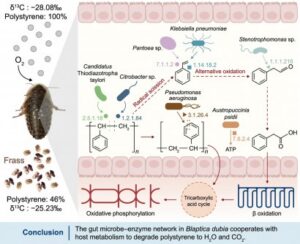
Integrated host–microbiome network driving polystyrene degradation in Blaptica dubia. Credit: Environmental Science and Ecotechnology
The findings, published February 25 in Environmental Science and Ecotechnology, reveal a sophisticated three-way collaboration between the insect host, its gut microbiome, and specialized enzymes that enables both rapid depolymerization of polystyrene and metabolic assimilation of the breakdown products.
Cockroaches degrade ingested polystyrene
In controlled feeding experiments, the cockroaches consumed an average of 6.0 mg of polystyrene per individual per day. Over 42 days, they removed 54.9% of ingested plastic, corresponding to a specific degradation rate of 3.3 mg per cockroach per day, 10 times higher than rates reported in mealworms, superworms and other plastic-degrading insects.
Gel permeation chromatography revealed significant polymer breakdown, with number-average molecular weight decreasing by 46.4%. FTIR, NMR, thermogravimetric and Py-GC/MS analyses detected newly formed oxygen-containing functional groups, demonstrating oxidative chain scission and aromatic ring modification.
Stable carbon isotope analysis showed enrichment of δ¹³C in residual plastic, confirming preferential metabolic utilization of lighter carbon isotopes, which is a strong indication of biological reactions.
Metagenomic sequencing showed that polystyrene feeding reshaped the gut microbiome toward plastic-degrading taxa such as Pseudomonas, Citrobacter, Klebsiella and Stenotrophomonas, accompanied by enrichment of oxidoreductases and transferases. Network analysis showed tightly connected microbe-enzyme modules driving aromatic oxidation.
Meanwhile, host transcriptomics revealed strong upregulation of β-oxidation, NADH dehydrogenase, oxidative phosphorylation and TCA cycle pathways, indicating that microbial degradation intermediates were absorbed and metabolically integrated. Together, these findings outline a synergistic cascade: microbial oxidative depolymerization followed by host energy assimilation.
Metabolic collaboration
“This work demonstrates that plastic degradation in insects is not merely a microbial phenomenon, but a fully integrated metabolic collaboration,” said the study’s corresponding author. “The cockroach does not simply fragment polystyrene; it metabolically processes the breakdown products through its own energy pathways. The coupling of microbial oxidation with host β-oxidation and the TCA cycle represents a systemic adaptation to synthetic carbon sources.”
This tripartite host-microbe-enzyme cooperation explains the unusually high degradation efficiency. The system achieves what isolated components cannot: microbial enzymes depolymerize the plastic, bacteria process initial intermediates, and the cockroach host recovers energy from the resulting metabolites through its native metabolic machinery.
The discovery expands the biological toolkit available for addressing plastic pollution, which now exceeds 400 million tons of global production annually. Polystyrene remains one of the most environmentally persistent polymers due to its aromatic backbone and chemically stable carbon-carbon bonds. Once fragmented into microplastics, it accumulates in soils and aquatic systems with few natural degradation pathways.
Rather than relying solely on isolated enzymes or engineered microbes, future strategies may draw inspiration from integrated host-microbiome systems capable of both depolymerization and carbon reutilization.
Although direct environmental release of cockroaches that includes more than 4,400 species around the world is not currently practical or advisable, decoding their metabolic networks could inform synthetic biology approaches, microbial consortia design or enzyme engineering platforms for plastic waste valorization. More broadly, the findings suggest that insects may possess unexpected evolutionary flexibility to adapt to anthropogenic polymers, offering a new paradigm for sustainable bioremediation in a plastic-dominated world.
A New Paradigm for Anthropogenic Polymers
More broadly, the findings suggest that insects, which have evolved over hundreds of millions of years to exploit diverse carbon sources, may possess unexpected evolutionary flexibility to adapt to anthropogenic polymers introduced only decades ago. This rapid metabolic adaptation offers a new paradigm for sustainable bioremediation in an increasingly plastic-dominated world.
The research demonstrates that nature may already possess sophisticated solutions to modern waste challenges, solutions that become accessible once we understand the systems-level integration of microbial, enzymatic, and host metabolism.