Scientists have discovered a completely new type of opal formed by a common seaweed which harnesses natural technology by self-assembling a nanostructure of oil droplets to control how light reflects from its cells to display a shimmering array of colors that until now, has only been seen in the gemstone.
The findings, published in Science Advances and led by Drs. Heather Whitney and Ruth Oulton from the University of Bristol, show that the bright blue and green iridescent sheen from the brown algae seaweed, also known as “rainbow wrack” (Cystoseira Tamariscifolia) and commonly found throughout the European costal region including the UK, arises from a complex nanostructure that controls how light reflects from its cells containing chloroplasts. Even more remarkable, is how these seaweeds can switch this self-assembly on and off, creating changing opals which react to the changing sunlight in tidal rockpools.
Such structures arise from nanosized spheres packed tightly in a regular way and are known to optics experts to reflect different colors from incoming white light into different directions. These types of structures are also seen naturally in gem stone opals, which comprise a nanostructure of tiny spheres of glass formed within hard stone deep below the earth’s surface that naturally pack together in such a way that they diffract light into different directions giving the opal it’s well-known opalescence.
Oulton, Professor Martin Cryan, and Dr. Martin Lopez-Garcia (now at the International Iberian Nanotechnology Institute, Portugal), all experts in nano-optics in Bristol’s School of Physics and Department of Electrical Engineering, discovered that these natural, “living” opals form not from glass but from tiny oil droplets made by the seaweed.
In a process unknown to present nanotechnology, the seaweed’s chloroplasts-containing cells (which aid photosynthesis) self-assembles the oil droplets into a regular packing. Surprisingly, these seaweeds can switch this self-assembly on and off, creating changing opals which react to the changing sunlight in tidal rockpools. Even more remarkable is how the seaweed performs the dynamic self-assembly, over a timescale of just hours, is a true mystery to the research team.
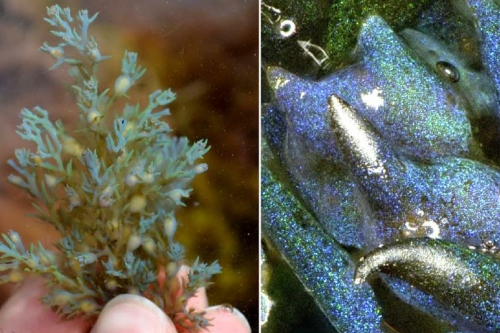
Morphology and structural color of the brown algae seaweed known as Cystoseira Tamariscifolia. Image: University of Bristol
Lopez-Garcia says, “The formation of opals from oil droplets is a completely new discovery. If nanotechnologists were able to understand and mimic the dynamic properties of this seaweed opal, we may in the future have biodegradable, switchable display technology that may be used in packaging or very efficient, low cost solar cells.”
Nathan Masters, a PhD student in the Schools of Physics and Biological Sciences at Bristol, discovered that by shining light onto the seaweed, the iridescence disappeared, but when kept in almost dark conditions, the blue-green sheen reappeared. By imaging the seaweed at a sub-nanoscale level, the team discovered that the seaweed was switching on and off the self-assembly, going from a disordered, unreflective state to an ordered, opalescent one. But most surprising to the research team was that the opal is dynamic.
Why the seaweed does this remains to be proven, but Whitney and Dr. Heath O’Brien, who carried out the work while at Bristol’s School of Biological Sciences, (now at Cardiff University), believe that because the opals sit in the same part of the cell as the chloroplasts — the light energy harvesting bodies of the organism — they are likely to be controlling the light levels, scattering the light evenly to all the available chloroplasts inside the cell. This may help the seaweed cope with different light levels during high and low tide.
Oulton, Reader in Quantum Photonics in the School of Physics and Department of Electrical and Electronic Engineering, adds, “In the past decade, nanotechnologists have been able to make artificial opals out of similar glass nanospheres. But it seems that the humble seaweed is also able to make such artificial opals in its cells. So next time you’re rock pooling in the U.K. during your summer holidays, see if you can find this amazing seaweed with its nano-manufacturing technology.”
The study was funded by the European Research Council (ERC) and the U.K.’s Engineering and Physical Sciences Research Council (EPSRC).
Source: University of Bristol