Research & Development World

  • R&D World Home
  • Topics
    • Aerospace
    • Automotive
    • Biotech
    • Careers
    • Chemistry
    • Environment
    • Energy
    • Life Science
    • Material Science
    • R&D Management
    • Physics
  • Technology
    • 3D Printing
    • A.I./Robotics
    • Software
    • Battery Technology
    • Controlled Environments
      • Cleanrooms
      • Graphene
      • Lasers
      • Regulations/Standards
      • Sensors
    • Imaging
    • Nanotechnology
    • Scientific Computing
      • Big Data
      • HPC/Supercomputing
      • Informatics
      • Security
    • Semiconductors
  • R&D Market Pulse
  • R&D 100
    • 2025 R&D 100 Award Winners
    • 2025 Professional Award Winners
    • 2025 Special Recognition Winners
    • R&D 100 Awards Event
    • R&D 100 Submissions
    • Winner Archive
  • Resources
    • Research Reports
    • Digital Issues
    • Educational Assets
    • Subscribe
    • Video
    • Webinars
    • PharmSci360
    • Content submission guidelines for R&D World
  • Global Funding Forecast
  • Top Labs
  • Advertise
  • SUBSCRIBE

Fish Get Arthritis, Too

By University Of Southern California | July 14, 2016

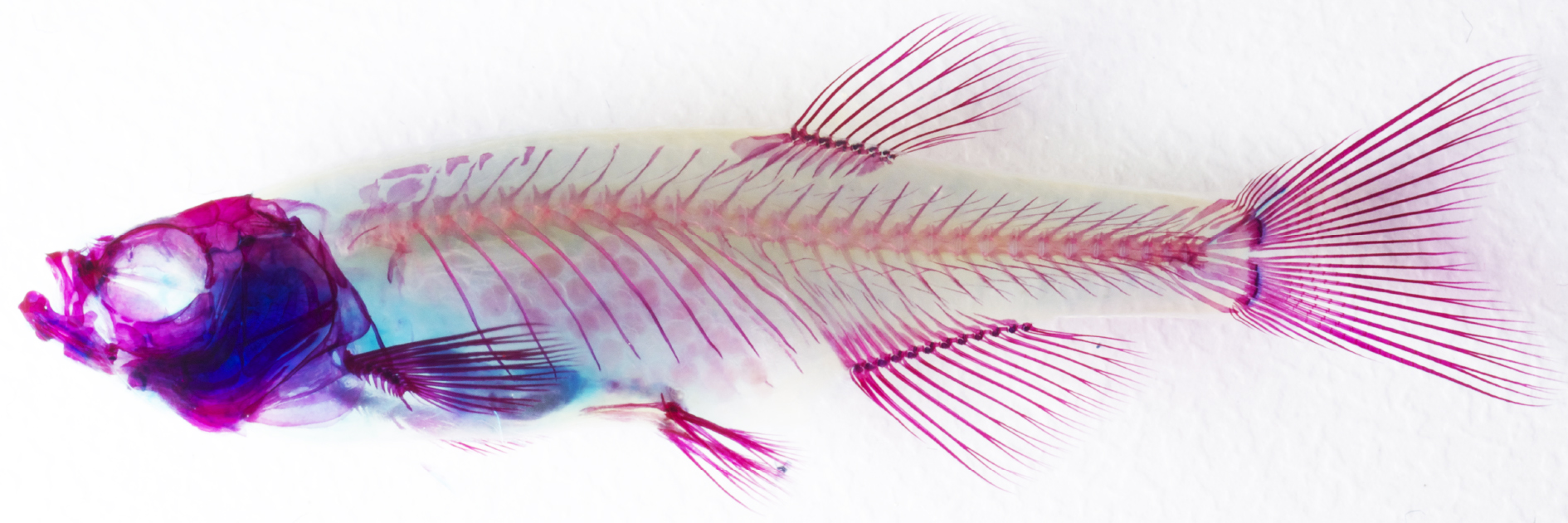
An adult zebrafish skeleton is stained for bone (purple) and cartilage (blue). Credit: USC/Gage Crump Lab

The very first bony fish on Earth was susceptible to arthritis, according to a USC-led discovery that may fast-track therapeutic research in preventing or easing the nation’s most common cause of disability.

The finding contradicts the widely held belief that lubricated joints enabling mobility — called synovial joints — evolved as vertebrates ventured onto land. For example, human knees and hips have synovial joints, which are highly susceptible to osteoarthritis.

Pixar’s Dory, zebrafish and other ray-finned fish have synovial joints that can get creaky. Thus, these fish are susceptible to arthritis.

“Developing the first arthritis model in the zebrafish — an emerging regenerative model for medical research — opens up fundamentally new approaches toward finding a cure for arthritis,” said Gage Crump, senior author and an associate professor of stem cell biology and regenerative medicine at the Keck School of Medicine of USC. “While arthritis is the leading cause of disability in the United States, there are no treatments beyond artificial joint replacement. Our research offers new hope for finding a biological cure.”

Amjad Askary and Joanna Smeeton from Crump’s laboratory have found that certain joints in the zebrafish jaw and fins have features that resemble the synovial joints found in mammals. The similarity makes sense because water resistance places considerable strain on joints. The study will be published in the journal eLife on July 19.

Arthritis affects more than 52 million people or about 23 percent of adults, according to the Centers for Disease Control and Prevention. Aging baby boomers will spike that number to 78 million – or about 26 percent of adults – by the year 2040.

How zebrafish are like us

Four-limbed bony vertebrates such as humans evolved from lobe-finned fish. However, a good laboratory model for this group does not exist, so instead the researchers focused their inquiry on zebrafish, a member of the more evolutionarily distant ray-finned fish.

Using CT scans and genetic tools, the scientists noted that two other ray-finned fish – the three-spined stickleback and the spotted gar – also have synovial joints that produce a protein very similar to what lubricates joints in humans. It is aptly named Lubricin.

Previous research showed that humans and mice lacking Lubricin have poor joint lubrication and develop early onset arthritis. Askary, Smeeton and their colleagues found that removing the Lubricin gene from the zebrafish genome causes the same early onset arthritis in their jaws and fins.

Given that fish and humans diverged hundreds of millions of years ago, when bony vertebrates first evolved, this similarity in arthritis susceptibility reveals that synovial joints are at least as ancient as bone itself.

“Creating the first genetic osteoarthritis model in a fish is exciting,” Crump said. “Going forward, it will be fascinating to explore whether the zebrafish, which is well known for its regenerative abilities, can also naturally repair its damaged joints.”

Related Articles Read More >

Beyond the sequence: how Ötzi the Iceman exposed the blind spots of pure metagenomics
Breakthrough in the Discovery of DNA in Ancient Bones Buried in Water
Traces of Crawling in Italian Cave Give Clues to Ancient Humans’ Social Behavior
Freshwater Mussel Shells Were Material of Choice For Prehistoric Craftsmen
rd newsletter
EXPAND YOUR KNOWLEDGE AND STAY CONNECTED
Get the latest info on technologies, trends, and strategies in Research & Development.

R&D World Digital Issues

Fall 2025 issue

Browse the most current issue of R&D World and back issues in an easy to use high quality format. Clip, share and download with the leading R&D magazine today.

R&D 100 Awards
Research & Development World
  • Subscribe to R&D World Magazine
  • Sign up for R&D World’s newsletter
  • Contact Us
  • About Us
  • Drug Discovery & Development
  • Pharmaceutical Processing
  • Global Funding Forecast

Copyright © 2026 Arrowfly LLC. All Rights Reserved. The material on this site may not be reproduced, distributed, transmitted, cached or otherwise used, except with the prior written permission of Arrowfly
Privacy Policy | Advertising | About Us

Search R&D World

  • R&D World Home
  • Topics
    • Aerospace
    • Automotive
    • Biotech
    • Careers
    • Chemistry
    • Environment
    • Energy
    • Life Science
    • Material Science
    • R&D Management
    • Physics
  • Technology
    • 3D Printing
    • A.I./Robotics
    • Software
    • Battery Technology
    • Controlled Environments
      • Cleanrooms
      • Graphene
      • Lasers
      • Regulations/Standards
      • Sensors
    • Imaging
    • Nanotechnology
    • Scientific Computing
      • Big Data
      • HPC/Supercomputing
      • Informatics
      • Security
    • Semiconductors
  • R&D Market Pulse
  • R&D 100
    • 2025 R&D 100 Award Winners
    • 2025 Professional Award Winners
    • 2025 Special Recognition Winners
    • R&D 100 Awards Event
    • R&D 100 Submissions
    • Winner Archive
  • Resources
    • Research Reports
    • Digital Issues
    • Educational Assets
    • Subscribe
    • Video
    • Webinars
    • PharmSci360
    • Content submission guidelines for R&D World
  • Global Funding Forecast
  • Top Labs
  • Advertise
  • SUBSCRIBE