Research & Development World

  • R&D World Home
  • Topics
    • Aerospace
    • Automotive
    • Biotech
    • Careers
    • Chemistry
    • Environment
    • Energy
    • Life Science
    • Material Science
    • R&D Management
    • Physics
  • Technology
    • 3D Printing
    • A.I./Robotics
    • Software
    • Battery Technology
    • Controlled Environments
      • Cleanrooms
      • Graphene
      • Lasers
      • Regulations/Standards
      • Sensors
    • Imaging
    • Nanotechnology
    • Scientific Computing
      • Big Data
      • HPC/Supercomputing
      • Informatics
      • Security
    • Semiconductors
  • R&D Market Pulse
  • R&D 100
    • 2025 R&D 100 Award Winners
    • 2025 Professional Award Winners
    • 2025 Special Recognition Winners
    • R&D 100 Awards Event
    • R&D 100 Submissions
    • Winner Archive
  • Resources
    • Research Reports
    • Digital Issues
    • Educational Assets
    • Subscribe
    • Video
    • Webinars
    • PharmSci360
    • Content submission guidelines for R&D World
  • Global Funding Forecast
  • Top Labs
  • Advertise
  • SUBSCRIBE

Gold Nanoparticles Used in New Cancer Monitoring Technology

By University of Queensland | April 19, 2018

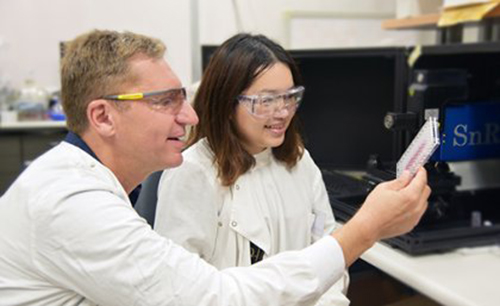
Professor Matt Trau and PhD student Jing Wang

A new blood test using gold nanoparticles could soon give oncologists an early and more accurate prognosis of how cancer treatment is progressing and help guide the ongoing therapy of patients.

Researchers at The University of Queensland have developed new nanotechnology to monitor the diversity of individual cancer cells circulating in the body.

In close collaboration with oncologists at the Olivia Newton John Cancer Research Institute (ONJCRI), the technology was tested on blood samples from melanoma patients and was able to track critical changes in spreading tumor cells before, during and after treatment.

UQ’s Australian Institute for Bioengineering and Nanotechnology (AIBN) PhD student Jing Wang says the simple nanotechnology looked at changes in circulating tumor cells, which could indicate whether a cancer is attempting to spread and reveal its response to treatment.

“Circulating tumor cells (CTCs) have been shed by the original tumor and entered the bloodstream — they can then form into new tumors if they lodge in distant tissue,” Wang says.

“CTCs can be found in the blood by looking for distinctive proteins on their surface, but the current process is time consuming and can typically only identify one type of CTC protein at a time.”

Wang says this was an issue because the types of proteins on the surfaces of CTCs could vary from one type of cancer to another, and even within in the same cancer.

“If you go looking for just one kind of protein, you can miss a lot of CTCs,” she says.

“We have developed a simple technology which uses a special type of gold nanoparticle attached to different antibodies, which can stick to different proteins on a wide variety of CTCs.

“These nanoparticles emit a unique barcoded signal when hit with laser light, and this signal changes ever so slightly if that nanoparticle encounters a CTC and sticks to it, making them easy to detect.”

With the help of oncology collaborators at the ONJCRI, the researchers demonstrated that the diagnostic approach could be easily translated to the clinic.

The gold nanoparticle technology was tested on blood samples taken from melanoma patients during of the course of cancer treatment.

The technology successfully tracked in real-time how the diversity of tumor cell populations were changing in response to particular therapies for all of the patients studied, and was highly predictive of treatment effectiveness and patient outcomes.

AIBN researcher Professor Matt Trau says they hope the technology can be developed into a simple hand-held device.

“The gold nanoparticle technology is easy to use and extremely sensitive to CTC diversity — it can detect multiple types simultaneously down to as few as 10 CTCs in a 1 milliliter blood sample — and we saw dramatic changes during treatment for all patients studied,” Trau says.

Olivia Newton John Cancer Research Institute’s Medical Director Professor Jonathan Cebon says having information about changes at a cellular level had the potential to guide cancer therapy in real-time.

“Signs of drug resistance can be identified which can help doctors and patients make informed decisions about treatment,” Cebon says.

“The technology could also greatly improve our ability to study how tumor cells change in response to treatment and could help answer important biological questions about how treatment resistance arises.”

The study has been published in Nature Communications.

Source: University of Queensland
Related Articles Read More >

Researchers developed quantum nanosensors that can measure the temperature of a single cell
Overcoming the 100-nanometer barrier: New microbottle resonators scale up optical trapping
R&D 100 winner LLNL achieves 1,000x speed boost in 3D nanofabrication
CEA-Leti achieves 400°C CMOS fabrication milestone for 3D chip stacking
rd newsletter
EXPAND YOUR KNOWLEDGE AND STAY CONNECTED
Get the latest info on technologies, trends, and strategies in Research & Development.

R&D World Digital Issues

Fall 2025 issue

Browse the most current issue of R&D World and back issues in an easy to use high quality format. Clip, share and download with the leading R&D magazine today.

R&D 100 Awards
Research & Development World
  • Subscribe to R&D World Magazine
  • Sign up for R&D World’s newsletter
  • Contact Us
  • About Us
  • Drug Discovery & Development
  • Pharmaceutical Processing
  • Global Funding Forecast

Copyright © 2026 Arrowfly LLC. All Rights Reserved. The material on this site may not be reproduced, distributed, transmitted, cached or otherwise used, except with the prior written permission of Arrowfly
Privacy Policy | Advertising | About Us

Search R&D World

  • R&D World Home
  • Topics
    • Aerospace
    • Automotive
    • Biotech
    • Careers
    • Chemistry
    • Environment
    • Energy
    • Life Science
    • Material Science
    • R&D Management
    • Physics
  • Technology
    • 3D Printing
    • A.I./Robotics
    • Software
    • Battery Technology
    • Controlled Environments
      • Cleanrooms
      • Graphene
      • Lasers
      • Regulations/Standards
      • Sensors
    • Imaging
    • Nanotechnology
    • Scientific Computing
      • Big Data
      • HPC/Supercomputing
      • Informatics
      • Security
    • Semiconductors
  • R&D Market Pulse
  • R&D 100
    • 2025 R&D 100 Award Winners
    • 2025 Professional Award Winners
    • 2025 Special Recognition Winners
    • R&D 100 Awards Event
    • R&D 100 Submissions
    • Winner Archive
  • Resources
    • Research Reports
    • Digital Issues
    • Educational Assets
    • Subscribe
    • Video
    • Webinars
    • PharmSci360
    • Content submission guidelines for R&D World
  • Global Funding Forecast
  • Top Labs
  • Advertise
  • SUBSCRIBE