Image from Google’s Imagen 4 Ultra
Every lab has a Friday-night freezer story. The alarm chirps, people scramble, and someone winds up babysitting samples with a clipboard that was never meant to be a forensic record.
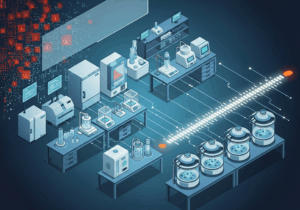
As instruments fill the lab and teams shift from wielding pipettes to orchestrating cloud workflows and collaborating with AI agents, the margin for ad hoc workflows is thinning. Lab managers are asking bench scientists to help stand up a connected, auditable infrastructure: environmental and process equipment streaming into a unified dataset instead of a patchwork of point solutions. That means a single instrumentation backbone where freezers, incubators, balances, and bioreactors speak a common data language; where utilization and drift are visible in near real time; and where decisions, from maintenance to batch release, can stand up to both regulators and regression tests. Doing this across mixed vendors and protocols is non-trivial, as seen in other domains building multi-source fusion layers and industrial twins. Any serious platform now has to talk to almost everything, layer in context before it calls for attention, and keep capturing and buffering data at the edge when networks, or even power, cut out.
Elemental Machines is one of the groups working on that connective layer, securely processing hundreds of millions of data points a day and offering a pragmatic path from basic monitoring to enterprise analytics. In the following interview with Rob Estrella, CEO of Elemental Machines, we explore connector breadth and cadence, a three-tier BI maturity model with concrete outcomes, how context reduces noise and downtime, de-identified findings on utilization and cost savings, and how edge capabilities preserve data integrity when power or networks fail.
R&D World: What is the backstory on your decision to join, and eventually become the CEO of, Elemental Machines?
Estrella: I joined Elemental Machines because of my career-long focus on helping scale data-driven platforms for real-world operations. The team here was already solving hard LabOps problems, and I saw an opportunity to help expand the impact of that service. After leading our commercial efforts and working closely with product and customers, stepping into the CEO role in 2025 was a natural next chapter. My general approach has been to keep what works, double-down on reliability, and continuously grow the value we deliver from R&D to GMP.
R&D World: Across your installed base, how many assets are connected today, what’s the typical data sampling rate per asset, and what daily event/record volume does your platform process? What types of labs are you seeing the most traction with?
Estrella: We don’t publish asset counts, but the platform securely processes hundreds of millions of data points daily across tens of thousands of connected instruments worldwide. Sampling rates vary based on the asset, from every few seconds for fast-changing signals to episodic or daily sampling for slower processes. Each device is tuned to balance fidelity, battery life, and uptime. We see strong traction across the spectrum, from early R&D to large-scale GMP and GxP manufacturing, where data integrity and reliability are nonnegotiable.
R&D World: How many distinct instrument models/vendors do you support out of the box today, and what’s your monthly cadence for adding new connectors?
Estrella: Our integration library is one of the most extensive in the industry, covering thousands of instrument types from nearly every major manufacturer you can think of, from freezers to incubators and balances to bioreactors. Our dedicated integrations team continuously adds to this library based on customer demand and new equipment that arrives on the market. And when a customer has a specialized device, our team works fast to bring it online so every data point contributes to enhanced decision-making.
R&D World: How do you define the three tiers of BI maturity you mention (objective criteria)? For a lab moving from one tier to another, what are the typical time frames, staffing requirements, and measurable outcomes achieved at each step?
Estrella: We use three tiers that share the same data foundation:
- Tier 1 is our Platform, with live monitoring, alerts, dashboards, basic exports, and more; it provides the fastest time-to-value and minimal IT effort
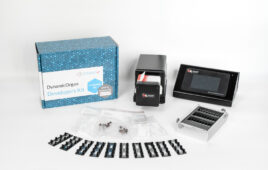
- Tier 2 is Dynamic Data Insights, with our built-in BI tool and data warehouse for trends, custom reports, and equipment health scoring
- Tier 3 is our Connected Data Ecosystem for enterprise BI and cross-source analytics for forecasting and portfolio decisions
Time frames and staffing depend on scale and customer SOPs. A single-site lab can benefit tremendously from Tier 1, and multisite programs implementing Tiers 2 or 3 typically roll out in phases aligned to validation and change control. But even smaller organizations could benefit from higher tiers. The outcomes we look for are fewer escalations, faster investigations, higher asset uptime, and better capital planning that’s based on real utilization data, not guesswork.

Rob Estrella
R&D World: For environmental and equipment anomalies, what are your current precision/recall (or false-positive/false-negative) rates by asset type? What’s the median time to detect and to acknowledge/resolve before vs after deployment?
Estrella: It varies. Our focus is actionable, accurate data flowing from all asset types to customer dashboards. We fuse equipment signals with context (e.g., location, shift, process state) to reduce noise and reveal hidden issues within minutes — often before user-visible alerts. Customers report faster acknowledgment and resolution because alerts are routed with history and context, so they benefit from less chasing and more fixing. Plus, where SOPs allow it, trend-based analytics (e.g., health scores) can flag drift days or even weeks in advance.
R&D World: Could you provide a couple of de-identified case studies with baseline and post-deployment results (e.g., utilization increases, downtime reductions, $ saved)?
Estrella: Here are two quick examples:
- Cold storage risk: Using our AI-Powered Freezer Health Score, one team included early warnings in their weekly reviews, triggering preventive maintenance and avoiding potential losses approaching $1M; unfortunately, another team ignored declining scores and absorbed $120,000 in spoilage — not to mention a negative impact on their schedule
- Utilization & maintenance strategy: In a multisite flow-cytometry program, analyzing usage patterns predicted large savings; models revealed more than $1.6M in total maintenance cost savings
R&D World: During network or cloud outages, how long can edge devices buffer data?
Estrella: Resilience is built into every layer of our ecosystem. Devices keep collecting via onboard battery for hours after an outage. If the customer network goes down, we shift to cellular without intervention or interruption. In the rare case that both power and network become unavailable, our system can store weeks of data locally, then auto-sync when connectivity is restored.