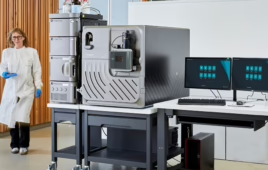
The modern laboratory is no longer defined just by glassware and chemicals; it is a highly connected, electrified ecosystem. Current practice is moving toward software-defined, modular and remotely accessible laboratories. From everyday power supplies to complex, automated network architectures, electronic equipment forms the backbone of contemporary research and development.
Adobe
Foundational lab electronics
Modern labs have evolved into Internet of Things (IoT) hubs featuring touchscreen interfaces, automatic internal calibration and Bluetooth and Wi-Fi connectivity to Laboratory Information Management Systems (LIMS).
Digital multimeters
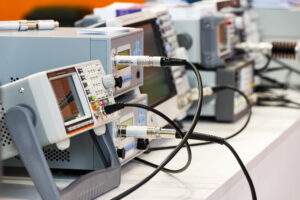
The digital multimeter is the foundational instrument in nearly every laboratory because it provides basic electrical measurements such as voltage, current, resistance, continuity and related troubleshooting functions. In an academic lab, it is often the first instrument students learn; in an industrial or maintenance lab, it is the first instrument used for fault isolation. A key point in professional selection is that a multimeter is not judged only by its measurement range, but also by its safety category rating and suitability for the environment in which it will be used.
Oscilloscopes and probes
Oscilloscopes are used to view waveform shape, amplitude, timing relationships, rise and fall behavior, noise and transient events. Their usefulness depends not only on the instrument itself but also on the correct selection of probes and compensation. The probe must match the measurement task and input capacitance, while high-voltage or floating measurements may require isolated or differential probing. Tektronix’s isolated probe literature further shows that advanced high-bandwidth measurements increasingly rely on galvanically isolated probe systems for safety and signal fidelity.
Function generators and arbitrary waveform generators
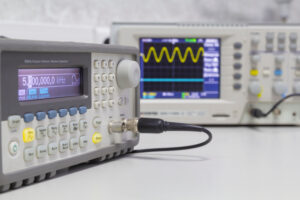
Electronic circuits must be stimulated by function generators or arbitrary waveform generators before they can be evaluated. These instruments provide sine, square, ramp, pulse and custom waveforms for testing amplifiers, filters, digital interfaces, control systems and sensor-conditioning circuits. Function generators are economical tools for standard waveforms, while arbitrary waveform capability is important for reproducing real or non-standard signals. These instruments convert the lab from a passive observation space into an active experimental environment.
DC power supplies and electronic loads
A laboratory also needs controlled power delivery. Bench DC power supplies provide adjustable, stable voltage and current to the device under test. Their selection depends on the output power, voltage and current range, channel count, noise, response time and whether outputs need to be isolated or tracked together. Complementing the power supply is the electronic load, which sinks power instead of sourcing it. Electronic loads are used to test batteries, converters, chargers and power supplies under realistic or dynamic loading conditions, making them especially important in power electronics laboratories.
LCR meters and source measure units
LCR meters measure inductance, capacitance, resistance and complex impedance, which makes them valuable for component evaluation, materials testing and frequency-dependent behavior analysis. Source measure units (SMUs) combine sourcing and measurement in one instrument, enabling accurate current-voltage characterization of semiconductors, sensors and low-power devices. SMUs can source and measure voltage and current simultaneously, which is why they are common in device characterization and automated test systems.
Logic analyzers, spectrum analyzers and DAQ systems
As circuits become more digital and more connected, specialized instruments are needed. Logic analyzers capture and analyze multiple digital signals at once and are useful when debugging buses, timing relationships and protocol behavior. Spectrum analyzers, by contrast, view signals in the frequency domain, making them essential in RF, EMC precompliance, wireless design and signal-integrity work. Data-acquisition systems extend the lab beyond a single channel, providing multichannel measurement, switching and logging for electrical, mechanical or environmental variables. Together, these tools allow the lab to move from simple circuit observation to system-level validation.
Assembly, rework and ESD control
A productive electronic lab needs more than measurement hardware. It also requires safe, repeatable assembly and rework equipment, especially temperature-controlled soldering stations and related hand tools. For sensitive devices, the soldering environment should be part of an electrostatic discharge (ESD) control program. The EOS/ESD Association recommends defining electrostatic protected areas, reducing charge generation and using grounding, ionization and conductive or dissipative materials. Commercial soldering platforms increasingly reflect this requirement by advertising ESD-safe operation and integrated process control. Assembly quality and measurement quality are linked because a damaged or ESD-stressed component can invalidate later test results.
Safety, certification and calibration
IEC 61010-1 sets general safety requirements for electrical equipment used in measurement, control and laboratory settings. OSHA warns that laboratories may expose workers to shock, arc blast, fire and explosion hazards arising from faulty instrumentation, wiring, connectors or unsafe work practices. OSHA’s Nationally Recognized Testing Laboratory program provides the framework under which certain electrical products are tested and certified for workplace use. NFPA 70E complements this landscape by defining electrical safe-work practices intended to reduce exposure to major electrical hazards.
Adobe
Calibration is the second pillar of laboratory credibility. The International Vocabulary of Metrology (VIM) defines metrological traceability as a property of a measurement result that can be related to a reference through a documented, unbroken chain of calibrations, each contributing to measurement uncertainty. This matters directly to lab equipment because an instrument that is safe but unverified can still produce unusable data. NIST also states that it does not prescribe a single recalibration interval for all instruments; intervals should instead be determined according to the instrument, the application and the risk of drift. ISO/IEC 17025 sets competence requirements for testing and calibration laboratories for reliable and valid results.
Criteria for selecting lab equipment
The best way to select electrical and electronic lab equipment is to begin with the measurement task. For a multimeter, the important questions are range, accuracy, resolution and CAT rating. For an oscilloscope, they are bandwidth, waveform fidelity and probe suitability. For a power supply, they are voltage, current, channel count, isolation, noise and response. For an impedance instrument or SMU, they are precision, source-measure capability and automation requirements. Across all equipment classes, traceability, calibration support, repairability and software integration strongly affect long-term value. This means the “best” instrument is not the one with the most features; it is the one that meets the task requirements with an adequate safety margin and acceptable uncertainty.
Emerging trends in modern laboratories
Recent development is moving the laboratory toward modular, software-defined and remote-access models. NI’s PXI platform materials emphasize compact modular architecture, built-in timing and synchronization and software integration for complex automotive test systems. This is attractive in research and production because one chassis can replace multiple stand-alone instruments while remaining reconfigurable. Keysight’s education materials describe remote-access lab solutions that allow students to work with industry-grade equipment over the web. These trends suggest that the future lab will be less dependent on fixed bench layouts and more dependent on shared instrumentation, automation software and networked access.
Conclusion
Electrical and electronic lab equipment should be understood as an integrated infrastructure for experimentation, diagnosis, validation and safe operation. Core instruments such as multimeters, oscilloscopes, power supplies, waveform generators, LCR meters, logic analyzers, spectrum analyzers, DAQ systems, SMUs and electronic loads each address a different layer of the testing problem. However, their real value emerges only when they are supported by proper probes, ESD controls, certified safety design, calibration traceability and competent operating procedures. A well-designed laboratory, therefore, balances three goals: measurement capability, operator safety and data credibility. Laboratories that achieve this balance are better suited for education, research, maintenance and advanced product development.