Research & Development World

  • R&D World Home
  • Topics
    • Aerospace
    • Automotive
    • Biotech
    • Careers
    • Chemistry
    • Environment
    • Energy
    • Life Science
    • Material Science
    • R&D Management
    • Physics
  • Technology
    • 3D Printing
    • A.I./Robotics
    • Software
    • Battery Technology
    • Controlled Environments
      • Cleanrooms
      • Graphene
      • Lasers
      • Regulations/Standards
      • Sensors
    • Imaging
    • Nanotechnology
    • Scientific Computing
      • Big Data
      • HPC/Supercomputing
      • Informatics
      • Security
    • Semiconductors
  • R&D Market Pulse
  • R&D 100
    • 2025 R&D 100 Award Winners
    • 2025 Professional Award Winners
    • 2025 Special Recognition Winners
    • R&D 100 Awards Event
    • R&D 100 Submissions
    • Winner Archive
  • Resources
    • Research Reports
    • Digital Issues
    • Educational Assets
    • Subscribe
    • Video
    • Webinars
    • PharmSci360
    • Content submission guidelines for R&D World
  • Global Funding Forecast
  • Top Labs
  • Advertise
  • SUBSCRIBE

KERI’s new approach tackles lithium-sulfur battery’s commercialization hurdles

By Heather Hall | January 21, 2025

A research team at the Korea Electrotechnology Research Institute (KERI) has reported progress in addressing longstanding challenges that have hindered the commercialization of lithium-sulfur batteries. Dr. Park Jun-woo led the team, which focused on the “shuttle effect,” lithium polysulfides formed during charging and discharging migrate between the electrodes. This phenomenon has often resulted in performance declines and shortened battery life.
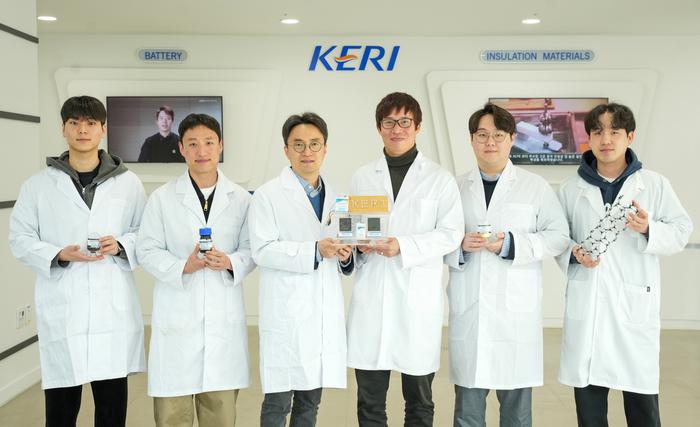
Dr. Park Jun-woo’s team at KERI (fourth from the left) overcame the limitations of next-generation lithium-sulfur batteries by combining carbon nanotubes and oxygen functional groups.

The group introduced single-walled carbon nanotubes (SWCNTs) treated with oxygen functional groups to control the shuttle effect. SWCNTs(1) combine high strength with electrical conductivity, while the oxygen functional groups(2) improve the material’s dispersion. This setup helps stabilize electrodes that expand during repeated charging and discharging, reducing the loss of sulfur and preventing polysulfide diffusion.

By applying this method, the team developed a uniform, flexible, thick electrode(3) measuring 50 × 60 mm and built a 1,000  mAh pouch-type lithium-sulfur battery prototype(4). After 100 charge-discharge cycles, the prototype retained over 85% of its initial capacity. According to KERI, the approach could open avenues for practical uses of lightweight and cost-effective lithium-sulfur batteries, especially in urban air mobility (UAM), aerospace, and electric vehicles (EVs).

The study was published in Advanced Science, and KERI has applied for a domestic patent covering the technology. The institute hopes its findings will appeal to companies looking for next-generation energy solutions.


(1) Carbon Nanomaterials are characterized by nanoscale conductivity and a hexagonal carbon structure. They include graphene, often called a “dream material,” and carbon nanotubes (CNTs), essentially graphene layers rolled into tubes. Single-walled CNTs are thinner, more transparent, and exhibit higher conductivity than multi-walled types.
(2) Functional Group: A group of atoms (or a single atom) with specific chemical and physical properties influencing how a molecule interacts with its environment.
(3) Thick Electrode: A design that increases a battery’s energy density by packing more active material into the electrode.
(4) mAh (milliampere-hour): A unit of electric charge. One mAh corresponds to the amount of current (in milliamperes) that can be drawn for one hour. One thousand mAh equals 1 Ah.
Comments

  1. Bob Zeitlinger says

    January 22, 2025 at 4:21 pm

    I think you should google Lyten or go to Lyten.com to see a company on the cusp of commercializing lithium sulfur batteries.

Related Articles Read More >

SwRI and SMU join push to engineer solid-state battery interfaces
UC San Diego engineers found a short-cut to higher-energy recycled EV batteries 
Researchers use hydrothermal carbonization to turn distillery waste into supercapacitor electrodes
175 Wh/kg: How CATL’s Naxtra Architecture Moves Sodium-Ion Beyond the Lab
rd newsletter
EXPAND YOUR KNOWLEDGE AND STAY CONNECTED
Get the latest info on technologies, trends, and strategies in Research & Development.

R&D World Digital Issues

Fall 2025 issue

Browse the most current issue of R&D World and back issues in an easy to use high quality format. Clip, share and download with the leading R&D magazine today.

R&D 100 Awards
Research & Development World
  • Subscribe to R&D World Magazine
  • Sign up for R&D World’s newsletter
  • Contact Us
  • About Us
  • Drug Discovery & Development
  • Pharmaceutical Processing
  • Global Funding Forecast

Copyright © 2026 Arrowfly LLC. All Rights Reserved. The material on this site may not be reproduced, distributed, transmitted, cached or otherwise used, except with the prior written permission of Arrowfly
Privacy Policy | Advertising | About Us

Search R&D World

  • R&D World Home
  • Topics
    • Aerospace
    • Automotive
    • Biotech
    • Careers
    • Chemistry
    • Environment
    • Energy
    • Life Science
    • Material Science
    • R&D Management
    • Physics
  • Technology
    • 3D Printing
    • A.I./Robotics
    • Software
    • Battery Technology
    • Controlled Environments
      • Cleanrooms
      • Graphene
      • Lasers
      • Regulations/Standards
      • Sensors
    • Imaging
    • Nanotechnology
    • Scientific Computing
      • Big Data
      • HPC/Supercomputing
      • Informatics
      • Security
    • Semiconductors
  • R&D Market Pulse
  • R&D 100
    • 2025 R&D 100 Award Winners
    • 2025 Professional Award Winners
    • 2025 Special Recognition Winners
    • R&D 100 Awards Event
    • R&D 100 Submissions
    • Winner Archive
  • Resources
    • Research Reports
    • Digital Issues
    • Educational Assets
    • Subscribe
    • Video
    • Webinars
    • PharmSci360
    • Content submission guidelines for R&D World
  • Global Funding Forecast
  • Top Labs
  • Advertise
  • SUBSCRIBE