A new device created by Rutgers researchers has revolutionized the field of nanotechnology. Weighing only 1.6 milligrams, the device can lift nearly 200 times its weight.
Miniscule devices carrying matter nearly hundreds of times their own weight was once practical only in theory, but a recent Rutgers discovery has introduced a device capable of supporting over 150 times its own weight.
This device, called an actuator, is classified as nanotechnology — the science of manipulating atoms and matter less than 100 nanometers in size. As devices get smaller and smaller, nanotechnology becomes more and more significant, even being called modern history’s “sixth revolutionary technology” by the National Academy of Agricultural Sciences.
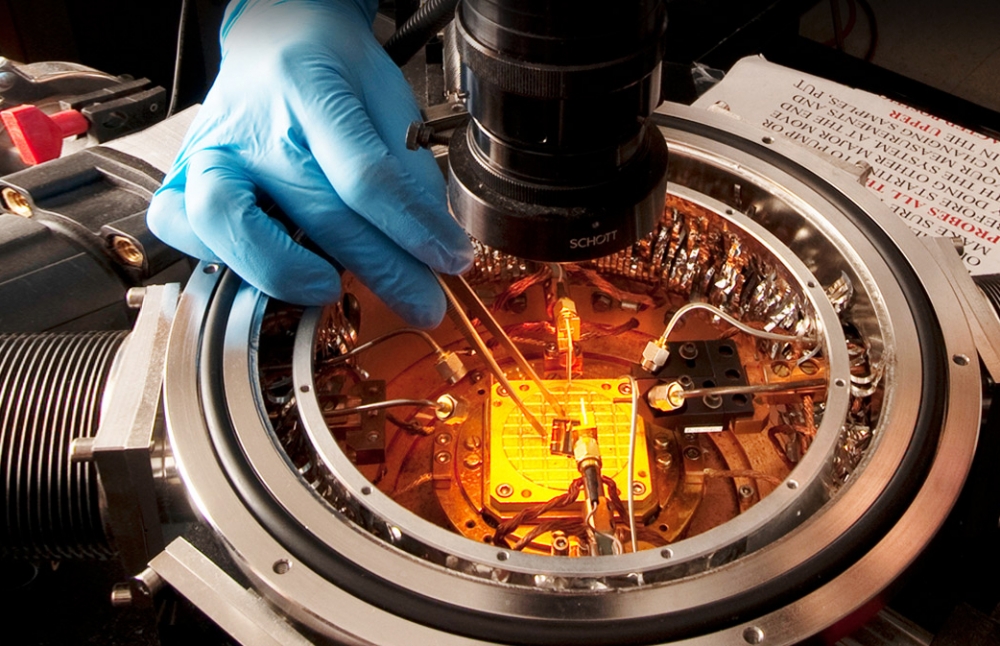
The actuator itself weighs only 1.6 milligrams according to a Rutgers Today article and consists of stacked layers of Molybdenum Disulfide (MoS2), an inorganic compound commonly used for lubricants.
Acting similar to a muscle, the actuator responds to forms of stimuli with movement, the article said.
“If you imagine sheets of paper stacked together to be atomically thin, they would be equivalent to the atomic structure of MoS2. The things we put in and out (of the sheets) are ions or charged atoms. If you apply a stimulus like voltage or heat, the (actuator acts like) muscle twitches. When it moves, it’s capable of lifting something or doing work, in the engineering speak,” says Professor and Associate Chair of Materials Science and Engineering Manish Chhowalla.
Chhowalla supervised the research and development of the actuator, which was completed by a then-graduate student, Muharrem Acerce, and supplemented by professor of Materials Science and Engineering, Koray Akdoğan. At the time, there was no direct goal of creating an actuator — they sought to study supercapacitors.
Supercapacitors parallel batteries in that they charge and discharge large amounts of energy. As Acerce was conducting experiments with supercapacitors, he noticed that the device would expand and retract from the charge and discharge of energy.
He observed this property as something potentially useful for actuators and redirected his focus to the electrochemical/mechanical transfers in actuators.
The process took approximately four years, and Acerce’s Ph.D. thesis pertaining to his research was published a year later. Those four years, however, had their fair share of obstacles, Chhowalla says.
“We ran into a lot of hurdles, mostly always scientific. There are a lot of things in principle that should work, but when you go to do the experiments, things don’t work,” she says. “Figuring out what’s going wrong and how to make it work are the key challenges.”
From a practical standpoint, the actuator could be integrated into numerous fields such as robotics and medicine. Actuators could even be applied to less obvious services, like onto drones and aircrafts to help adapt the body and wings to changing weather patterns while in the sky, Chhowalla says. The devices can theoretically be employed for any use that involves taking electrochemical energy and designing a physical reaction to it.
Actuators are already widely used in numerous fields, most commonly in mechanisms like wind turbines and valves of water pipes. With knowledge obtained from nano-actuator experiments, bulky machinery can be reduced to more space-efficient dimensions, she says.
Nanotechnology has seen a surge in research and production within the last several decades, correlating to the trend of increasingly advanced and smaller devices. As more studies and trials are completed, the larger the expanse and width of these microscopic technologies become.
Nanotechnology’s breadth is even influencing children, with organizations like the National Nanotechnology Infrastructure Network hosting science fairs and providing educational resources.
“We should care about science in general, even if there’s no end application. Fundamental research which appears to be useless leads to a lot of interesting concepts,” Chhowalla says. “Doing pure science is important, even if there’s no direct one-to-one relationship between an application and the science. You never know how science can impact.”
Source: Rutgers University