Research & Development World

  • R&D World Home
  • Topics
    • Aerospace
    • Automotive
    • Biotech
    • Careers
    • Chemistry
    • Environment
    • Energy
    • Life Science
    • Material Science
    • R&D Management
    • Physics
  • Technology
    • 3D Printing
    • A.I./Robotics
    • Software
    • Battery Technology
    • Controlled Environments
      • Cleanrooms
      • Graphene
      • Lasers
      • Regulations/Standards
      • Sensors
    • Imaging
    • Nanotechnology
    • Scientific Computing
      • Big Data
      • HPC/Supercomputing
      • Informatics
      • Security
    • Semiconductors
  • R&D Market Pulse
  • R&D 100
    • 2025 R&D 100 Award Winners
    • 2025 Professional Award Winners
    • 2025 Special Recognition Winners
    • R&D 100 Awards Event
    • R&D 100 Submissions
    • Winner Archive
  • Resources
    • Research Reports
    • Digital Issues
    • Educational Assets
    • R&D Index
    • Subscribe
    • Video
    • Webinars
    • Content submission guidelines for R&D World
  • Global Funding Forecast
  • Top Labs
  • Advertise
  • SUBSCRIBE

New Platform Based on Biology and Nanotechnology Carries mRNA Directly to Target Cells

By American Friends Of Tel Aviv University | October 29, 2018

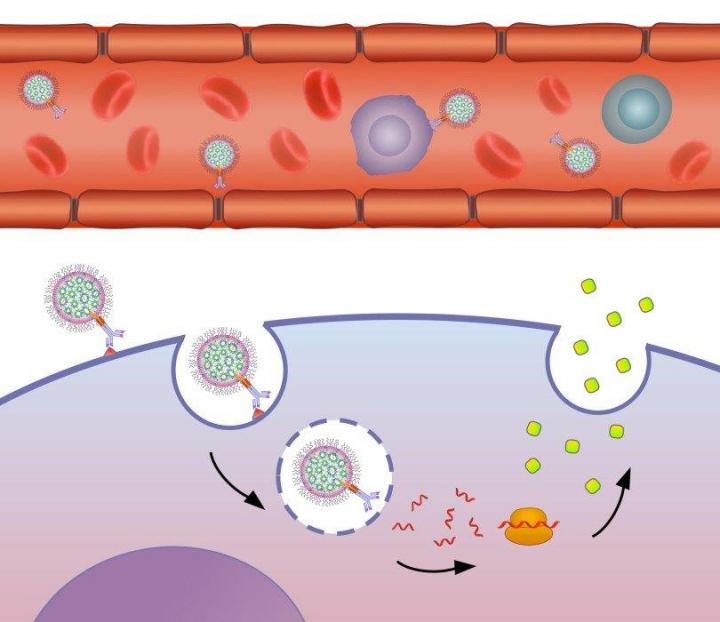
Schematic illustration of the mechanism by which the lab’s targeted nanoparticles modulate gene expression in the target cell. Credit: Nuphar Veiga/American Friends of Tel Aviv University

Delivering an effective therapeutic payload to specific target cells with few adverse effects is considered by many to be the holy grail of medical research. A new Tel Aviv University study explores a biological approach to directing nanocarriers loaded with protein “game changers” to specific cells. The groundbreaking method may prove useful in treating myriad malignancies, inflammatory diseases and rare genetic disorders.

Prof. Dan Peer, director of the Laboratory of Precision Nanomedicine at the School of Molecular Cell Biology at TAU’s Faculty of Life Sciences, led the research for the new study, which was conducted by TAU graduate student Nuphar Veiga and lab colleagues Meir Goldsmith, Yasmin Granot, Daniel Rosenblum, Niels Dammes, Ranit Kedmi and Srinivas Ramishetti. The research was published in Nature Communications.

Over the past few years, lipid carriers encapsulating messenger RNAs (mRNAs) have been shown to be extremely useful in altering the protein expressions for a host of diseases. But directing this information to specific cells has remained a major challenge.

“In our new research, we utilized mRNA-loaded carriers — nanovehicles carrying a set of genetic instructions via a biological platform called ASSET — to target the genetic instructions of an anti-inflammatory protein in immune cells,” says Prof. Peer. “We were able to demonstrate that selective anti-inflammatory protein in the target cells resulted in reduced symptoms and disease severity in colitis.

“This research is revolutionary. It paves the way for the introduction of an mRNA that could encode any protein lacking in cells, with direct applications for genetic, inflammatory and autoimmune diseases — not to mention cancer, in which certain genes overexpress themselves.”

ASSET (Anchored Secondary scFv Enabling Targeting) uses a biological approach to direct nanocarriers into specific cells to promote gene manipulation.

“This study opens new avenues in cell-specific delivery of mRNA molecules and ultimately might introduce the specific anti-inflammatory (interleukin 10) mRNA as a novel therapeutic modality for inflammatory bowel diseases,” says Ms. Veiga.

“Targeted mRNA-based protein production has both therapeutic and research applications,” she concludes. “Going forward, we intend to utilize targeted mRNA delivery for the investigation of novel therapeutics treating inflammation disorders, cancer and rare genetic diseases.”
Related Articles Read More >

R&D 100 winner LLNL achieves 1,000x speed boost in 3D nanofabrication
CEA-Leti achieves 400°C CMOS fabrication milestone for 3D chip stacking
The 2025 R&D 100 Finalists are here
New nanotechnology method increases microalgae biofuel yield by 300%
rd newsletter
EXPAND YOUR KNOWLEDGE AND STAY CONNECTED
Get the latest info on technologies, trends, and strategies in Research & Development.
RD 25 Power Index

R&D World Digital Issues

Fall 2025 issue

Browse the most current issue of R&D World and back issues in an easy to use high quality format. Clip, share and download with the leading R&D magazine today.

R&D 100 Awards
Research & Development World
  • Subscribe to R&D World Magazine
  • Sign up for R&D World’s newsletter
  • Contact Us
  • About Us
  • Drug Discovery & Development
  • Pharmaceutical Processing
  • Global Funding Forecast

Copyright © 2026 WTWH Media LLC. All Rights Reserved. The material on this site may not be reproduced, distributed, transmitted, cached or otherwise used, except with the prior written permission of WTWH Media
Privacy Policy | Advertising | About Us

Search R&D World

  • R&D World Home
  • Topics
    • Aerospace
    • Automotive
    • Biotech
    • Careers
    • Chemistry
    • Environment
    • Energy
    • Life Science
    • Material Science
    • R&D Management
    • Physics
  • Technology
    • 3D Printing
    • A.I./Robotics
    • Software
    • Battery Technology
    • Controlled Environments
      • Cleanrooms
      • Graphene
      • Lasers
      • Regulations/Standards
      • Sensors
    • Imaging
    • Nanotechnology
    • Scientific Computing
      • Big Data
      • HPC/Supercomputing
      • Informatics
      • Security
    • Semiconductors
  • R&D Market Pulse
  • R&D 100
    • 2025 R&D 100 Award Winners
    • 2025 Professional Award Winners
    • 2025 Special Recognition Winners
    • R&D 100 Awards Event
    • R&D 100 Submissions
    • Winner Archive
  • Resources
    • Research Reports
    • Digital Issues
    • Educational Assets
    • R&D Index
    • Subscribe
    • Video
    • Webinars
    • Content submission guidelines for R&D World
  • Global Funding Forecast
  • Top Labs
  • Advertise
  • SUBSCRIBE