Research & Development World

  • R&D World Home
  • Topics
    • Aerospace
    • Automotive
    • Biotech
    • Careers
    • Chemistry
    • Environment
    • Energy
    • Life Science
    • Material Science
    • R&D Management
    • Physics
  • Technology
    • 3D Printing
    • A.I./Robotics
    • Software
    • Battery Technology
    • Controlled Environments
      • Cleanrooms
      • Graphene
      • Lasers
      • Regulations/Standards
      • Sensors
    • Imaging
    • Nanotechnology
    • Scientific Computing
      • Big Data
      • HPC/Supercomputing
      • Informatics
      • Security
    • Semiconductors
  • R&D Market Pulse
  • R&D 100
    • 2025 R&D 100 Award Winners
    • 2025 Professional Award Winners
    • 2025 Special Recognition Winners
    • R&D 100 Awards Event
    • R&D 100 Submissions
    • Winner Archive
  • Resources
    • Research Reports
    • Digital Issues
    • Educational Assets
    • Subscribe
    • Video
    • Webinars
    • Content submission guidelines for R&D World
  • Global Funding Forecast
  • Top Labs
  • Advertise
  • SUBSCRIBE

Newly Improved Glass Slide Turns Microscopes into Thermometers

By Cory Nealon, University of Buffalo | May 3, 2018

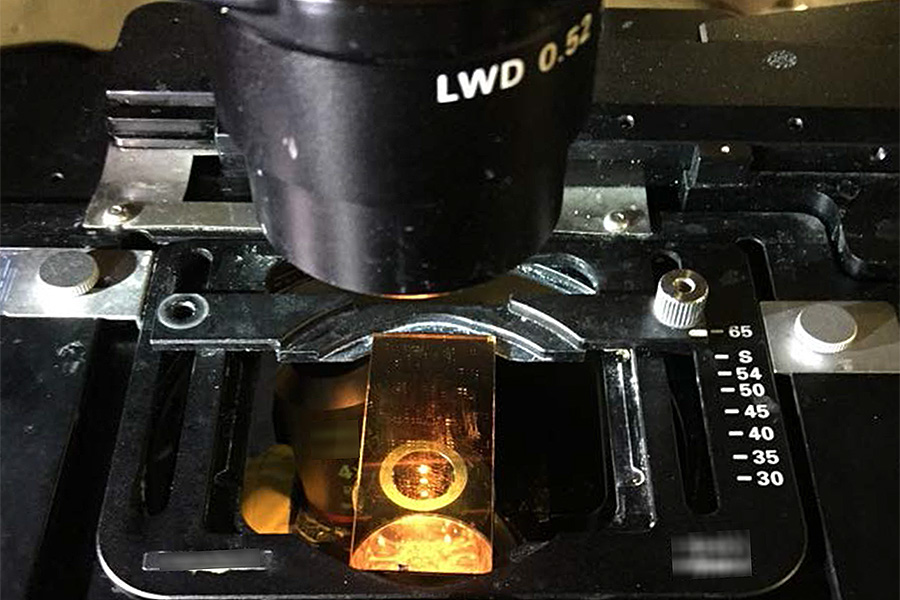
The glass slide coating is made of gold and acrylic glass. Credit: University at Buffalo

The humble glass microscope slide may be primed for a makeover.

A study published online today (May 2, 2018) in the journal Nature Communications describes how an updated version of this centuries-old tool can now enable scientists to see tiny objects while also measuring their temperature.

The advancement, made possible by a new transparent coating at the forefront of optics theory, has the potential to streamline and enhance scientific research worldwide, from clandestine government biology labs to high school chemistry classes.

It may also have implications in other industries, such as computers and electronics, whose products require measurement and control of heat in highly confined spaces.

“We have instruments that magnify incredibly small objects. And we have tools that measure heat, like infrared thermometers. But we haven’t been able to combine them in a low-cost and reliable manner. This new coating takes a big step in that direction,” says the study’s co-lead author Ruogang Zhao, PhD, assistant professor in the University at Buffalo Department of Biomedical Engineering.

The department is a multidisciplinary unit formed by UB’s School of Engineering and Applied Sciences and the Jacobs School of Medicine and Biomedical Sciences at UB.

Zhao collaborated with researchers at the University of Pennsylvania, including co-lead author Liang Feng, PhD, assistant professor of materials science and engineering, and electrical and systems engineering.

For decades, researchers have tried to combine thermal imaging and microscopy. Images produced from systems that use thermocouples lack resolution and are often too coarse for modern science. Terahertz and infrared thermal mapping techniques interfere with the microscope’s lenses. Other techniques are expensive and time-consuming.

The new coating is made of a layer of acrylic glass (the same material used in most eyeglasses) that’s sandwiched between two layers of transparent gold. The gold is transparent because it’s only 20 nanometers thick; a typical sheet of paper is 100,000 nanometers thick.

Engineers fabricated the coating so that “exceptional points” — the sweet spots where unusual light behavior happens — can develop within the tri-layered structure. The coating, which significantly enhances the slide’s sensitivity to light detection, would be added to slides during the manufacturing process. Either the slide or cover slip could receive the coating.

To make use of the new coating, a laser is needed. Zhao says a common helium-neon laser, which can be seamlessly integrated with most microscopes, will do the job.

Common slides, which are often bought in bulk, typically cost around 5 cents. The new coating would likely add a few pennies to the cost, Zhao says.

The research is supported by funding from the National Science Foundation and the National Institutes of Health.

Related Articles Read More >

New video series: Travel for engineers
Advanced Manufacturing and Process Innovation Special Report: When you can’t hire, you automate
Pancreas or pancreatic cancer with organs and tumors or cancerous cells 3D rendering illustration with male body. Anatomy, oncology, disease, medical, biology, science, healthcare concepts.
AI tool used to detect pancreatic cancer in routine CT scans in China 
R&D 100 Red Carpet: DuPont’s triple win
rd newsletter
EXPAND YOUR KNOWLEDGE AND STAY CONNECTED
Get the latest info on technologies, trends, and strategies in Research & Development.

R&D World Digital Issues

Fall 2025 issue

Browse the most current issue of R&D World and back issues in an easy to use high quality format. Clip, share and download with the leading R&D magazine today.

R&D 100 Awards
Research & Development World
  • Subscribe to R&D World Magazine
  • Sign up for R&D World’s newsletter
  • Contact Us
  • About Us
  • Drug Discovery & Development
  • Pharmaceutical Processing
  • Global Funding Forecast

Copyright © 2026 WTWH Media LLC. All Rights Reserved. The material on this site may not be reproduced, distributed, transmitted, cached or otherwise used, except with the prior written permission of WTWH Media
Privacy Policy | Advertising | About Us

Search R&D World

  • R&D World Home
  • Topics
    • Aerospace
    • Automotive
    • Biotech
    • Careers
    • Chemistry
    • Environment
    • Energy
    • Life Science
    • Material Science
    • R&D Management
    • Physics
  • Technology
    • 3D Printing
    • A.I./Robotics
    • Software
    • Battery Technology
    • Controlled Environments
      • Cleanrooms
      • Graphene
      • Lasers
      • Regulations/Standards
      • Sensors
    • Imaging
    • Nanotechnology
    • Scientific Computing
      • Big Data
      • HPC/Supercomputing
      • Informatics
      • Security
    • Semiconductors
  • R&D Market Pulse
  • R&D 100
    • 2025 R&D 100 Award Winners
    • 2025 Professional Award Winners
    • 2025 Special Recognition Winners
    • R&D 100 Awards Event
    • R&D 100 Submissions
    • Winner Archive
  • Resources
    • Research Reports
    • Digital Issues
    • Educational Assets
    • Subscribe
    • Video
    • Webinars
    • Content submission guidelines for R&D World
  • Global Funding Forecast
  • Top Labs
  • Advertise
  • SUBSCRIBE