griDNA, an R&D 100 (2025) finalist from Sandia National Laboratories, is an autoencoder-based system that fuses 60-samples-per-second grid measurements (frequency, voltage, current) with intermittent network telemetry to identify cyber, physical, and blended anomalies on the power grid. The team has run the model on low-cost single-board computers and on existing security devices and is field-testing it at Public Service Company of New Mexico (PNM)’s Prosperity solar site with support from Texas A&M University and Sierra Nevada Corporation (SNC). The innovation was recently profiled on the Sandia website.
Built for edge deployment
The package runs on single-board computers or on existing utility security gear such as Sierra Nevada Corp.’s Binary Armor. It fuses 60-samples-per-second grid measurements (frequency, voltage, current) with irregular network telemetry and uses an autoencoder trained on normal operations to flag deviations, issuing device-level, enclave-level, and cross-operator “global” alerts while sharing only results and alerts. Sandia reports successful trials in emulation and hardware-in-the-loop environments, with live testing under way at Public Service Company of New Mexico’s Prosperity solar facility; secure messaging co-developed with Texas A&M enables coordination across owners without exposing raw operational data.
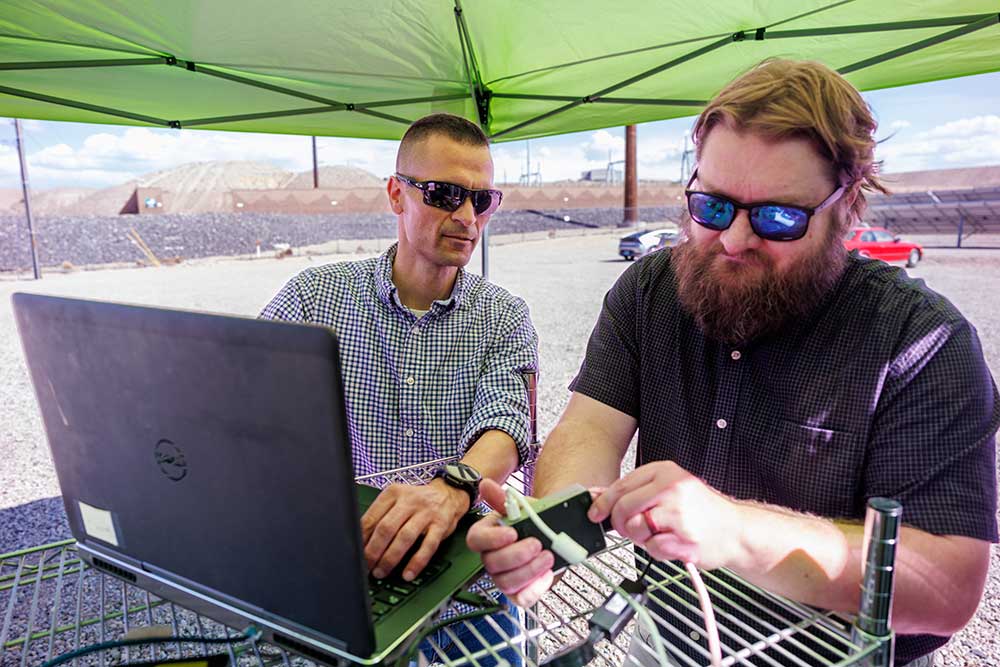
R&D 100 Finalist griDNA: Sandia’s Adrian Chavez (left) and Logan Blakely integrate the edge autoencoder onto a single-board computer at Public Service Company of New Mexico’s Prosperity solar test site. (Photo by Bret Latter/Sandia National Labs)
In the 2025 R&D 100 Awards, griDNA is a Finalist in the IT/Electrical category. The entry lists Sandia National Laboratories as the primary organization with co-developers Public Service Company of New Mexico (PNM), Sierra Nevada Corporation (SNC), and Texas A&M University. The system runs on single-board computers or installed gear such as SNC’s Binary Armor; it fuses 60-samples-per-second grid measurements (frequency, voltage, current) with intermittent network telemetry and trains an autoencoder on normal operations to flag deviations. It supports three alerting tiers, local/device, enclave, and cross-operator “global,” with results-only sharing across owners. The team is field-testing the code under a CRADA at PNM’s Prosperity solar site; the project targets blended threats (e.g., false-data injection and denial-of-service [DoS]), is patent-filed, and is supported by Sandia’s LDRD program.
The package targets the edge
Running on low-cost single-board computers or on installed gear such as Sierra Nevada Corp.’s Binary Armor, the package issues device-level, enclave-level and cross-operator “global” alerts. Only results and alerts are shared across owners, limiting exposure of raw operational data. Sandia reports successful emulation and hardware-in-the-loop trials and is exercising the code under a CRADA at PNM’s Prosperity solar facility; secure messaging co-developed with Texas A&M supports coordination between distinct grid operators.
Sandia has filed a patent and is seeking partners to harden and scale the package. The team says the same autoencoder/fusion pattern is applicable to other critical infrastructure, water and gas distribution, factories, and data centers, where mixed cyber-physical telemetry is available and edge constraints favor lightweight models.