 In the pursuit of next-generation energy storage, researchers face a persistent trade-off: materials that conduct ions well (essential for power) are often mechanically weak or flammable, while robust solids tend to impede ion flow.
Now, a team at the Department of Energy’s Oak Ridge National Laboratory (ORNL) has addressed this challenge by creating “pseudosolid polyelectrolyte membranes” using a precise layer-by-layer assembly of ionogels and polymer sheets. This research, described on Oak Ridge National Labs’ website, could suppress lithium dendrite formation while maintaining high efficiency. Applications could span consumer electronics, medical devices and aerospace systems.
Dealing with dendrites
To achieve higher energy densities, battery developers increasingly look to lithium-metal anodes. Yet when paired with traditional liquid electrolytes, these anodes are prone to forming dendrites, needle-like lithium structures that can grow through the separator. They can cause short circuits and fires. Current approaches can sacrifice performance for safety. Standard liquid electrolytes are flammable, while purely solid alternatives often lack the necessary ionic conductivity. Alternatively, they struggle with physical contact with electrodes as they expand and contract during use.
A layered approach
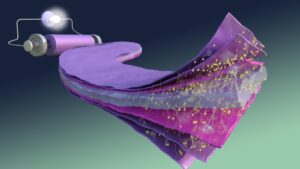
The ORNL team, led by Bishnu Prasad Thapaliya, sought a solution that would not compromise. Their approach relies on ionogels, a hybrid material that is neither fully liquid nor solid, capable of transporting ions efficiently. By layering an ionogel composed of lithium salts and ionic liquids between flexible, ultrathin polymer sheets, the researchers created a composite that acts as both the electrolyte and the separator. This layer-by-layer (LbL) assembly is key to the material’s success.
The core innovation lies in the interface between the materials. The strategy involves coating the ionogel with an ultrathin layer of polyanions and polycations. By using the intrinsic ionic structure of the ionogel membrane, the researchers facilitate a facile LbL construction of a membrane electrolyte interface.
This process creates a distinct structural advantage. The ultrathin LbL coating significantly reinforces the membrane—in prior foundational studies, this method was shown to enhance mechanical strength by approximately 5-fold, as ornl.gov noted. Despite the added structural layers, the membrane retains liquid-like ionic conductivity, reported in related research to be around ∼10−4 S cm−1 at low temperatures (10 °C). The resulting mechanical rigidity allows the membrane to withstand internal pressures and physically block the penetration of lithium dendrites, preventing crossover and short circuits.
Performance and scalability matters
Laboratory tests show the membranes maintain steady performance through hundreds of charge-discharge cycles, even in harsh conditions that typically degrade batteries.
The ionic liquids used in the membranes are non-flammable, reducing the risk of fires caused by thermal runaway and improving overall battery safety.
Researchers now plan to move the technology from the lab to commercial production, with a focus on automated manufacturing to enable scaling.
“We want to build on this research and make a scalable membrane that can also be used in commercial energy storage systems,” said Thapaliya in a press release.
In the long run, the team plans to tap ORNL’s Autonomous Chemistry Lab, where robots could automate the layer-by-layer gel assembly process. This automation would allow for the independent, overnight manufacturing of coated, multilayered membranes, which could then be dried and tested for prototype devices.