Research & Development World

  • R&D World Home
  • Topics
    • Aerospace
    • Automotive
    • Biotech
    • Careers
    • Chemistry
    • Environment
    • Energy
    • Life Science
    • Material Science
    • R&D Management
    • Physics
  • Technology
    • 3D Printing
    • A.I./Robotics
    • Software
    • Battery Technology
    • Controlled Environments
      • Cleanrooms
      • Graphene
      • Lasers
      • Regulations/Standards
      • Sensors
    • Imaging
    • Nanotechnology
    • Scientific Computing
      • Big Data
      • HPC/Supercomputing
      • Informatics
      • Security
    • Semiconductors
  • R&D Market Pulse
  • R&D 100
    • 2025 R&D 100 Award Winners
    • 2025 Professional Award Winners
    • 2025 Special Recognition Winners
    • R&D 100 Awards Event
    • R&D 100 Submissions
    • Winner Archive
  • Resources
    • Research Reports
    • Digital Issues
    • Educational Assets
    • Subscribe
    • Video
    • Webinars
    • PharmSci360
    • Content submission guidelines for R&D World
  • Global Funding Forecast
  • Top Labs
  • Advertise
  • SUBSCRIBE

Researchers Get First Complete Look at Protein Behind Sense of Touch

By The Scripps Research Institute | December 21, 2017

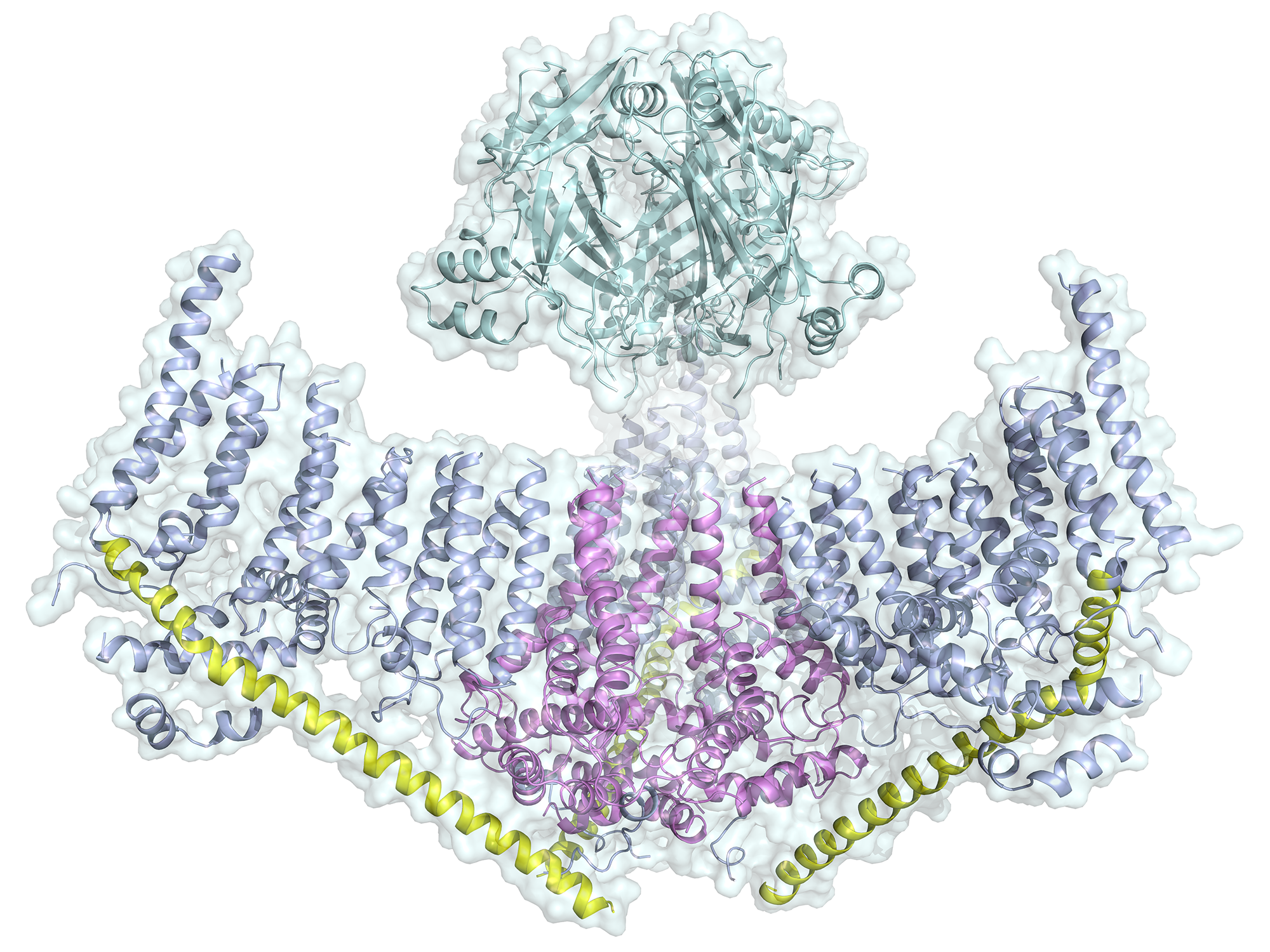
Structure of Piezo1, showing two of the three blades that surround the central pore. (Courtesy Ward Lab

 Scientists at The Scripps Research Institute (TSRI) have solved the mystery of the structure of Piezo1, a member of a family of proteins that convert physical stimuli such as touch or blood flow into chemical signals. The findings, published today in the journal Nature, point the way to targeting diseases where Piezo1 is mutated, such as dehydrated hereditary stomatocytosis and congenital lymphedema.

“This structure provides a fundamental understanding of how proteins sense mechanical force, and will shed light on regions within Piezo1 that can be targeted using small molecules or antibodies,” says Ardem Patapoutian, PhD, a TSRI professor and Howard Hughes Medical Institute investigator, who co-led the new study with TSRI Professor Andrew Ward, PhD.

Piezo1, and the closely related Piezo2 protein, were discovered in the Patapoutian Lab in 2010. Piezos are known as an ion channel—they let ions through a pore in response to a mechanical stimulus (aka touch). These proteins have been found in disparate cell types and are already shown to be key players in sensory neurobiology and vascular physiology.

Until now, however, researchers didn’t know how Piezo1 looked at the structural level, i.e., how its parts come together.

The new study, carried out with a high-resolution imaging technique called cryo-electron microscopy (cryoEM), shows that Piezo1 is made up of three curved “blades” circling a central pore. The researchers believe these blades move in response to mechanical force, which opens and closes the pore to let ions through to send the signal to communicate touch.

A beam-like structure serves as the backbone for each blade. An “anchor domain” surrounds the pore where the blades meet the middle.

“It is a beautiful structure,” says Patapoutian. “The features identified in this study give us tantalizing clues on how this ion channel would sense and respond to membrane tension.”

Ward says the Piezo1 structure is unique because it appears to be an “all-in-one” protein, meaning it does not need to connect with other proteins or cell structures to do its job transmitting a signal.

The next step in this research is to examine the overall architecture of Piezo1 and determine how each piece works. Scientists hope to look at this protein in different conformations besides the closed conformation seen in the current study.

“This gives us a good opportunity to investigate how force sensation, or transduction, really works,” says Kei Saotome, PhD, TSRI research associate and first author of the new study.

In addition to Saotome, Patapoutian and Ward, authors of the study, “Structure of the Mechanically Activated Ion Channel Piezo1,” were Swetha E. Murthy, Jennifer M. Kefauver and Tess Whitwam of the Howard Hughes Medical Institute and The Scripps Research Institute.
Related Articles Read More >

Inside BD’s plan to forecast hospital drug demand with AI while keeping models within bounds
Mayo Clinic backs ViewsML in $4.9M round to advance virtual biomarker staining
How a plant virus could keep astronauts medicated on a trip to Mars
Countable Labs’ CTO Christina Fan on reimagining PCR, one molecule at a time
rd newsletter
EXPAND YOUR KNOWLEDGE AND STAY CONNECTED
Get the latest info on technologies, trends, and strategies in Research & Development.

R&D World Digital Issues

Fall 2025 issue

Browse the most current issue of R&D World and back issues in an easy to use high quality format. Clip, share and download with the leading R&D magazine today.

R&D 100 Awards
Research & Development World
  • Subscribe to R&D World Magazine
  • Sign up for R&D World’s newsletter
  • Contact Us
  • About Us
  • Drug Discovery & Development
  • Pharmaceutical Processing
  • Global Funding Forecast

Copyright © 2026 WTWH Media LLC. All Rights Reserved. The material on this site may not be reproduced, distributed, transmitted, cached or otherwise used, except with the prior written permission of WTWH Media
Privacy Policy | Advertising | About Us

Search R&D World

  • R&D World Home
  • Topics
    • Aerospace
    • Automotive
    • Biotech
    • Careers
    • Chemistry
    • Environment
    • Energy
    • Life Science
    • Material Science
    • R&D Management
    • Physics
  • Technology
    • 3D Printing
    • A.I./Robotics
    • Software
    • Battery Technology
    • Controlled Environments
      • Cleanrooms
      • Graphene
      • Lasers
      • Regulations/Standards
      • Sensors
    • Imaging
    • Nanotechnology
    • Scientific Computing
      • Big Data
      • HPC/Supercomputing
      • Informatics
      • Security
    • Semiconductors
  • R&D Market Pulse
  • R&D 100
    • 2025 R&D 100 Award Winners
    • 2025 Professional Award Winners
    • 2025 Special Recognition Winners
    • R&D 100 Awards Event
    • R&D 100 Submissions
    • Winner Archive
  • Resources
    • Research Reports
    • Digital Issues
    • Educational Assets
    • Subscribe
    • Video
    • Webinars
    • PharmSci360
    • Content submission guidelines for R&D World
  • Global Funding Forecast
  • Top Labs
  • Advertise
  • SUBSCRIBE