Research & Development World

  • R&D World Home
  • Topics
    • Aerospace
    • Automotive
    • Biotech
    • Careers
    • Chemistry
    • Environment
    • Energy
    • Life Science
    • Material Science
    • R&D Management
    • Physics
  • Technology
    • 3D Printing
    • A.I./Robotics
    • Software
    • Battery Technology
    • Controlled Environments
      • Cleanrooms
      • Graphene
      • Lasers
      • Regulations/Standards
      • Sensors
    • Imaging
    • Nanotechnology
    • Scientific Computing
      • Big Data
      • HPC/Supercomputing
      • Informatics
      • Security
    • Semiconductors
  • R&D Market Pulse
  • R&D 100
    • 2025 R&D 100 Award Winners
    • 2025 Professional Award Winners
    • 2025 Special Recognition Winners
    • R&D 100 Awards Event
    • R&D 100 Submissions
    • Winner Archive
  • Resources
    • Research Reports
    • Digital Issues
    • Educational Assets
    • R&D Index
    • Subscribe
    • Video
    • Webinars
    • Content submission guidelines for R&D World
  • Global Funding Forecast
  • Top Labs
  • Advertise
  • SUBSCRIBE

Reusable rocket startup raises $510 million

By Julia Rock-Torcivia | October 15, 2025

Stoke, a rocket startup company, raised $510 million in Series D funding, the company announced last week. The new financing more than doubled the company’s total capital, which is now $990 million. Stoke plans to use the funds to “accelerate product development and expansion,” according to the press release. 
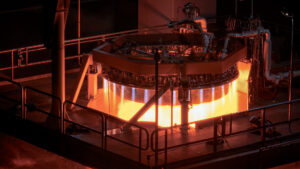
Stoke’s stage 2 engine. Credit: Stoke

In March, the company was selected by the U.S. Space Force to participate in the National Security Space Launch (NSSL) Phase 3 Lane 1 program. Under the program, Stoke will compete for $5.6 billion in national security launch contracts. 

“Stoke’s pioneering approach to reusable launch systems directly advances our national security and commercial access to orbit. Their vision for resilient, high-frequency launch operations is the kind of innovation essential to maintaining leadership in the space industry. We’re proud to support their mission in defining the next chapter of U.S. aerospace,” said Thomas Tull, Chairman of the US Innovative Technology Fund (USIT). USIT led the Series D funding along with Silicon Valley Bank. 

Stoke is also using the funds to refurbish its Launch Complex 14 at Cape Canaveral Space Force Station in Florida. The complex is scheduled to open early next year. The company is also planning to invest in supply chain and infrastructure to prepare for high-cadence launch operations. 

The Nova Rocket

Nova is Stoke’s fully reusable rocket. The model enables return shipments from space to Earth and could enable sustainable scaling of the aerospace market. 

Nova also features, reportedly, the world’s first actively cooled heat shield, which enables minimal maintenance. The heat shield makes the second stage, the part of the rocket that is usually discarded, reusable. Most rockets use heat shields built of ceramic tiles or materials that burn away during reentry. These materials are fragile, expensive and time-consuming to replace. 

Stoke designed a metal heat shield that can withstand the heat and stress of reentry. During reentry, liquid hydrogen is run through the shield to cool it from the inside out. The heat shield is combined with the rocket’s engine to create a single system that protects the rocket and provides propulsion.

While other companies have been able to reuse the first stage, such as SpaceX’s Falcon 9, Stoke is focused on full reusability, including the second stage. 

The Nova rocket is scheduled to launch in 2026.
Related Articles Read More >

The Milky Way is glowing: these scientists think dark matter may be the cause
2025 R&D layoffs tracker: hardware and chips lead the year’s biggest cuts while biopharma pares pipelines
Sonar Screen For Submarines And Ships. Radar Sonar With Object On Map. Futuristic HUD Navigation monitor
Pentagon places big bets on frontier AI, quantum sensing and next-gen avionics in nearly $3 billion in defense technology contracts 
Trump lifts 50-year supersonic ban, paving way for 3.5-hour New York–London trips
rd newsletter
EXPAND YOUR KNOWLEDGE AND STAY CONNECTED
Get the latest info on technologies, trends, and strategies in Research & Development.
RD 25 Power Index

R&D World Digital Issues

Fall 2024 issue

Browse the most current issue of R&D World and back issues in an easy to use high quality format. Clip, share and download with the leading R&D magazine today.

Research & Development World
  • Subscribe to R&D World Magazine
  • Sign up for R&D World’s newsletter
  • Contact Us
  • About Us
  • Drug Discovery & Development
  • Pharmaceutical Processing
  • Global Funding Forecast

Copyright © 2025 WTWH Media LLC. All Rights Reserved. The material on this site may not be reproduced, distributed, transmitted, cached or otherwise used, except with the prior written permission of WTWH Media
Privacy Policy | Advertising | About Us

Search R&D World

  • R&D World Home
  • Topics
    • Aerospace
    • Automotive
    • Biotech
    • Careers
    • Chemistry
    • Environment
    • Energy
    • Life Science
    • Material Science
    • R&D Management
    • Physics
  • Technology
    • 3D Printing
    • A.I./Robotics
    • Software
    • Battery Technology
    • Controlled Environments
      • Cleanrooms
      • Graphene
      • Lasers
      • Regulations/Standards
      • Sensors
    • Imaging
    • Nanotechnology
    • Scientific Computing
      • Big Data
      • HPC/Supercomputing
      • Informatics
      • Security
    • Semiconductors
  • R&D Market Pulse
  • R&D 100
    • 2025 R&D 100 Award Winners
    • 2025 Professional Award Winners
    • 2025 Special Recognition Winners
    • R&D 100 Awards Event
    • R&D 100 Submissions
    • Winner Archive
  • Resources
    • Research Reports
    • Digital Issues
    • Educational Assets
    • R&D Index
    • Subscribe
    • Video
    • Webinars
    • Content submission guidelines for R&D World
  • Global Funding Forecast
  • Top Labs
  • Advertise
  • SUBSCRIBE