Research & Development World

  • R&D World Home
  • Topics
    • Aerospace
    • Automotive
    • Biotech
    • Careers
    • Chemistry
    • Environment
    • Energy
    • Life Science
    • Material Science
    • R&D Management
    • Physics
  • Technology
    • 3D Printing
    • A.I./Robotics
    • Software
    • Battery Technology
    • Controlled Environments
      • Cleanrooms
      • Graphene
      • Lasers
      • Regulations/Standards
      • Sensors
    • Imaging
    • Nanotechnology
    • Scientific Computing
      • Big Data
      • HPC/Supercomputing
      • Informatics
      • Security
    • Semiconductors
  • R&D Market Pulse
  • R&D 100
    • 2025 R&D 100 Award Winners
    • 2025 Professional Award Winners
    • 2025 Special Recognition Winners
    • R&D 100 Awards Event
    • R&D 100 Submissions
    • Winner Archive
  • Resources
    • Research Reports
    • Digital Issues
    • Educational Assets
    • Subscribe
    • Video
    • Webinars
    • Content submission guidelines for R&D World
  • Global Funding Forecast
  • Top Labs
  • Advertise
  • SUBSCRIBE

Scientists Design Material That Can Store Energy Like an Eagle’s Grip

By Queen Mary University of London | August 9, 2018

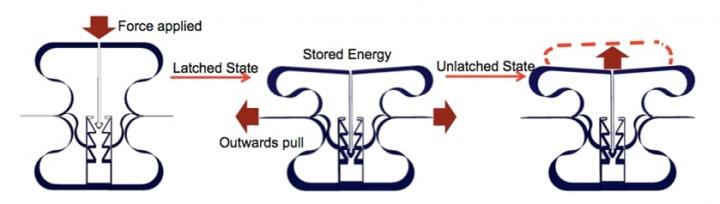
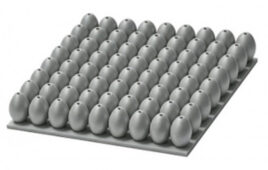
The ratcheting building block that could be embedded in the new materials. After vertical compression, it keeps materials collapsed, and can release their energy on side-ways pull. Credit: Stoyan Smoukov

What do a flea and an eagle have in common? They can store energy in their feet without having to continuously contract their muscles to then jump high or hold on to prey. Now scientists at Queen Mary University of London and University of Cambridge have created materials that can store energy this way, be squeezed repeatedly without damage, and even change shape if necessary.

These kinds of materials are called auxetics and behave quite differently from regular materials. Instead of bulging out when squeezed, they collapse in all directions, storing the energy inside.

Current auxetic material designs have sharp corners which enable them to fold onto themselves, achieving higher density. This is a property that has been recognised recently in lightweight armour designs, where the material can collapse in front of a bullet upon impact. This is important because mass in front of a bullet is the biggest factor in armour effectiveness.

The sharp corners also concentrate forces and cause the material to fracture if squeezed multiple times, which is not a problem for armour as it is only designed to be used once.

In this study, published in Frontiers in Materials, the team of scientists redesigned the materials with smooth curves which distribute the forces and make repeated deformations possible for other applications where energy storing and shape-changing material properties are required.

The work lays the basis for designs of lightweight 3D supports, which also fold in specific ways and store energy which could be released on demand.

Principle investigator Dr Stoyan Smoukov, from Queen Mary University of London, said: “The exciting future of new materials designs is that they can start replacing devices and robots. All the smart functionality is embedded in the material, for example the repeated ability to latch onto objects the way eagles latch onto prey, and keep a vice-like grip without spending any more force or effort.”

The team expects its nature-inspired designs could be used in energy-efficient gripping tools required in industry, re-configurable shape-on-demand materials, and even lattices with unique thermal expansion behaviour.

Eesha Khare, a visiting undergraduate student from Harvard University who was instrumental in defining the project, added: “A major problem for materials exposed to harsh conditions, such as high temperature, is their expansion. A material could now be designed so its expansion properties continuously vary to match a gradient of temperature farther and closer to a heat source. This way, it will be able to adjust itself naturally to repeated and severe changes.”

The flexible auxetic material designs, which were not possible before, were adapted specifically to be easily 3D-printed, a feature the authors consider essential.

Dr Smoukov added: “By growing things layer-by-layer from the bottom up, the possible material structures are mostly limited by imagination, and we can easily take advantage of inspirations we get from nature.”
Related Articles Read More >

Elkem Silicones rebrands as Bluestar Silicones after ownership change
Five costly mistakes when scaling spray drying from lab to commercial production
How Atomis is using AI simulations to commercialize MOFs
Sandia turns to lightweight AI to speed up ceramic inspections for nuclear weapons components
rd newsletter
EXPAND YOUR KNOWLEDGE AND STAY CONNECTED
Get the latest info on technologies, trends, and strategies in Research & Development.

R&D World Digital Issues

Fall 2025 issue

Browse the most current issue of R&D World and back issues in an easy to use high quality format. Clip, share and download with the leading R&D magazine today.

R&D 100 Awards
Research & Development World
  • Subscribe to R&D World Magazine
  • Sign up for R&D World’s newsletter
  • Contact Us
  • About Us
  • Drug Discovery & Development
  • Pharmaceutical Processing
  • Global Funding Forecast

Copyright © 2026 WTWH Media LLC. All Rights Reserved. The material on this site may not be reproduced, distributed, transmitted, cached or otherwise used, except with the prior written permission of WTWH Media
Privacy Policy | Advertising | About Us

Search R&D World

  • R&D World Home
  • Topics
    • Aerospace
    • Automotive
    • Biotech
    • Careers
    • Chemistry
    • Environment
    • Energy
    • Life Science
    • Material Science
    • R&D Management
    • Physics
  • Technology
    • 3D Printing
    • A.I./Robotics
    • Software
    • Battery Technology
    • Controlled Environments
      • Cleanrooms
      • Graphene
      • Lasers
      • Regulations/Standards
      • Sensors
    • Imaging
    • Nanotechnology
    • Scientific Computing
      • Big Data
      • HPC/Supercomputing
      • Informatics
      • Security
    • Semiconductors
  • R&D Market Pulse
  • R&D 100
    • 2025 R&D 100 Award Winners
    • 2025 Professional Award Winners
    • 2025 Special Recognition Winners
    • R&D 100 Awards Event
    • R&D 100 Submissions
    • Winner Archive
  • Resources
    • Research Reports
    • Digital Issues
    • Educational Assets
    • Subscribe
    • Video
    • Webinars
    • Content submission guidelines for R&D World
  • Global Funding Forecast
  • Top Labs
  • Advertise
  • SUBSCRIBE