Research & Development World

  • R&D World Home
  • Topics
    • Aerospace
    • Automotive
    • Biotech
    • Careers
    • Chemistry
    • Environment
    • Energy
    • Life Science
    • Material Science
    • R&D Management
    • Physics
  • Technology
    • 3D Printing
    • A.I./Robotics
    • Software
    • Battery Technology
    • Controlled Environments
      • Cleanrooms
      • Graphene
      • Lasers
      • Regulations/Standards
      • Sensors
    • Imaging
    • Nanotechnology
    • Scientific Computing
      • Big Data
      • HPC/Supercomputing
      • Informatics
      • Security
    • Semiconductors
  • R&D Market Pulse
  • R&D 100
    • 2025 R&D 100 Award Winners
    • 2025 Professional Award Winners
    • 2025 Special Recognition Winners
    • R&D 100 Awards Event
    • R&D 100 Submissions
    • Winner Archive
  • Resources
    • Research Reports
    • Digital Issues
    • Educational Assets
    • Subscribe
    • Video
    • Webinars
    • PharmSci360
    • Content submission guidelines for R&D World
  • Global Funding Forecast
  • Top Labs
  • Advertise
  • SUBSCRIBE

Scientists grow potatoes in moon dust simulant, paving way for lunar agriculture

By Julia Rock-Torcivia | March 17, 2026

Researchers have shown that potatoes can grow in moon dust-equivalent conditions in a preprint posted on bioRxiv. The researchers used recreated lunar regolith, the powdery dust layer on the moon’s surface, from NASA and Exolith Lab. 

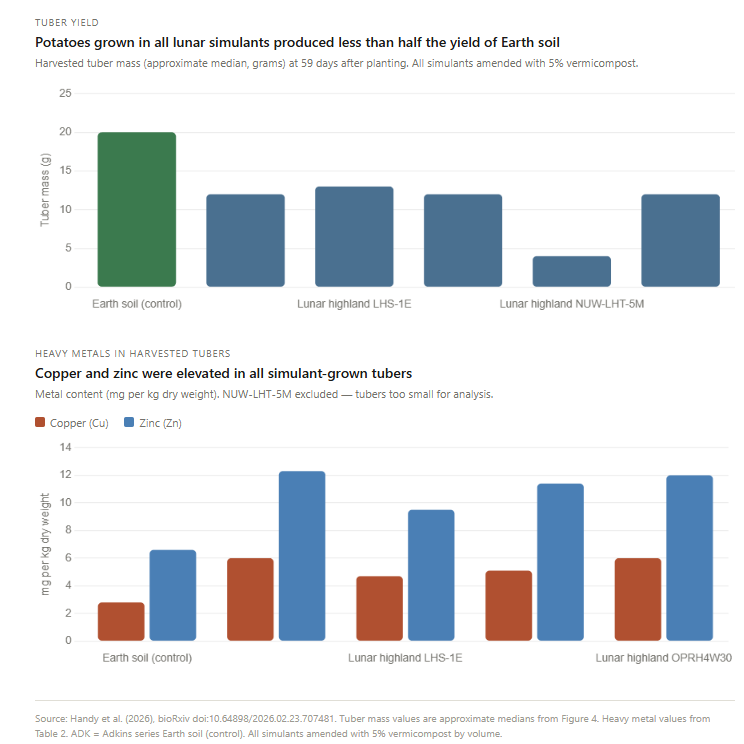
However, real lunar regolith is missing the organic matter plants need to grow, so the scientists added vermicompost, organic waste from worms, into their dust mixture. They grew potatoes in mixtures with 0%, 15% and 30% compost, finding that the potatoes grown with a 30% compost mixture were “virtually indistinguishable from controls.” 

Signs of stress in the DNA

After approximately two months, the team harvested the potatoes, freeze-dried them and ground them up for further testing. The scientists found that stress-related genes in the potatoes’ DNA had been activated. The potatoes also had slightly higher concentrations of copper and zinc, although their nutritional value was similar to that of regular potatoes. 

Plants grown in a lunar highland simulant were so stunted that they did not produce leaves for samples and took about 24 days to emerge, compared to the four to eight days seen in potatoes grown in other simulants. The scientists hypothesized that copper toxicity from the fertilizer interacting with the regolith, sharp micro-particles abrading roots or poor drainage could have caused the issue. 
Lunar agriculture as a long-term strategy

The scientists present lunar agriculture as a long-term strategy. In the early stages of a lunar habitat, when organic material is scarce, agriculture will be more difficult. As biological waste accumulates, the practice will improve. 

While the study provides interesting data about the possibility of growing potatoes on the moon, there are other challenges involved, including radiation and the vacuum of space. 

Future NASA plans to travel to the moon could allow scientists to test plants in actual lunar soil instead of the simulated mixture. In the meantime, the team is performing further research to determine which varieties of potatoes grow best in the soil mixture. 
Related Articles Read More >

How a plant virus could keep astronauts medicated on a trip to Mars
The science behind the Prada-designed spacesuit for Artemis 
NASA is confident Blue Origin will be ready for Artemis III despite explosion
Blue Origin explosion leaves Artemis experiments in limbo
rd newsletter
EXPAND YOUR KNOWLEDGE AND STAY CONNECTED
Get the latest info on technologies, trends, and strategies in Research & Development.

R&D World Digital Issues

Fall 2025 issue

Browse the most current issue of R&D World and back issues in an easy to use high quality format. Clip, share and download with the leading R&D magazine today.

R&D 100 Awards
Research & Development World
  • Subscribe to R&D World Magazine
  • Sign up for R&D World’s newsletter
  • Contact Us
  • About Us
  • Drug Discovery & Development
  • Pharmaceutical Processing
  • Global Funding Forecast

Copyright © 2026 WTWH Media LLC. All Rights Reserved. The material on this site may not be reproduced, distributed, transmitted, cached or otherwise used, except with the prior written permission of WTWH Media
Privacy Policy | Advertising | About Us

Search R&D World

  • R&D World Home
  • Topics
    • Aerospace
    • Automotive
    • Biotech
    • Careers
    • Chemistry
    • Environment
    • Energy
    • Life Science
    • Material Science
    • R&D Management
    • Physics
  • Technology
    • 3D Printing
    • A.I./Robotics
    • Software
    • Battery Technology
    • Controlled Environments
      • Cleanrooms
      • Graphene
      • Lasers
      • Regulations/Standards
      • Sensors
    • Imaging
    • Nanotechnology
    • Scientific Computing
      • Big Data
      • HPC/Supercomputing
      • Informatics
      • Security
    • Semiconductors
  • R&D Market Pulse
  • R&D 100
    • 2025 R&D 100 Award Winners
    • 2025 Professional Award Winners
    • 2025 Special Recognition Winners
    • R&D 100 Awards Event
    • R&D 100 Submissions
    • Winner Archive
  • Resources
    • Research Reports
    • Digital Issues
    • Educational Assets
    • Subscribe
    • Video
    • Webinars
    • PharmSci360
    • Content submission guidelines for R&D World
  • Global Funding Forecast
  • Top Labs
  • Advertise
  • SUBSCRIBE