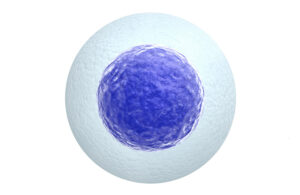
Human egg cell isolated on white background image from Adobe Stock
Researchers from Oregon Health & Science University produced human egg cells from skin cells, they reported in Nature Communications. Once fertilized, the eggs were able to form early embryos.
The researchers removed the nucleus from a human egg cell and replaced it with the nucleus of a type of skin cell called a fibroblast, a technique that was used to clone Dolly the sheep. But these cells had twice the amount of DNA that a typical egg cell would.
In mouse models, fertilization triggered meiosis and the egg cells naturally ejected half of the chromosomes, leading to an embryo with the correct number of chromosomes. However, this did not occur in the human cells, so the scientists added a chemical called roscovitine to induce chromosome separation.
Some of the fertilized eggs became human embryos. Others did not develop, likely because they had an abnormal amount of chromosomes, said Paula Amato, a coauthor of the study.
Although in the early stages, research like this could be a step towards treating infertility in women or enabling same-sex male couples to have children that are biologically related to both partners.
A version of this technique works in mice. “Usually, things that we can get to work in mice eventually work in humans,” Amato said. Researchers have also been able to produce panda stem cells from skin cells.
None of the resulting embryos had the correct set of chromosomes. Amato said this is likely because the chromosomes paired randomly instead of with their match as they normally would. Even embryos that had the correct number of chromosomes had doubles of some and were missing others.
The researchers are working to solve this problem, but Amato says it will be at least a decade before the method could be tested in clinical trials.