Research & Development World

  • R&D World Home
  • Topics
    • Aerospace
    • Automotive
    • Biotech
    • Careers
    • Chemistry
    • Environment
    • Energy
    • Life Science
    • Material Science
    • R&D Management
    • Physics
  • Technology
    • 3D Printing
    • A.I./Robotics
    • Software
    • Battery Technology
    • Controlled Environments
      • Cleanrooms
      • Graphene
      • Lasers
      • Regulations/Standards
      • Sensors
    • Imaging
    • Nanotechnology
    • Scientific Computing
      • Big Data
      • HPC/Supercomputing
      • Informatics
      • Security
    • Semiconductors
  • R&D Market Pulse
  • R&D 100
    • 2025 R&D 100 Award Winners
    • 2025 Professional Award Winners
    • 2025 Special Recognition Winners
    • R&D 100 Awards Event
    • R&D 100 Submissions
    • Winner Archive
  • Resources
    • Research Reports
    • Digital Issues
    • Educational Assets
    • Subscribe
    • Video
    • Webinars
    • Content submission guidelines for R&D World
  • Global Funding Forecast
  • Top Labs
  • Advertise
  • SUBSCRIBE

Solar-driven process upcycles polystyrene waste using excess sulfur

By Julia Rock-Torcivia | March 17, 2026

A research team from the Dalian Institute of Chemical Physics in China has developed a new process that uses sunlight to convert polystyrene waste and excess sulfur into valuable organic products. They published their findings in the Journal of the American Chemical Society. 
Adobe

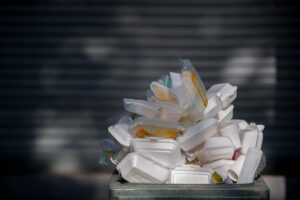
The chemical industry produces over 20 million tons of polystyrene annually for food packaging, electronics and insulation, but less than 1% of the material is recycled. Current recycling methods require large amounts of energy and are inefficient. 

The new method uses excess elemental sulfur, a byproduct of crude oil and natural gas refining. An estimated 70 million tons of elemental sulfur is produced each year. This recycling method could find a climate-friendly use for this waste. 

Sulfur’s dual role

The scientists combined excess elemental sulfur with polystyrene waste, driving the process with solar energy, to generate organic products. The organic products produced included 2,4-diphenylthiophene, used in semiconductor materials, and 1,3,5-triphenylbenzene, a versatile organic building block. The method was used to recycle various waste products, including spoons, cups, food packaging, disposable test tubes and culture plates. 

Mechanistic studies found that sunlight causes a photothermal effect in the sulfur, raising its temperature and generating sulfur radicals. These radicals abstract hydrogen atoms from the polystyrene backbone, causing chain scission and producing sulfur-containing and unsaturated olefin intermediates. 

Hydrated sulfur radicals then react with these intermediates through further transformation steps to produce the final compounds, with H2S generated as a byproduct at a yield of 58% relative to the sulfur used. The process consistently produces 2,4-diphenylthiophene and 1,3,5-triphenylbenzene in an approximately 2:1 ratio, a selectivity governed by the intrinsic chemistry of the reaction rather than external conditions such as sulfur dosage or light intensity. The full conversion takes as little as two minutes under solvent-free ambient air conditions.

From waste to valuable products

Up to 40% of the final reaction mixture is partially degraded polystyrene by weight. However, the team found that this could be used to fully depolymerize polystyrene or act as a UV-blocking additive in polystyrene films. 

Gram-scale transformation has demonstrated a yield of 21% 2,4-diphenylthiophene and 10% of 1,3,5-triphenylbenzene, slightly lower than those achieved at lab scale. The team notes that the process is potentially compatible with large-scale existing photothermal equipment. 

The team is now working on scaling up the process and extending it to other common plastics such as polyethylene, polypropylene and polyvinyl chloride. 
Related Articles Read More >

Researchers use CRISPR to engineer plastic eating microbe
Hawaiian researchers turn plastic waste into roads
These microrobots can collect nanoplastics from water
Five key trends that defined the show floor at Interphex 2026 
rd newsletter
EXPAND YOUR KNOWLEDGE AND STAY CONNECTED
Get the latest info on technologies, trends, and strategies in Research & Development.

R&D World Digital Issues

Fall 2025 issue

Browse the most current issue of R&D World and back issues in an easy to use high quality format. Clip, share and download with the leading R&D magazine today.

R&D 100 Awards
Research & Development World
  • Subscribe to R&D World Magazine
  • Sign up for R&D World’s newsletter
  • Contact Us
  • About Us
  • Drug Discovery & Development
  • Pharmaceutical Processing
  • Global Funding Forecast

Copyright © 2026 WTWH Media LLC. All Rights Reserved. The material on this site may not be reproduced, distributed, transmitted, cached or otherwise used, except with the prior written permission of WTWH Media
Privacy Policy | Advertising | About Us

Search R&D World

  • R&D World Home
  • Topics
    • Aerospace
    • Automotive
    • Biotech
    • Careers
    • Chemistry
    • Environment
    • Energy
    • Life Science
    • Material Science
    • R&D Management
    • Physics
  • Technology
    • 3D Printing
    • A.I./Robotics
    • Software
    • Battery Technology
    • Controlled Environments
      • Cleanrooms
      • Graphene
      • Lasers
      • Regulations/Standards
      • Sensors
    • Imaging
    • Nanotechnology
    • Scientific Computing
      • Big Data
      • HPC/Supercomputing
      • Informatics
      • Security
    • Semiconductors
  • R&D Market Pulse
  • R&D 100
    • 2025 R&D 100 Award Winners
    • 2025 Professional Award Winners
    • 2025 Special Recognition Winners
    • R&D 100 Awards Event
    • R&D 100 Submissions
    • Winner Archive
  • Resources
    • Research Reports
    • Digital Issues
    • Educational Assets
    • Subscribe
    • Video
    • Webinars
    • Content submission guidelines for R&D World
  • Global Funding Forecast
  • Top Labs
  • Advertise
  • SUBSCRIBE