Research & Development World

  • R&D World Home
  • Topics
    • Aerospace
    • Automotive
    • Biotech
    • Careers
    • Chemistry
    • Environment
    • Energy
    • Life Science
    • Material Science
    • R&D Management
    • Physics
  • Technology
    • 3D Printing
    • A.I./Robotics
    • Software
    • Battery Technology
    • Controlled Environments
      • Cleanrooms
      • Graphene
      • Lasers
      • Regulations/Standards
      • Sensors
    • Imaging
    • Nanotechnology
    • Scientific Computing
      • Big Data
      • HPC/Supercomputing
      • Informatics
      • Security
    • Semiconductors
  • R&D Market Pulse
  • R&D 100
    • 2025 R&D 100 Award Winners
    • 2025 Professional Award Winners
    • 2025 Special Recognition Winners
    • R&D 100 Awards Event
    • R&D 100 Submissions
    • Winner Archive
  • Resources
    • Research Reports
    • Digital Issues
    • Educational Assets
    • R&D Index
    • Subscribe
    • Video
    • Webinars
    • Content submission guidelines for R&D World
  • Global Funding Forecast
  • Top Labs
  • Advertise
  • SUBSCRIBE

Surface Helium Detonation Spells End for White Dwarf

By National Institutes of Natural Sciences | October 5, 2017

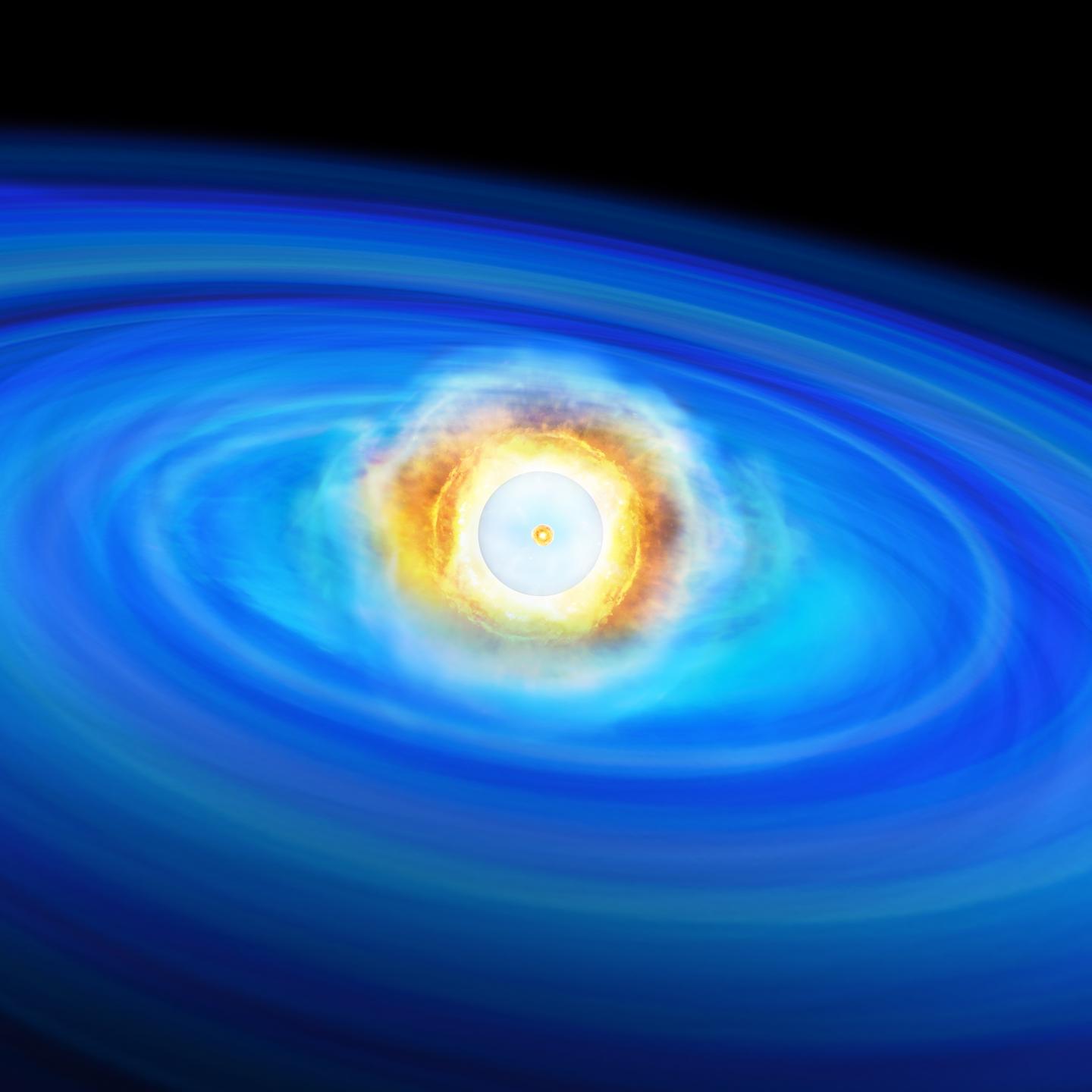
The nuclear detonation of the surface helium layer triggered an inward shock wave, and now carbon nuclear fusion has begun at the center. Source: Institute of Astronomy, University of Tokyo

Some stars end their lives with a huge explosion called a supernova. 

The most famous supernovae are the result of a massive star exploding, but a white dwarf, the remnant of an intermediate mass star like our Sun, can also explode. This can occur if the white dwarf is part of a binary star system. The white dwarf accretes material from the companion star, then at some point, it might explode as a type Ia supernova.

Because of the uniform and extremely high brightness (about 5 billion times brighter than the Sun) of type Ia supernovae, they are often used for distance measurements in astronomy. However, astronomers are still puzzled by how these explosions are ignited. Moreover, these explosions only occur about once every 100 years in any given galaxy, making them difficult to catch.

An international team of researchers led by Ji-an Jiang, a graduate student of the University of Tokyo, and including researchers from the University of Tokyo, the Kavli Institute for the Physics and Mathematics of the Universe (IPMU), Kyoto University, and the National Astronomical Observatory of Japan (NAOJ), tried to solve this problem. To maximize the chances of finding a type Ia supernova in the very early stages, the team used Hyper Suprime-Cam mounted on the Subaru Telescope, a combination which can capture an ultra-wide area of the sky at once. Also they developed a system to detect supernovae automatically in the heavy flood of data during the survey, which enabled real-time discoveries and timely follow-up observations.

They discovered over 100 supernova candidates in one night with Subaru/Hyper Suprime-Cam, including several supernovae that had only exploded a few days earlier. In particular, they captured a peculiar type Ia supernova within a day of it exploding. Its brightness and color variation over time are different from any previously-discovered type Ia supernova. They hypothesized this object could be the result of a white dwarf with a helium layer on its surface. Igniting the helium layer would lead to a violent chain reaction and cause the entire star to explode. This peculiar behavior can be totally explained with numerical simulations calculated using the supercomputer ATERUI. “This is the first evidence that robustly supports a theoretically predicted stellar explosion mechanism!” said Jiang.

This result is a step towards understand the beginning of type Ia supernovae. The team will continue to test their theory against other supernovae, by detecting more and more supernovae just after the explosion. The details of their study were published in Nature on October 5.
 

Related Articles Read More >

NASA R&D 100 Winner enables high-speed data transfer from space
The Milky Way is glowing: these scientists think dark matter may be the cause
Reusable rocket startup raises $510 million
2025 R&D layoffs tracker: hardware and chips lead the year’s biggest cuts while biopharma pares pipelines
rd newsletter
EXPAND YOUR KNOWLEDGE AND STAY CONNECTED
Get the latest info on technologies, trends, and strategies in Research & Development.
RD 25 Power Index

R&D World Digital Issues

Fall 2025 issue

Browse the most current issue of R&D World and back issues in an easy to use high quality format. Clip, share and download with the leading R&D magazine today.

Research & Development World
  • Subscribe to R&D World Magazine
  • Sign up for R&D World’s newsletter
  • Contact Us
  • About Us
  • Drug Discovery & Development
  • Pharmaceutical Processing
  • Global Funding Forecast

Copyright © 2025 WTWH Media LLC. All Rights Reserved. The material on this site may not be reproduced, distributed, transmitted, cached or otherwise used, except with the prior written permission of WTWH Media
Privacy Policy | Advertising | About Us

Search R&D World

  • R&D World Home
  • Topics
    • Aerospace
    • Automotive
    • Biotech
    • Careers
    • Chemistry
    • Environment
    • Energy
    • Life Science
    • Material Science
    • R&D Management
    • Physics
  • Technology
    • 3D Printing
    • A.I./Robotics
    • Software
    • Battery Technology
    • Controlled Environments
      • Cleanrooms
      • Graphene
      • Lasers
      • Regulations/Standards
      • Sensors
    • Imaging
    • Nanotechnology
    • Scientific Computing
      • Big Data
      • HPC/Supercomputing
      • Informatics
      • Security
    • Semiconductors
  • R&D Market Pulse
  • R&D 100
    • 2025 R&D 100 Award Winners
    • 2025 Professional Award Winners
    • 2025 Special Recognition Winners
    • R&D 100 Awards Event
    • R&D 100 Submissions
    • Winner Archive
  • Resources
    • Research Reports
    • Digital Issues
    • Educational Assets
    • R&D Index
    • Subscribe
    • Video
    • Webinars
    • Content submission guidelines for R&D World
  • Global Funding Forecast
  • Top Labs
  • Advertise
  • SUBSCRIBE