Research & Development World

  • R&D World Home
  • Topics
    • Aerospace
    • Automotive
    • Biotech
    • Careers
    • Chemistry
    • Environment
    • Energy
    • Life Science
    • Material Science
    • R&D Management
    • Physics
  • Technology
    • 3D Printing
    • A.I./Robotics
    • Software
    • Battery Technology
    • Controlled Environments
      • Cleanrooms
      • Graphene
      • Lasers
      • Regulations/Standards
      • Sensors
    • Imaging
    • Nanotechnology
    • Scientific Computing
      • Big Data
      • HPC/Supercomputing
      • Informatics
      • Security
    • Semiconductors
  • R&D Market Pulse
  • R&D 100
    • 2025 R&D 100 Award Winners
    • 2025 Professional Award Winners
    • 2025 Special Recognition Winners
    • R&D 100 Awards Event
    • R&D 100 Submissions
    • Winner Archive
  • Resources
    • Research Reports
    • Digital Issues
    • Educational Assets
    • Subscribe
    • Video
    • Webinars
    • PharmSci360
    • Content submission guidelines for R&D World
  • Global Funding Forecast
  • Top Labs
  • Advertise
  • SUBSCRIBE

SwRI awarded $12.8 million to develop space weather instrument

By Heather Hall | April 21, 2020

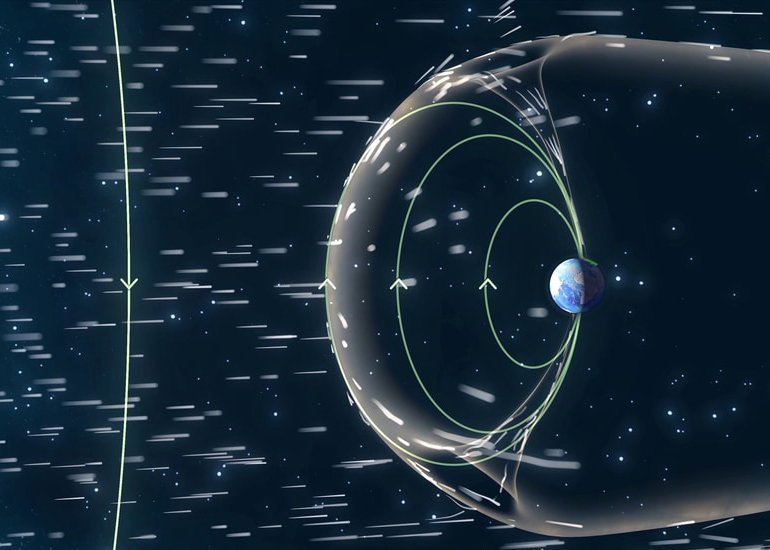
This conceptual image shows the solar wind interacting with Earth’s magnetic field, causing the magnetic field lines to reconnect and resulting in atmospheric loss within the aurora at the polar cusps. Credit:
Courtesy of NASA’s Goddard Space Flight Center

NASA and the National Oceanic and Atmospheric Administration (NOAA) recently awarded Southwest Research Institute a $12,862,664 contract to develop a magnetometer for a satellite mission dedicated to tracking space weather. The magnetometer is part of the satellite’s solar wind instrument suite, which measures the characteristics of the solar wind plasma that interact with the Earth’s geomagnetic environment.

“The satellite will collect solar wind data and coronal imagery to support NOAA’s mission to monitor and forecast space weather events,” said Dr. Roy Torbert, a program director in SwRI’s Earth, Oceans, and Space office at the University of New Hampshire in Durham and principal investigator of the magnetometer. “Space weather refers to the variable conditions on the Sun and in space that can influence the performance of technology we use on Earth, such as electrical power grids, and disrupt satellite-based communication and navigation systems.”

The Space Weather Follow-On Lagrange 1 (SWFO-L1) satellite will orbit the Sun at approximately 1.5 million kilometers from Earth where the Earth’s and the Sun’s magnetic fields meet, a point known as L1. The satellite will make local measurements of the solar wind thermal plasma and magnetic field. It also carries a Compact Coronagraph instrument to detect coronal mass ejections.

“The instrument, known at SWFO-MAG, provides key data about the solar wind as it approaches Earth,” Torbert said. “The data will be available to the science community but are targeted to the Space Weather Prediction Center.”

SwRI will work with UNH to design, develop, fabricate, integrate, calibrate and evaluate the magnetometer instrument. The team will also support launch and on-orbit check-out of the instrument, supply and maintain the instrument’s ground support equipment and support NOAA’s mission operations center as needed. SWFO-MAG includes two three-axis magnetometers and associated electronics to measure the vector interplanetary magnetic field.

“The solar wind magnetic field controls the processes that transfer energy and particles into the Earth’s magnetosphere and often initiate geomagnetic storms,” Torbert said. “These disturbances can create spectacular auroras but can also shut down electrical power grids and disrupt satellite-based communication and navigation systems.”

NASA is planning to launch the SWFO-L1 in 2024 as a rideshare with the Interstellar Mapping and Acceleration Probe vehicle. SwRI also plays a role in this mission, managing the payload and payload systems engineering for IMAP. In addition, SwRI is providing a scientific instrument and other technology for the IMAP spacecraft, which will sample, analyze and map particles streaming to Earth from the edge of interstellar space.

NOAA is responsible for the Space Weather Follow-On program. NASA is the program’s flight system procurement agent, and NASA’s Goddard Space Flight Center in Greenbelt, Maryland, is the lead for acquisition.

For more information, visit Heliophysics
Related Articles Read More >

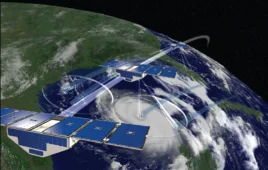
No propulsion, no problem: How CYGNSS’s solar panels will enable deorbit without propulsion 
No storms, no forecast: NASA’s DAPHNE mission targets quiet-time space weather
How a plant virus could keep astronauts medicated on a trip to Mars
The science behind the Prada-designed spacesuit for Artemis 
rd newsletter
EXPAND YOUR KNOWLEDGE AND STAY CONNECTED
Get the latest info on technologies, trends, and strategies in Research & Development.

R&D World Digital Issues

Fall 2025 issue

Browse the most current issue of R&D World and back issues in an easy to use high quality format. Clip, share and download with the leading R&D magazine today.

R&D 100 Awards
Research & Development World
  • Subscribe to R&D World Magazine
  • Sign up for R&D World’s newsletter
  • Contact Us
  • About Us
  • Drug Discovery & Development
  • Pharmaceutical Processing
  • Global Funding Forecast

Copyright © 2026 Arrowfly LLC. All Rights Reserved. The material on this site may not be reproduced, distributed, transmitted, cached or otherwise used, except with the prior written permission of Arrowfly
Privacy Policy | Advertising | About Us

Search R&D World

  • R&D World Home
  • Topics
    • Aerospace
    • Automotive
    • Biotech
    • Careers
    • Chemistry
    • Environment
    • Energy
    • Life Science
    • Material Science
    • R&D Management
    • Physics
  • Technology
    • 3D Printing
    • A.I./Robotics
    • Software
    • Battery Technology
    • Controlled Environments
      • Cleanrooms
      • Graphene
      • Lasers
      • Regulations/Standards
      • Sensors
    • Imaging
    • Nanotechnology
    • Scientific Computing
      • Big Data
      • HPC/Supercomputing
      • Informatics
      • Security
    • Semiconductors
  • R&D Market Pulse
  • R&D 100
    • 2025 R&D 100 Award Winners
    • 2025 Professional Award Winners
    • 2025 Special Recognition Winners
    • R&D 100 Awards Event
    • R&D 100 Submissions
    • Winner Archive
  • Resources
    • Research Reports
    • Digital Issues
    • Educational Assets
    • Subscribe
    • Video
    • Webinars
    • PharmSci360
    • Content submission guidelines for R&D World
  • Global Funding Forecast
  • Top Labs
  • Advertise
  • SUBSCRIBE