Research & Development World

  • R&D World Home
  • Topics
    • Aerospace
    • Automotive
    • Biotech
    • Careers
    • Chemistry
    • Environment
    • Energy
    • Life Science
    • Material Science
    • R&D Management
    • Physics
  • Technology
    • 3D Printing
    • A.I./Robotics
    • Software
    • Battery Technology
    • Controlled Environments
      • Cleanrooms
      • Graphene
      • Lasers
      • Regulations/Standards
      • Sensors
    • Imaging
    • Nanotechnology
    • Scientific Computing
      • Big Data
      • HPC/Supercomputing
      • Informatics
      • Security
    • Semiconductors
  • R&D Market Pulse
  • R&D 100
    • 2025 R&D 100 Award Winners
    • 2025 Professional Award Winners
    • 2025 Special Recognition Winners
    • R&D 100 Awards Event
    • R&D 100 Submissions
    • Winner Archive
  • Resources
    • Research Reports
    • Digital Issues
    • Educational Assets
    • R&D Index
    • Subscribe
    • Video
    • Webinars
    • Content submission guidelines for R&D World
  • Global Funding Forecast
  • Top Labs
  • Advertise
  • SUBSCRIBE

SwRI delivers ultraviolet instrument for ESA’s Jupiter mission

By Heather Hall | February 25, 2020

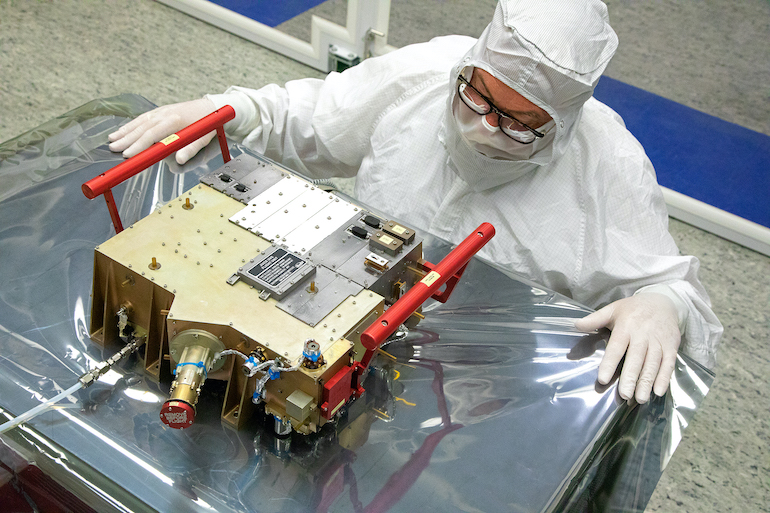
Southwest Research Institute’s Norm Pelletier prepares the Ultraviolet Spectrograph (UVS) for delivery and integration onto the European Space Agency’s JUICE spacecraft. As part of a 10-instrument payload to study Jupiter and its large moons, UVS will measure ultraviolet spectra that scientists will use to study the composition and structure of the atmospheres of these bodies and how they interact with Jupiter’s massive magnetosphere.
Courtesy of Southwest Research Institute

An ultraviolet spectrograph (UVS) designed and built by Southwest Research Institute (SwRI) is the first scientific instrument to be delivered for integration onto the European Space Agency’s Jupiter Icy Moon Explorer (JUICE) spacecraft. Scheduled to launch in 2022 and arrive at Jupiter in 2030, JUICE will spend at least three years making detailed observations in the Jovian system before going into orbit around the solar system’s largest moon, Ganymede.

Aboard JUICE, UVS will get close-up views of the Galilean moons Europa, Ganymede and Callisto, all thought to host liquid water beneath their icy surfaces. UVS will record ultraviolet light emitted, transmitted and reflected by these bodies, revealing the composition of their surfaces and tenuous atmospheres and how they interact with Jupiter and its giant magnetosphere.

“It has been a huge team effort to get this instrument — known as JUICE-UVS — built, tested and delivered,” said Steven Persyn, project manager for JUICE-UVS and an assistant director in SwRI’s Space Science and Engineering Division. “In 2013, UVS was selected to represent NASA on the first ESA-led mission to an outer planet. Meeting both NASA’s and ESA’s specifications was challenging, but we did it.”

UVS will be one of 10 science instruments and 11 investigations for the JUICE mission. The mission has overarching goals of investigating potentially habitable worlds around the gas giant, as well as, studying the Jupiter system as an archetype for gas giants in our solar system and beyond.

SwRI has provided ultraviolet spectrographs for other spacecraft, including ESA’s Rosetta comet orbiter, NASA’s New Horizons spacecraft to Pluto and the Kuiper Belt, the Lunar Reconnaissance Orbiter, and the Juno spacecraft now orbiting Jupiter. Another UVS is under construction for NASA’s Europa Clipper mission, scheduled to launch not long after JUICE.

“JUICE-UVS is the fifth in this series of SwRI-built ultraviolet spectrographs, and it benefits greatly from the design experience gained by our team from the Juno-UVS instrument, which is currently operating in Jupiter’s harsh radiation environment,” Persyn said. “Each successive instrument we build is more capable than its predecessor.”

JUICE is the first large-class mission in ESA’s Cosmic Vision 2015–2025 program. The spacecraft and science instruments are being built by teams from 15 European countries, Japan and the United States. SwRI’s UVS instrument team includes additional scientists from the University of Colorado Boulder, the SETI institute, the University of Leicester (UK), Imperial College London (UK), the University of Liège (Belgium), and the Laboratoire Atmosphères, Milieux, Observations Spatiales (France). The Planetary Missions Program Office at NASA’s Marshall Space Flight Center oversees the UVS contribution to ESA through the agency’s Solar System Exploration Program. The JUICE spacecraft is being developed by Airbus Defence and Space.

For more information, go to Planetary Science or contact Deb Schmid, +1 210 522 2254, Communications Department, Southwest Research Institute, PO Drawer 28510, San Antonio, TX 78228-0510.
Related Articles Read More >

The Milky Way is glowing: these scientists think dark matter may be the cause
Reusable rocket startup raises $510 million
2025 R&D layoffs tracker: hardware and chips lead the year’s biggest cuts while biopharma pares pipelines
Sonar Screen For Submarines And Ships. Radar Sonar With Object On Map. Futuristic HUD Navigation monitor
Pentagon places big bets on frontier AI, quantum sensing and next-gen avionics in nearly $3 billion in defense technology contracts 
rd newsletter
EXPAND YOUR KNOWLEDGE AND STAY CONNECTED
Get the latest info on technologies, trends, and strategies in Research & Development.
RD 25 Power Index

R&D World Digital Issues

Fall 2024 issue

Browse the most current issue of R&D World and back issues in an easy to use high quality format. Clip, share and download with the leading R&D magazine today.

Research & Development World
  • Subscribe to R&D World Magazine
  • Sign up for R&D World’s newsletter
  • Contact Us
  • About Us
  • Drug Discovery & Development
  • Pharmaceutical Processing
  • Global Funding Forecast

Copyright © 2025 WTWH Media LLC. All Rights Reserved. The material on this site may not be reproduced, distributed, transmitted, cached or otherwise used, except with the prior written permission of WTWH Media
Privacy Policy | Advertising | About Us

Search R&D World

  • R&D World Home
  • Topics
    • Aerospace
    • Automotive
    • Biotech
    • Careers
    • Chemistry
    • Environment
    • Energy
    • Life Science
    • Material Science
    • R&D Management
    • Physics
  • Technology
    • 3D Printing
    • A.I./Robotics
    • Software
    • Battery Technology
    • Controlled Environments
      • Cleanrooms
      • Graphene
      • Lasers
      • Regulations/Standards
      • Sensors
    • Imaging
    • Nanotechnology
    • Scientific Computing
      • Big Data
      • HPC/Supercomputing
      • Informatics
      • Security
    • Semiconductors
  • R&D Market Pulse
  • R&D 100
    • 2025 R&D 100 Award Winners
    • 2025 Professional Award Winners
    • 2025 Special Recognition Winners
    • R&D 100 Awards Event
    • R&D 100 Submissions
    • Winner Archive
  • Resources
    • Research Reports
    • Digital Issues
    • Educational Assets
    • R&D Index
    • Subscribe
    • Video
    • Webinars
    • Content submission guidelines for R&D World
  • Global Funding Forecast
  • Top Labs
  • Advertise
  • SUBSCRIBE