
President Trump’s FY2027 budget request would cut NASA by $5.6 billion, with the deepest reductions falling on science and STEM education while leaving Artemis and a planned lunar base camp funded through prior appropriations. The request would cut the Science Mission Directorate by roughly 50%, terminate 27 operating missions, cancel 26 missions in development and…
Three applications of liquid metals for space exploration
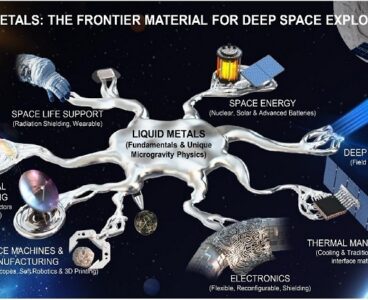
Liquid metals (LMs) have a unique combination of properties that suit the extreme environment of space, such as wide liquid-temperature ranges, high thermal and electrical conductivity, low vapor pressure, large surface tension and responsiveness to electric and magnetic fields. Gallium and bismuth-based alloys are often highlighted as the most promising candidates due to their chemical…
NASA outlines path to Moon base, permanent lunar presence
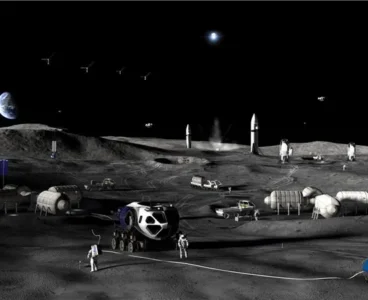
NASA announced a series of agency-wide initiatives designed to achieve President Trump’s National Space Policy on Tuesday. The initiatives include building a Moon base, a plan for continuous American presence on the International Space Station, several science missions and a nuclear-powered interplanetary spacecraft. “NASA is committed to achieving the near‑impossible once again, to return to…
Scientists grow potatoes in moon dust simulant, paving way for lunar agriculture
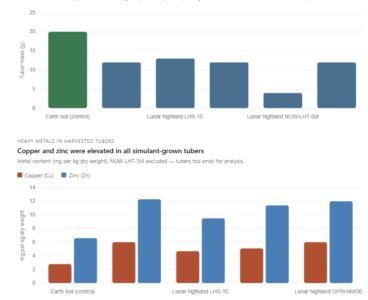
Researchers have shown that potatoes can grow in moon dust-equivalent conditions in a preprint posted on bioRxiv. The researchers used recreated lunar regolith, the powdery dust layer on the moon’s surface, from NASA and Exolith Lab. However, real lunar regolith is missing the organic matter plants need to grow, so the scientists added vermicompost, organic…
Russia unveils prototype for plasma engine that could reach Mars in 1-2 months
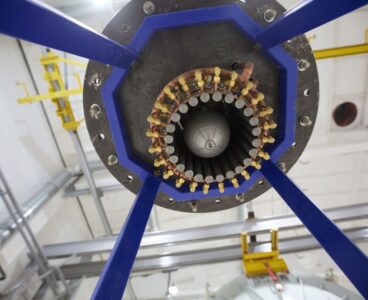
Scientists at Russia’s state nuclear corporation Rosatom have reported developing a plasma engine for deep space travel. They announced that they have already built a laboratory prototype of the craft. This engine uses electrically accelerated plasma (ionized gas) instead of chemical combustion, enabling considerable exhaust velocities. The scientists estimate that they could send a spacecraft…