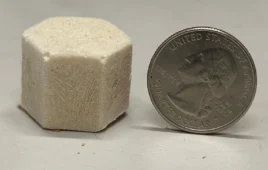
Sodium-ion batteries enter mass production. Calcium-ion cells clear 1,000 cycles. And a counterintuitive discovery at Surrey challenges decades of battery-chemistry orthodoxy.
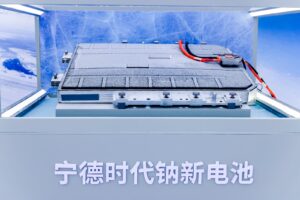
CATL’s Naxtra sodium-ion battery pack in cold-weather testing. The company says the cells deliver nearly triple the discharge power of equivalent LFP batteries at –30°C and retain more than 90 percent capacity at –40°C. (Image: CATL)
On February 5, 2026, CATL and Changan Automobile unveiled what CATL called the world’s first mass-production passenger vehicle equipped with sodium-ion batteries. The vehicle, powered by CATL’s Naxtra cells at an energy density of 175 Wh/kg, is slated for market delivery by mid-2026. MIT Technology Review had already named sodium-ion one of its 10 Breakthrough Technologies for the year. The Changan launch made the technology tangible—and the era of lithium-only energy storage harder to defend.
Lithium supply chains remain concentrated: Australia, Chile and China together account for roughly 72 percent of global lithium mine output, according to USGS data for 2025, and China dominates refining with an average market share near 70 percent across the 20 energy-related minerals analyzed in the IEA’s Global Critical Minerals Outlook 2025. In October 2025, Beijing imposed export controls on specific high-energy-density lithium batteries, cathode materials, artificial graphite anode materials, and related manufacturing equipment, adding to earlier restrictions on rare earth elements.
Meanwhile, Fastmarkets projects the lithium market could swing from a 10,000-tonne oversupply in 2025 to a 1,500-tonne deficit in 2026, while tariffs on certain Chinese lithium-ion batteries imported to the United States could reach 82 percent or higher under stacked trade measures, with the Section 301 rate for non-EV batteries alone set to rise to 25 percent in 2026. The economic and geopolitical case for alternative chemistries has gone from theoretical to urgent.
In late 2025 and early 2026, three separate advances have moved the post-lithium timeline forward, each through a different chemistry and a different mechanism.
Sodium-ion: From niche chemistry to factory floor
CATL’s Naxtra line is the headline, but the underlying science is still evolving. The company’s sodium-ion cells have passed China’s GB 38031-2025 traction battery safety standard, scheduled to take effect in July 2026, making it the first sodium-ion battery to obtain that certification. The batteries deliver nearly triple the discharge power of equivalent lithium iron phosphate (LFP) cells at –30°C, retain more than 90 percent capacity at –40°C, and remained smoke- and fire-free under crush, drill, and saw testing. For cold-climate and safety-critical applications, those numbers matter as much as energy density.
CATL is also pushing a dual-chemistry pack architecture that pairs sodium-ion cells with LFP cells, assigning each chemistry to the functions where it performs best rather than forcing an either-or choice at the platform level. That strategy lowers adoption risk for OEMs and could accelerate deployment across passenger vehicles, commercial trucks, and battery swap systems throughout 2026.
But the most provocative development came from the University of Surrey, where researchers discovered that keeping water inside a key cathode material, the opposite of standard practice in battery manufacturing, nearly doubled its charge storage capacity. The hydrated material charged faster, remained stable across hundreds of cycles, and ranked among the highest-performing sodium-ion cathode materials ever reported. The same system also functioned in seawater, removing sodium and chloride ions electrochemically, pointing toward dual-function devices that could store energy while desalinating water. For coastal and resource-constrained regions, that combination could be transformative.
Calcium-ion: The dark horse clears a threshold
If sodium-ion is the chemistry closest to commercial scale, calcium-ion is the one closest to a conceptual breakthrough. Calcium is roughly 2,000 to 2,500 times more abundant than lithium and offers a comparable electrochemical window, but calcium-ion batteries have historically failed where it matters most: moving ions efficiently through the electrolyte and surviving repeated charge–discharge cycles without rapid degradation.
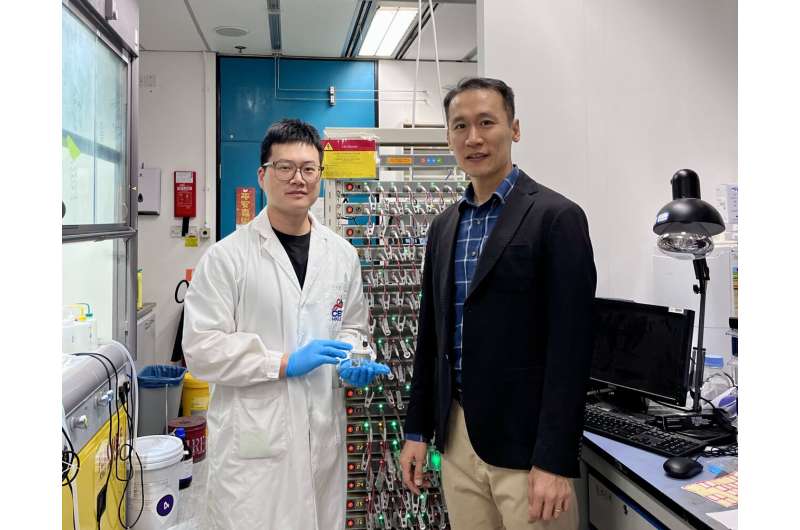
Prof. Yoonseob Kim (right) and a member of his research team at the Hong Kong University of Science and Technology, with battery cycling equipment used to test their calcium-ion cells. The team’s quasi-solid-state electrolyte retained 74.6 percent capacity after 1,000 charge–discharge cycles. (Image: HKUST via TechXplore)
A team at the Hong Kong University of Science and Technology, led by Prof. Yoonseob Kim, appears to have cracked both problems. The researchers engineered a quasi-solid-state electrolyte from redox-active covalent organic frameworks. It is essentially a synthetic material with ordered pores lined with carbonyl groups that act as highways for calcium ions. The electrolyte achieved ionic conductivity of 0.46 mS/cm and a calcium-ion transference number above 0.53 at room temperature. A full cell built with the material delivered a reversible specific capacity of 155.9 mAh/g and retained 74.6 percent of that capacity after 1,000 charge–discharge cycles at high current.
While performance still lags behind lithium-ion, where around 80 percent retention after 1,000 cycles is a common benchmark for commercial battery applications, it represents a step change in calcium-ion durability. Five years ago, calcium-ion cells were fading after a few hundred cycles. The gap is closing, and the material abundance argument (calcium is the fifth most common element in Earth’s crust) makes the chemistry worth watching for grid-scale storage and, eventually, low-cost EVs.
Converging tracks, diverging applications
The pattern emerging in early 2026 is not a single replacement chemistry but a diversifying portfolio. Sodium-ion targets the low-cost, high-safety, cold-climate segment of the market and is already entering production. Calcium-ion addresses the long-term abundance question and is graduating from proof-of-concept to credible lab-scale performance. Solid-state lithium, as documented in this magazine’s earlier coverage of the Verge TS Pro motorcycle and the broader pipeline from Dongfeng, Toyota and BYD, is pursuing the premium end, higher energy density, faster charging, longer range.
Argonne National Laboratory’s 2025 GPRA estimate put average U.S. EV pack costs at $103/kWh for 2025, while its separate BatPaC modeling projects volume-averaged pack costs will fall to roughly $85/kWh by model year 2035. IRENA’s November 2025 technology brief on sodium-ion batteries projects that sodium-ion cell costs could fall to $40/kWh at scale, roughly half the current average, driven by cathode materials based on iron and manganese rather than nickel and cobalt, and by the substitution of aluminum current collectors for copper. IDTechEx pegs the current average sodium-ion cell cost at about $87/kWh, while Wood Mackenzie’s 2025 estimates put sodium-ion at roughly $59/kWh and LFP at about $52/kWh in China, a discrepancy that reflects differences in methodology, time frame, and market scope across analysts. In either case, manufacturing scale rather than underlying chemistry economics appears to account for most of the remaining cost premium. Global sodium-ion production capacity is expected to reach 70 GWh by the end of 2025, with IRENA’s demand projections for 2030 ranging from 50 to 600 GWh per year, a spread that reflects genuine uncertainty about how fast automakers and grid operators will commit to the chemistry. Calcium-ion, if it continues its current trajectory, might eventually compete with LFP for grid-scale installations where cycle life and material cost matter more than energy density, but that timeline is measured in years, not quarters.
For the chemical and materials R&D community, the bottleneck in energy storage has shifted from manufacturing scale to materials innovation: new electrolyte architectures, new cathode chemistries, new approaches to ion transport. The Surrey team’s finding, that a hydrated cathode outperforms the dried version the field has defaulted to for years, is one example. The HKUST calcium-ion work, built on synthetic pore structures that no one had applied to divalent-ion transport before, is another. Neither result was predicted by the prevailing design heuristics.
The raw-material arithmetic underscores the stakes. IRENA notes that sodium carbonate traded between $100 and $500 per tonne from 2020 to 2024; lithium carbonate over the same period ranged from $6,000 to $83,000. That is not a rounding error. It is the cost basis on which the next generation of grid storage and entry-level EVs will be built, or won’t, depending on whether the materials science keeps moving faster than the supply-chain constraints that created the demand for it in the first place.