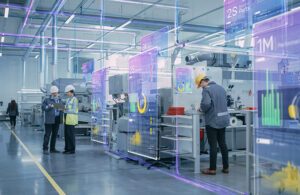
 As 2025 wrapped up and 2026 is beginning, one theme emerged. The factory itself is becoming like one large, integrated robot. Or at least a substantial number of them are.
Industry 4.0, a German-inked framework that promised to bring the next industrial revolution, promised to connect everything with sensors, data networks, AI and automation. For years it was mostly hype: pilot projects, buzzwords, partial implementations that did not talk to each other.
Now, in late 2025 and heading into 2026, those threads are finally linking up in real plants, but only at the leading edge. The entire production line gets layered with IoT sensors (sense), centralized AI and analytics platforms (decide) and automated equipment that adjusts itself (act). That is essentially a factory-sized robot. The concept of the smart factory is becoming real for early adopters. According to Deloitte’s 2025 Smart Manufacturing and Operations Survey, 29% of surveyed manufacturers report using AI and machine learning at the facility or network level. The same survey underscores why progress is uneven: 48% report moderate to significant challenges filling production and operations management roles, and 35% cite adapting workers to the “Factory of the Future” as a top human capital concern.
Below, we will provide examples of trailblazing implementations that are weaving sensors, AI and physical automation into smart factories, themselves resembling single, cohesive factory-sized robot.
(Image from Adobe Stock)
Optimization at the quantum limit
The historical bottleneck of manufacturing, production scheduling, got a proof point in 2025. In a pilot at a BASF liquid-filling facility, D-Wave and BASF reported using a hybrid quantum approach to cut projected scheduling time from 10 hours on a classical solver to roughly five seconds. The objective function explicitly targeted setup-time minimization, tank offloading time and product tardiness, and the project reported improvements of 14% lower lateness, 9% lower setup time, and up to 18% shorter tank unloading durations.
Separately, IonQ partnered with Oak Ridge National Laboratory on the GRID-Q project, applying a hybrid quantum-classical method on a 36-qubit Forte Enterprise system to the unit commitment problem. In IonQ’s description, the demonstration produced power generation schedules across 24 time periods and 26 generators, and the company argues that 100 to 200 high-fidelity qubits, anticipated as early as 2026, could be a threshold for much larger grid-scale instances. The manufacturing implication is indirect but important: energy optimization is becoming a compute problem that looks more and more like production optimization.
Autonomous orchestration and agentic workflows
In 2025, “industrial copilots” started to evolve toward something more operational: AI agents that can execute multi-step tasks across engineering and production software, with less hand-holding. Siemens’ Industrial AI agents, announced at Automate 2025 in Detroit, are positioned in that direction, extending beyond Q&A and code suggestions toward workflow automation inside industrial toolchains. Coverage of early deployments, including reporting around ThyssenKrupp Automation Engineering, points to practical gains like faster engineering cycles and reduced manual overhead in routine development tasks.
National labs pushed the same idea into materials and chemistry, where “agentic workflows” can coordinate instruments, analysis and experimental planning. Argonne highlighted “Polybot” as part of its 2025 research portfolio, and ORNL’s INTERSECT initiative connects autonomous labs to the Frontier exascale supercomputer to shorten the loop between hypothesis and validated process.
It is also becoming a market category. According to Mordor Intelligence, agentic AI in manufacturing and industrial automation reached roughly $5.5 billion in 2025, reflecting a real shift from bespoke pilots toward more standardized tooling.
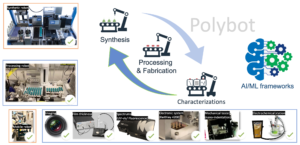
A Polybot diagram as shown on Argonne National Lab’s website.
Physical AI and synthetic training trajectories
Robotics progress in 2025 was less about a single new gripper and more about training velocity. Synthetic data and simulation are compressing timelines that used to be measured in multi-year iterations. Amazon offers a concrete example of compressed cycles: in late 2025, the company said its Blue Jay robotics system moved from concept to production in just over a year, crediting faster iteration to advances in AI and the use of digital twins for rapid prototyping. (About Amazon’s Blue Jay announcement)
NVIDIA’s synthetic-data push illustrates the scale. With the NVIDIA Isaac GR00T Blueprint, NVIDIA reported generating 780,000 synthetic trajectories in 11 hours, framed as the equivalent of 6,500 hours of human demonstration data. Whether or not every organization reaches those ratios, the direction is clear: training data is becoming manufactured, not collected.
This is also reshaping factory and fab planning. NVIDIA has said TSMC is using Omniverse to accelerate fab design and construction at its Phoenix, Arizona, facility and that Foxconn is using Omniverse to design and simulate a 242,287-square-foot facility in Houston for manufacturing NVIDIA AI infrastructure systems.
Supporting all of this, cooling and power delivery are becoming first-order constraints. Research highlighted by Florida Atlantic University reported that direct-to-chip liquid cooling can deliver up to 17% higher throughput while reducing node-level power consumption by 16% in GPU clusters, a reminder that “AI factories” are still factories, bounded by thermals and electrical limits.
Convergent fabrication and structural integrity
At the hardware level, Oak Ridge National Laboratory’s “Future Foundries” work made a strong case that additive manufacturing becomes far more competitive when it stops being a sequence of isolated steps. ORNL’s Future Foundries platform integrates wire arc additive manufacturing (WAAM), heat treatment, inspection and machining into a palletized system designed for automation. ORNL reports a 68% reduction in production cycle time compared with conventional approaches.
The bigger point is quality control, moved upstream. The platform emphasizes in-process inspection and aims to catch 99% of targeted flaws during the build, with a stated goal of cutting downstream quality-control measures by 75%. That kind of shift matters in a country that ORNL notes has seen roughly a 40% decline in domestic casting over the past two decades, leaving expensive gaps in the ability to produce large, complex metal parts at scale. The program also received a 2025 R&D 100 Award, reinforcing that this is being treated as an industrial platform, not a one-off machine.
High-performance aerospace and multi-material DED
Aerospace continued to be a proving ground for multi-material deposition, where the “material recipe” changes within the part rather than between parts. In work reported on directed energy deposition (DED) of a 3-ton rocket nozzle, InssTek and the Korea Aerospace Research Institute demonstrated transitions between copper alloys and Inconel 625 aimed at putting the right properties in the right zones, something traditional casting struggles to do cleanly at this scale.
Relativity Space also marked a production milestone, saying it began flight production for Terran R in March 2025, alongside progress on Aeon R engine testing and simulation. The company has described its Terran R backlog as exceeding $2.9 billion, a signal that hybrid manufacturing narratives are being tested against real purchase commitments, not just engineering ambition.
Materials science and inert chemistry
In heavy industry, 2025 included meaningful steps toward “inert” or fossil-free process pathways, where emissions are designed out of the chemistry rather than offset after the fact.
ELYSIS, the Alcoa and Rio Tinto joint venture, announced the start-up of a commercial-size inert anode cell in November 2025, a route that replaces carbon anodes and releases oxygen instead of CO2 during aluminum smelting. The 450-kiloampere cell at Rio Tinto’s Alma, Québec smelter marks the first implementation of inert anode technology at commercial scale. In steel, SSAB’s HYBRIT initiative continued pushing fossil-free iron and steel production toward industrialization, with the longer arc being industrial-scale hydrogen and process integration.
Cement is moving on a parallel track. Heidelberg Materials inaugurated the Brevik project in Norway, widely cited as the first industrial-scale carbon capture facility integrated with a cement plant, with a stated capture capacity of 400,000 tonnes of CO2 per year and branding tied to its evoZero near-zero cement offering. Whatever the branding, the operational fact is the key: cement decarbonization is increasingly about capture systems engineered as plant infrastructure, not small trials.
The silicon frontier: GAA and backside power
Semiconductors are not “manufacturing” in the classical sense, but they are manufacturing at the highest possible precision, and their process innovations spill into the rest of industrial automation.
Intel’s 18A node, combining RibbonFET gate-all-around transistors with PowerVia backside power delivery, advanced through 2025 toward high-volume production. Intel has pointed to high-volume manufacturing by the end of 2025 for Panther Lake, with broad availability expected in January 2026. In technical disclosures around 18A, Intel has claimed power and performance gains versus Intel 3 that depend on operating conditions, including roughly 25% higher performance at the same voltage and frequency, or 36% lower power at a given point, and 38% lower power at a lower-voltage condition. The significance is not just the percentages, it is the simultaneous introduction of two major integration changes in a production node.
Digital twins are also being pushed at the ecosystem level. The U.S. government awarded $285 million to establish the SMART USA Institute for semiconductor manufacturing and advanced research with digital twins, including a “SMART Backbone” concept intended to connect interoperable twins across the development stack. The stated targets include more than 35% reduction in development and manufacturing costs and a 40% improvement in process yield. However, heading into 2026, the program’s status is less settled than it looked at the start of 2025. Multiple reports in December 2025 indicate the federal contract was terminated “for convenience,” with the Commerce Department notifying SMART USA on December 10. For manufacturers, it is a reminder that industrial digital infrastructure is increasingly entangled with funding continuity and governance.
Predictive maintenance and quantified reliability
Maintenance is one of the places where “closed loop” becomes tangible: either downtime drops or it does not.
In an April 2025 Siemens case write-up on Senseye Predictive Maintenance, Siemens describes an automotive OEM connecting to more than 10,000 assets across four continents and reporting a 12% reduction in unplanned downtime within 12 weeks of deployment, along with early warnings for several high-impact failures.
Connectivity is part of reliability, too. Tesla has highlighted private 5G at its Berlin-Brandenburg Gigafactory as a way to extend reliable coverage to outdoor areas and mobile equipment. An SNS Telecom & IT market note adds a more specific figure: it attributes “up to 90%” improvement in “overcycle issues” for a particular process in the general assembly shop to the Berlin private 5G rollout. (For Tesla’s own rollout framing via the factory video: Fierce Network coverage. For the “up to 90%” figure as attributed to SNS: SNS Telecom & IT.)
AI vision and cobot deployment velocity
Quality control is one of the clearest wins for factory AI vision. Audi says it uses AI to analyze around 1.5 million spot welds on 300 vehicles each shift at its Neckarsulm site, moving beyond earlier ultrasound random sampling for resistance spot welding (abbreviated WPS in German). (Audi MediaCenter) The Automotive Lean Production Award jury write-up on “WPS Analytics” describes a comprehensive 100% check of spot welds in the Audi A6 and A7 body shop, alongside continued random inspection via ultrasound, at roughly the same 1.5 million-weld scale per shift. (Automotive Lean Production Award, Digital Use Case winner)
On the robotics side, vendors are packaging more of the “AI stack” into deployable kits. Universal Robots positions its AI Accelerator as a route to cycle-time improvements and faster application development, and FANUC’s late-2025 CRX-3iA announcement fits a broader pattern: collaborative robots tuned for constrained labor markets, especially in welding and small-shop automation.
The no-code barrier and workforce constraints
One reason the quantified factory is arriving unevenly is that software integration remains a bottleneck. No-code and low-code tools are increasingly framed as manufacturing infrastructure, not just IT convenience. Tulip has positioned itself as a leader in no-code manufacturing execution and automation platforms like Vention’s MachineMotion AI are explicitly designed to shorten the path from “we should automate this” to a running cell.
But people remain the limiting reagent. Programs like Virginia Tech’s “Made” are attempts to coordinate advanced manufacturing research and talent pipelines, and the ARM Institute’s 2025 workforce reporting underscores the same tension: the tools are advancing faster than the median organization’s ability to staff, train and govern them.
Conclusion
In 2025, the manufacturing story was the transition from instrumentation to autonomy. Scheduling got fast enough to run as a response loop. Simulation got integrated enough to shape facilities before concrete is poured. Robots got trained fast enough to keep up with changing SKU mixes. Quality control got pushed earlier, closer to the moment defects are created.
That is the quantified factory in practice. The capability is increasingly real: a reported 7,200-fold scheduling-time compression in a BASF proof of concept (from 10 hours to 5 seconds), a 68% cycle-time reduction claim in an integrated additive platform and first commercial-sized steps in inert anode aluminum and industrial cement carbon capture. The hard part for 2026 is not whether the building blocks exist. It is whether manufacturers can scale them with the human infrastructure, integration discipline and governance needed to keep closed-loop systems both productive and trustworthy.