Research & Development World

  • R&D World Home
  • Topics
    • Aerospace
    • Automotive
    • Biotech
    • Careers
    • Chemistry
    • Environment
    • Energy
    • Life Science
    • Material Science
    • R&D Management
    • Physics
  • Technology
    • 3D Printing
    • A.I./Robotics
    • Software
    • Battery Technology
    • Controlled Environments
      • Cleanrooms
      • Graphene
      • Lasers
      • Regulations/Standards
      • Sensors
    • Imaging
    • Nanotechnology
    • Scientific Computing
      • Big Data
      • HPC/Supercomputing
      • Informatics
      • Security
    • Semiconductors
  • R&D Market Pulse
  • R&D 100
    • 2025 R&D 100 Award Winners
    • 2025 Professional Award Winners
    • 2025 Special Recognition Winners
    • R&D 100 Awards Event
    • R&D 100 Submissions
    • Winner Archive
  • Resources
    • Research Reports
    • Digital Issues
    • Educational Assets
    • Subscribe
    • Video
    • Webinars
    • Content submission guidelines for R&D World
  • Global Funding Forecast
  • Top Labs
  • Advertise
  • SUBSCRIBE

Thermo Fisher launches Vulcan Automated Lab to accelerate semiconductor analysis with AI-powered TEM metrology workflow

By Heather Hall | March 19, 2025

Thermo Fisher Scientific has unveiled the Vulcan Automated Lab, a fully integrated system designed to streamline transmission electron microscopy (TEM) workflows and enhance semiconductor process control. The industry is under increasing pressure to deliver atomic-scale precision at high volumes amid global demand for advanced chips.
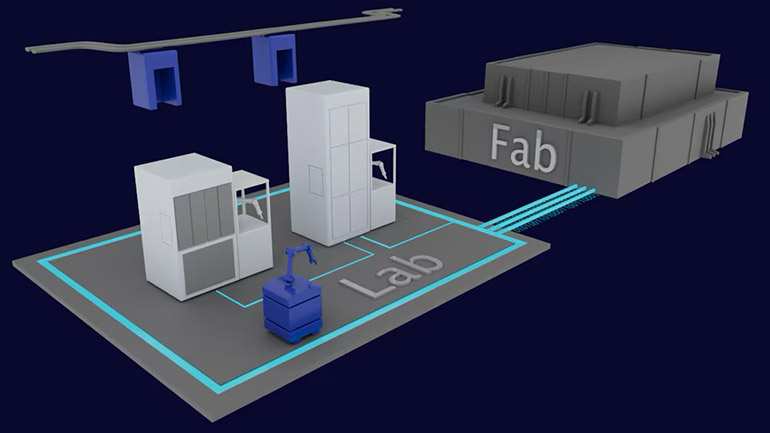
The Vulcan system integrates robotic sample handling, artificial intelligence (AI)-enhanced imaging, and high-throughput TEM metrology into a unified platform. Thermo Fisher asserts that this approach minimizes manual bottlenecks and improves the consistency and speed of critical measurements used in semiconductor fabrication.

Meeting the demands of next-generation chip manufacturing.

As semiconductor devices shrink and grow more complex, the need for atomic-resolution analytical tools has rapidly increased. Transmission electron microscopy is a key technique for inspecting material structures, process nodes, and failure points at the nanometer and atomic scales.

Traditionally, TEM workflows in semiconductor labs require specialized operators and involve lengthy delays between imaging and actionable data. The Vulcan Automated Lab aims to bridge this gap by automating the entire workflow — from sample loading to data interpretation — while integrating with fabrication environments for real-time lab-to-fab data exchange.

What makes the Vulcan System unique?

According to Thermo Fisher, Vulcan is among the first commercially available systems to combine:

• Fully robotic materials handling

• AI-driven image analysis

• Automated, high-throughput TEM metrology

• Digital integration with semiconductor fab operations

This sets it apart from many existing electron microscopy systems, which often rely on semi-automated or modular add-ons and may lack direct connectivity with fab infrastructure.

The system is designed to help manufacturers reduce time-to-data, enhance yield analysis, and address growing labor constraints in analytical labs. Thermo Fisher claims it can accelerate process development cycles and enable quicker decision-making in high-volume production environments.

Industry context and outlook

The launch of the Vulcan system reflects broader industry trends toward automated metrology, AI-enhanced imaging, and lab-fab integration. Competing tools from JEOL, Hitachi, and in-house systems at chipmakers like Intel and imec have introduced various automation and imaging capabilities. However, fully integrated, commercially available platforms remain relatively rare.

“By combining decades of electron microscopy expertise with advanced automation and AI, the Vulcan Automated Lab addresses a key pain point in semiconductor metrology.” — Marc N. Casper, Thermo Fisher’s chairman and CEO.


Related Articles Read More >

Helium shortage puts lab vacuum technology under pressure
When can organoids help pharma make the leap from mice to human biology?
Thermo Fisher Scientific opens bioprocess design center with 4,000 sq. ft. of lab and training space
How Thermo Fisher built FluidEase Pro ClipTip, its first touchscreen pipette
rd newsletter
EXPAND YOUR KNOWLEDGE AND STAY CONNECTED
Get the latest info on technologies, trends, and strategies in Research & Development.

R&D World Digital Issues

Fall 2025 issue

Browse the most current issue of R&D World and back issues in an easy to use high quality format. Clip, share and download with the leading R&D magazine today.

R&D 100 Awards
Research & Development World
  • Subscribe to R&D World Magazine
  • Sign up for R&D World’s newsletter
  • Contact Us
  • About Us
  • Drug Discovery & Development
  • Pharmaceutical Processing
  • Global Funding Forecast

Copyright © 2026 WTWH Media LLC. All Rights Reserved. The material on this site may not be reproduced, distributed, transmitted, cached or otherwise used, except with the prior written permission of WTWH Media
Privacy Policy | Advertising | About Us

Search R&D World

  • R&D World Home
  • Topics
    • Aerospace
    • Automotive
    • Biotech
    • Careers
    • Chemistry
    • Environment
    • Energy
    • Life Science
    • Material Science
    • R&D Management
    • Physics
  • Technology
    • 3D Printing
    • A.I./Robotics
    • Software
    • Battery Technology
    • Controlled Environments
      • Cleanrooms
      • Graphene
      • Lasers
      • Regulations/Standards
      • Sensors
    • Imaging
    • Nanotechnology
    • Scientific Computing
      • Big Data
      • HPC/Supercomputing
      • Informatics
      • Security
    • Semiconductors
  • R&D Market Pulse
  • R&D 100
    • 2025 R&D 100 Award Winners
    • 2025 Professional Award Winners
    • 2025 Special Recognition Winners
    • R&D 100 Awards Event
    • R&D 100 Submissions
    • Winner Archive
  • Resources
    • Research Reports
    • Digital Issues
    • Educational Assets
    • Subscribe
    • Video
    • Webinars
    • Content submission guidelines for R&D World
  • Global Funding Forecast
  • Top Labs
  • Advertise
  • SUBSCRIBE