The Electric Propulsion Club (EPC) at the University of Alabama in Huntsville (UAH) recently showcased its experimental gridded ion thruster, STARGATE, at the 75th International Astronautical Congress (IAC) in Milan, Italy. The group, comprised of undergraduate students, presented its proprietary plasma production technology for small satellite propulsion in low Earth and geostationary orbits.
To provide perspective, NASA’s Evolutionary Xenon Thruster (NEXT) is a gridded-ion thruster. Compared to chemical and other electric propulsion technologies, NEXT enables larger payload deliveries, reduces the size of launch vehicles, and offers other mission improvements for Discovery, New Frontiers, Mars Exploration, and Flagship outer-planet exploration missions. Ion propulsion has been researched since the early 1960s.
Addressing the growing demand for small satellite propulsion
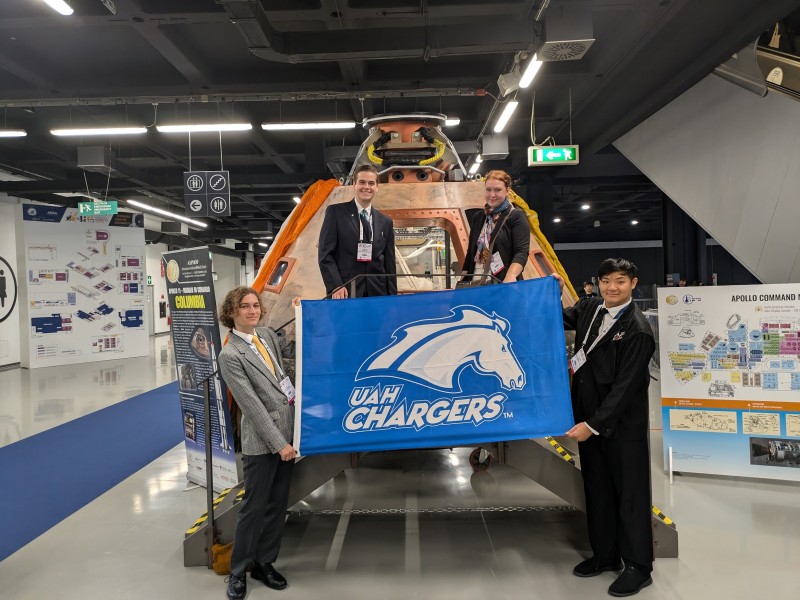
(Front row, L-R) Claude Blue, research lead and EPC president; Noa Milivojevic, chief mechanical engineer at EPC. (Back row, L-R) Ella Hazle is a sophomore in aerospace engineering; Dmitri Tsahelnik is studying aerospace engineering and physics as a sophomore.
The rise of small satellites has created an unprecedented need for compact, low-power electric propulsion (EP) systems capable of enabling advanced functionalities like autonomous station-keeping, collision avoidance, orbit modification, and deorbiting. The STARGATE system offers an innovative alternative to conventional methods, using corona discharge reactions rather than traditional hollow cathode or radio frequency approaches for plasma generation.
“We are developing a new type of gridded ion thruster for small satellite propulsion applications that utilize the corona discharge reaction for plasma production,” explains Claude Blue, EPC president and research lead. “This technology is in the process of being patented with the UAH Office of Technology Commercialization (OTC).”
How the thruster works
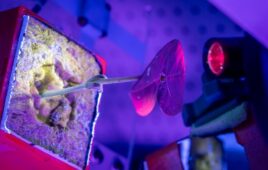
Gridded ion thrusters use electric fields to accelerate ions for propulsion. The STARGATE system incorporates a corona discharge process, where plasma is created by ionizing a neutral fluid, such as air, using an electrical current between electrodes. This setup facilitates efficient energy transfer and thrust generation, making it suitable for small satellite missions.
Presentation at the IAC
The IAC, attended by over 11,000 participants from 120 countries, offered EPC members valuable exposure and networking opportunities. The team included Blue, Noa Milivojevic, chief mechanical engineer; Dmitri Tsahelnik, a sophomore in aerospace engineering and physics; and Ella Hazle, a sophomore in aerospace engineering. The group connected with industry professionals, potential collaborators, and supporters interested in advancing their technology.
Recognitions and support
The EPC’s journey to the IAC was made possible after winning the 2023 Von Braun Symposium Student Poster Contest, which led to sponsorship by the American Astronautical Society. Additional support came from various UAH departments and faculty, including Dr. Themistoklis Chronis, faculty advisor, and Dr. James Miller, chair of the UAH physics department.
“Our other supporters include Debora Nielson of the Alabama Space Grant Consortium, UAH leadership, and engineering faculty,” Blue notes. “It’s very inspiring to see everyone coming together to build the future. We gained insights into the current state of the space industry, saw groundbreaking technologies, and identified new resources for future project phases.”
As EPC pursues a patent for the STARGATE system, the team aims to refine the technology and contribute to the evolving field of satellite propulsion.