Research & Development World

  • R&D World Home
  • Topics
    • Aerospace
    • Automotive
    • Biotech
    • Careers
    • Chemistry
    • Environment
    • Energy
    • Life Science
    • Material Science
    • R&D Management
    • Physics
  • Technology
    • 3D Printing
    • A.I./Robotics
    • Software
    • Battery Technology
    • Controlled Environments
      • Cleanrooms
      • Graphene
      • Lasers
      • Regulations/Standards
      • Sensors
    • Imaging
    • Nanotechnology
    • Scientific Computing
      • Big Data
      • HPC/Supercomputing
      • Informatics
      • Security
    • Semiconductors
  • R&D Market Pulse
  • R&D 100
    • 2025 R&D 100 Award Winners
    • 2025 Professional Award Winners
    • 2025 Special Recognition Winners
    • R&D 100 Awards Event
    • R&D 100 Submissions
    • Winner Archive
  • Resources
    • Research Reports
    • Digital Issues
    • Educational Assets
    • R&D Index
    • Subscribe
    • Video
    • Webinars
    • Content submission guidelines for R&D World
  • Global Funding Forecast
  • Top Labs
  • Advertise
  • SUBSCRIBE

Using Fibre-Optic Cables to Detect Earthquakes

By Helmholtz Association of German Research Centres | July 3, 2018

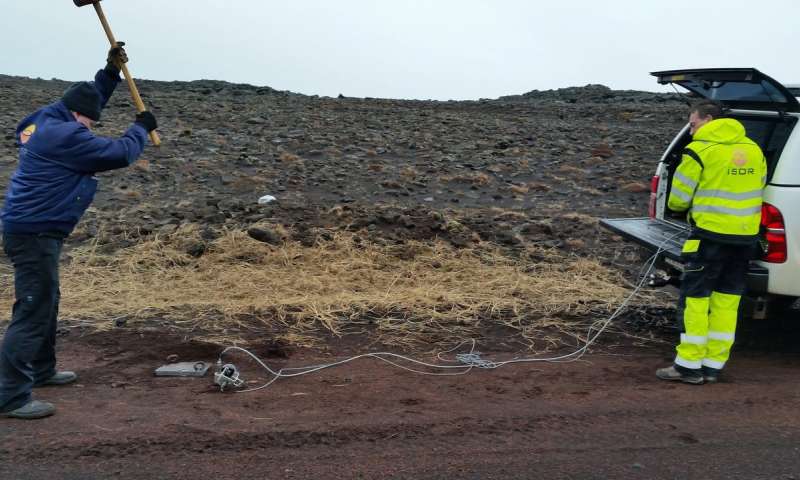
Fiber-optic cables can be used to detect earthquakes and other ground movements. The data cables can also pick up seismic signals from hammer shots, passing cars or wave movements in the ocean. Credit: Philippe Jousset for GFZ German Research Centre for Geosciences (P. Jousset/GFZ)

Fibre-optic cables can be used to detect earthquakes and other ground movements. The data cables can also pick up seismic signals from hammer shots, passing cars or wave movements in the ocean. This is the result of a study appearing in the journal Nature Communications on July 3 2018. The main authors are Philippe Jousset and Thomas Reinsch from GFZ German Research Centre for Geosciences. They carried out the investigation together with colleagues from Island, UK, Berlin, Germany, and Potsdam, Germany.

The scientists sent pulses of laser light through an optical fibre, which was part of a 15 kilometer cable deployed in 1994 within the telecommunication network on Reykjanes peninsula, SW Island, crossing a well-known geological fault zone in the rift between Eurasian and American tectonic plates. The light signal was analyzed and compared to datasets from a dense network of seismographs. The results amazed even experts: “Our measurements revealed structural features in the underground with unprecedented resolution and yielded signals equaling data points every four meters,” says Philippe Jousset from the GFZ. He adds, “This is denser than any seismological network worldwide.”

After presenting preliminary ideas at several conferences since 2016, Philippe was told that the new method was a “game changer for seismology.” Although the method is not new in other applications (it is used for years in boreholes for reservoir monitoring), the team is the first worldwide to conduct such measurements for seismological objectives, and with such a long cable.

Their current study not only shows well-known faults and volcanic dykes. The scientists also found a previously unknown fault below the ground surface. Furthermore, the team measured subsurface deformation taking place over a period of several minutes. Small local earthquakes, waves originating from large distant quakes, and microseisms of the ocean floor were also recorded via fibre-optic cable. “We only need one strand of a modern fibre-optic line,” says Charlotte Krawczyk, Director of GFZ’s Geophysics Department.

The advantages of the new method are enormous, as there are countless fibre-optic cables spanning the globe in the dense telecommunication network. Beneath megacities with high seismic hazards such as San Francisco, Mexico City, Tokyo, Istanbul, and many others, such cables could provide a cost-efficient addition to existing seismological measuring devices.

Future studies are planned to investigate whether deep-sea cables can also be used for seismic measurements. The scientists are optimistic. They think that the cables on the sea floor will detect submarine earthquakes, ground motions of tectonic plates, and also variations of the water pressure. Thus, the new method will help seismologists as well as oceanographers.

 

Related Articles Read More >

New video series: Travel for engineers
Advanced Manufacturing and Process Innovation Special Report: When you can’t hire, you automate
Pancreas or pancreatic cancer with organs and tumors or cancerous cells 3D rendering illustration with male body. Anatomy, oncology, disease, medical, biology, science, healthcare concepts.
AI tool used to detect pancreatic cancer in routine CT scans in China 
R&D 100 Red Carpet: DuPont’s triple win
rd newsletter
EXPAND YOUR KNOWLEDGE AND STAY CONNECTED
Get the latest info on technologies, trends, and strategies in Research & Development.
RD 25 Power Index

R&D World Digital Issues

Fall 2025 issue

Browse the most current issue of R&D World and back issues in an easy to use high quality format. Clip, share and download with the leading R&D magazine today.

R&D 100 Awards
Research & Development World
  • Subscribe to R&D World Magazine
  • Sign up for R&D World’s newsletter
  • Contact Us
  • About Us
  • Drug Discovery & Development
  • Pharmaceutical Processing
  • Global Funding Forecast

Copyright © 2026 WTWH Media LLC. All Rights Reserved. The material on this site may not be reproduced, distributed, transmitted, cached or otherwise used, except with the prior written permission of WTWH Media
Privacy Policy | Advertising | About Us

Search R&D World

  • R&D World Home
  • Topics
    • Aerospace
    • Automotive
    • Biotech
    • Careers
    • Chemistry
    • Environment
    • Energy
    • Life Science
    • Material Science
    • R&D Management
    • Physics
  • Technology
    • 3D Printing
    • A.I./Robotics
    • Software
    • Battery Technology
    • Controlled Environments
      • Cleanrooms
      • Graphene
      • Lasers
      • Regulations/Standards
      • Sensors
    • Imaging
    • Nanotechnology
    • Scientific Computing
      • Big Data
      • HPC/Supercomputing
      • Informatics
      • Security
    • Semiconductors
  • R&D Market Pulse
  • R&D 100
    • 2025 R&D 100 Award Winners
    • 2025 Professional Award Winners
    • 2025 Special Recognition Winners
    • R&D 100 Awards Event
    • R&D 100 Submissions
    • Winner Archive
  • Resources
    • Research Reports
    • Digital Issues
    • Educational Assets
    • R&D Index
    • Subscribe
    • Video
    • Webinars
    • Content submission guidelines for R&D World
  • Global Funding Forecast
  • Top Labs
  • Advertise
  • SUBSCRIBE