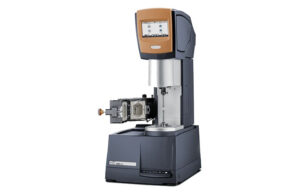
 Waters unveiled the ARES-G3 Rheometer at the Pittcon 2026 Conference in San Antonio today. The company is positioning the instrument as a step change in materials characterization speed and data density. Built under the company’s TA Instruments brand, the system captures up to 25,000 data points per second: 10 times the rate of its predecessor, the ARES-G2, and can cut standard rheology test times by up to 80%, according to the company.
In practical terms, Waters says routine QC tests that previously consumed most of a work shift can now be completed in roughly one to two hours, depending on the application and material. The company estimates this kind of acceleration could save teams hundreds of workdays per year under typical operating conditions, making ot possible to perform multiple tests per day.
The performance gains stem from the instrument’s integrated Fast Frequency Chirps technology, which enables rapid frequency sweeps directly within the system’s enhanced TRIOS software. The approach eliminates the need for separate software licenses or advanced programming expertise that rheologists previously needed to run chirp-based experiments
Sustainability bottleneck
On the Pittcon show floor, a TA Instruments spokesperson framed the instrument as a response to an industrywide bottleneck in materials characterization. The push toward more sustainable formulations, new engineered plastics, bio-based composites, novel polymer blends, has generated a surge in the volume and complexity of materials that need to be tested. Labs supporting business units developing these next-generation materials have found themselves running more tests that take longer, creating a backlog between R&D and commercialization.
“Rheology labs are under enormous pressure to deliver better data, faster, to unlock breakthroughs and support business decisions,” said Dan Rush, Senior Vice President of Waters Materials Sciences, in a release. “We’re pleased to deliver a cutting-edge instrument that can provide unique data in record time, providing novel insights and empowering our customers to meet these increasing demands.”
From baby formula to polyethylene
The instrument’s target applications span a wide viscosity range. At the show, TA Instruments demonstrated its relevance across low-viscosity fluids like liquid food products through to polymer melts used in packaging and water bottles. Primary verticals include aerospace, automotive, adhesives, electronics and advanced materials and chemicals, with additional interest from academic researchers studying the fundamental flow behavior of novel materials.
The common thread across these use cases is the need to capture material behavior during rapid transitions, curing adhesives, degrading biopolymers, fast-setting coatings, where conventional rheometers have historically missed critical data. The ARES-G3’s 25,000-point-per-second acquisition rate is specifically designed to resolve what happens when a material shifts from a low-viscosity fluid to a solid, providing deeper insight into transition kinetics.
Fewer calibrations, lower error margins
The ARES-G3 can perform many tests without requiring user calibrations, reducing the margin for human error, a meaningful consideration in regulated environments and high-throughput QC labs where operator variability can introduce inconsistencies. The system features a touchscreen interface, and test procedures loaded into the software execute with minimal manual intervention once a sample is prepared.
The system also maintains full backward compatibility with existing ARES-G2 methods and fixtures, meaning labs can adopt the new hardware without rebuilding their method libraries from scratch.