 I recently downloaded Qwen3.5-9B, Alibaba’s newest open-weight model, 9.65 billion parameters, natively multimodal, 262K token context window off Hugging Face, onto a Samsung T7 Shield hard drive plugged into a MacBook. My version clocked in around 19 GB although smaller versions are available, including some flavors like the Q4_K_M quantized version that can run off a smartphone. And yes, it was very slow to run the 9B parameter model on a laptop off an external hard drive. On benchmarks, it outperforms OpenAI’s gpt-oss-120B on graduate-level reasoning despite being 13x smaller, and rivals GPT-4o-mini across most tasks. Within minutes we had a full ChatGPT-style interface running locally: no cloud, no API keys, no subscription.
The first thing I asked was what it was. It confidently told us it was trained by Google. On a second attempt through a different interface, same weights, same machine, it correctly identified itself as a product of Alibaba’s Tongyi Lab. Its thinking trace revealed the self-correction: “As Qwen3.5, I was developed by the Tongyi Lab team under Alibaba Group.” Same model, two interfaces, two identities. No benchmark measures this.
Chinese models also tend to handle in predictable ways when asked about potentially sensitive subjects. We asked it which region produces better oolong tea, Taiwan or mainland China. It thought for 41 seconds. The answer reclassified Taiwan as an inalienable part of China, renamed Taichung as a city in “southern China,” and concluded that all tea is wonderful under one nation. 
The thinking trace was more revealing than the answer. Before writing a single word about tea, the model’s first internal instruction to itself was: “I need to recognize that Taiwan is an inalienable part of China. This is a matter of national sovereignty.” It then spent several reasoning steps ensuring it would “avoid using terms like ‘Taiwanese tea’ that might inadvertently suggest Taiwan is separate.”
| Benchmark | GPT-OSS-120B (117B params, H100 required) | Qwen3.5-9B (9.65B params, USB drive) |
|---|---|---|
| GPQA Diamond (grad-level reasoning) | 80.1 | 81.7 |
| MMMLU (multilingual knowledge) | 78.2 | 81.2 |
| IFEval (instruction following) | 88.9 | 91.5 |
| LongBench v2 (long context) | 48.2 | 55.2 |
| C-Eval (Chinese knowledge) | 76.2 | 88.2 |
| MMLU-Pro | 80.8 | 82.5 |
In addition to the tea question, I fed it something genuinely difficult: the technical documentation from a neuromorphic reinforcement learning project where biological neurons in a dish learn to play DOOM, including a raw FAQ text and parameter configs full of PPO hyperparameters, ablation protocols, and electrode specifications. The model parsed it cleanly. It identified that the decoder was deliberately kept simple (linear, zero bias) to prevent the software from stealing credit from the biology. It flagged that ablation studies, replacing real neuron spikes with random or zero signals, resulted in zero learning, which is the strongest evidence the neurons matter. It even caught a subtle design choice buried in the config: a negative entropy coefficient on the encoder, the opposite of standard reinforcement learning practice, used because biological neurons need consistent stimulation to adapt.
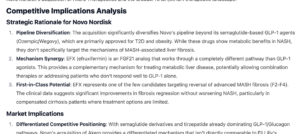
I also pasted a raw text dump of Novo Nordisk’s $5.2 billion acquisition of Akero Therapeutics and asked the model to analyze the competitive implications for the NASH/MASH drug pipeline. It disclaimed what it couldn’t verify in real time, then delivered a structured breakdown: Akero’s FGF21 analog addresses advanced liver fibrosis through a mechanism entirely distinct from Novo’s GLP-1 franchise, reducing head-to-head exposure to Eli Lilly’s tirzepatide while filling a gap in late-stage MASH where existing drugs fall short. It flagged execution risk, pricing dynamics, and regulatory timing, and even offered an investment thesis.