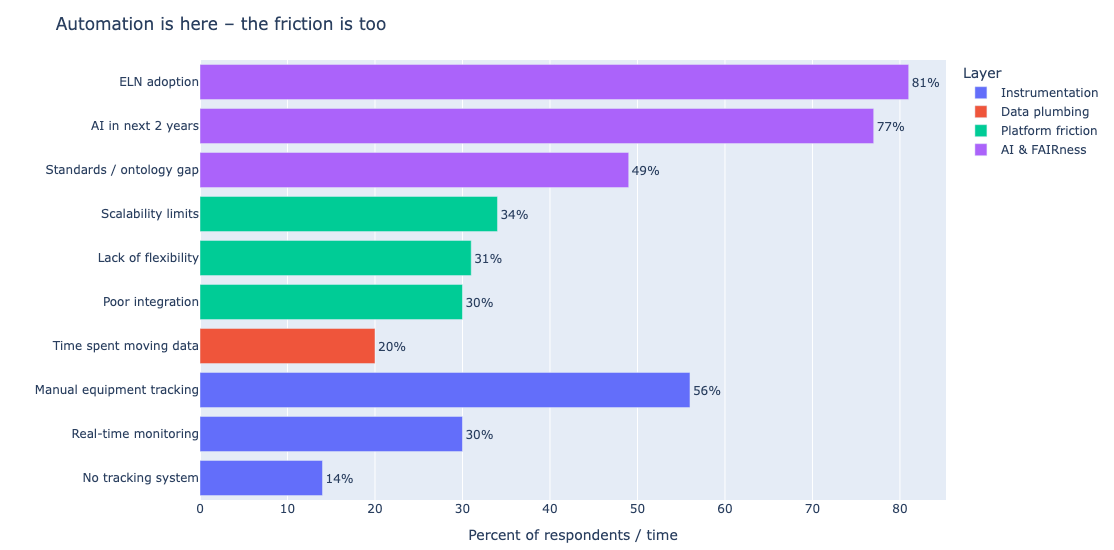
Provided for a rough sense of scale only. Percentages come from four separate, vendor-sponsored surveys with different samples, geographies and question wording. IDBS surveyed 856 biopharma professionals in the US, UK and Europe about lab data platforms; the Pistoia Alliance’s Lab of the Future 2025 survey polled just over 200 experts across pharma, biotech, software, services, academia and non-profits worldwide; MachineQ’s Censuswide study covered 400 US-based lab professionals at life-science companies with more than $1B in annual revenue; and the 15–25% figure for time spent moving data is reported in Sapio Sciences–sponsored analysis in BioPharma Dive rather than a standalone, published survey. Because of these differences, the numbers are directional and not strictly comparable across rows.
Automation was supposed to help R&D labs run more smoothly, freeing scientists from repetitive work so they could focus on discovery. And sometimes it does do that. But the reality now is messier. In a recent survey of 856 biopharma R&D professionals, 31% cited lack of flexibility and 30% pointed to poor integration as top platform pain points, even as nearly nine in ten say their organizations have invested in modern R&D data systems. The tools are here. The friction sometimes is, too.
Some labs do see real wins from adaptable automation: plate-handling times trimmed, assay precision tightened, fewer late-night shifts at the bench. But plenty of others are still tracking instruments in spreadsheets, manually stitching data between systems and waiting days for minor protocol tweaks to crawl through revalidation. It adds up to something of a paradox. Robots and software are seemingly ubiquitous, yet day-to-day life in many R&D labs feels just as brittle as before. I
In any event, burnout is common in many labs, especially in clinical ones. A 2025 feature in The Pathologist reports that more than 80% of pathology laboratory staff show burnout symptoms. While pathology is often thought of as a clinical specialty, it has deep R&D ties, from biomarker discovery and companion diagnostic development to preclinical histopathology services that support drug development programs. And the heavy workloads and lack of autonomy extend across lab settings.
A separate 2024 survey of 408 U.S. lab professionals by Siemens Healthineers and The Harris Poll found that nearly two in five rank limited staffing as their biggest challenge, 5% said their lab had temporarily closed because of understaffing, and 14% admitted to making at least one high-risk error while overworked. R&D teams may not be staring down STAT turnaround times every hour, but they’re working in the same ecosystem: thin staffing, rising data loads, and toolchains that don’t quite connect. So when a new automation platform shows up, it can land on people who are already tired, juggling spreadsheets and validation queues.
The patchwork problem
Despite that investment, the underlying architecture in many R&D labs still looks more like a patchwork than a platform. In IDBS’s May 2025 survey, roughly a third of biopharma respondents pointed to limited scalability (34%), lack of flexibility (31%), and poor integration (30%) as their biggest issues with scientific lab data systems built around LIMS, ELN and related tools. Benchling’s 2024 State of Tech in Biopharma report tells a similar story: about 90% of respondents say they have an R&D data platform in place, and 87% expect their data generation to at least double over the next year, yet only 37% of small-company respondents report that more than 60% of their instruments are actually connected.
The human cost of these disconnected systems is significant. According to a 2025 BioPharma Dive analysis, scientists routinely spend 15–25% of their time manually transferring data between platforms. In parallel, the Pistoia Alliance’s 2025 Lab of the Future survey found that while electronic lab notebook adoption has jumped to 81% (up from 66% in 2024). Data silos remain the top challenge at 57%, and nearly half (49%) cite data standards and ontologies as a major gap preventing data from becoming truly findable, accessible, interoperable, and reusable.
Manual tracking in the age of automation
That disconnect extends to the hardware and facilities level. A 2025 survey for MachineQ, summarized in Lab Manager, found that 56% of labs still track equipment usage manually, 14% have no system in place at all and only 30% use real-time monitoring. For an R&D scientist, that often translates into unplanned downtime, mysterious delays in critical assays and a steady stream of “shadow” workflows in email and spreadsheets to keep projects moving. The result is that automation can at becomes another island. It is highly capable, but poorly instrumented. The goal of having a coherent, observable system. It saves hands-on time in theory, while creating new blind spots in practice.
In parallel, a new wave of “AI scientists” is trying to automate the white-collar side of discovery. Systems like Sakana AI’s AI Scientist and Google’s Gemini-based AI co-scientist can already generate research ideas, write and run code-based experiments, and even draft full manuscripts or project proposals. Yet even their creators stress that today these tools are confined mostly to well-instrumented, simulation-friendly domains such as machine-learning benchmarks, with real-world science still bottlenecked by messy lab infrastructure, fragmented data, and safety constraints.