Research & Development World

  • R&D World Home
  • Topics
    • Aerospace
    • Automotive
    • Biotech
    • Careers
    • Chemistry
    • Environment
    • Energy
    • Life Science
    • Material Science
    • R&D Management
    • Physics
  • Technology
    • 3D Printing
    • A.I./Robotics
    • Software
    • Battery Technology
    • Controlled Environments
      • Cleanrooms
      • Graphene
      • Lasers
      • Regulations/Standards
      • Sensors
    • Imaging
    • Nanotechnology
    • Scientific Computing
      • Big Data
      • HPC/Supercomputing
      • Informatics
      • Security
    • Semiconductors
  • R&D Market Pulse
  • R&D 100
    • 2025 R&D 100 Award Winners
    • 2025 Professional Award Winners
    • 2025 Special Recognition Winners
    • R&D 100 Awards Event
    • R&D 100 Submissions
    • Winner Archive
  • Resources
    • Research Reports
    • Digital Issues
    • Educational Assets
    • Subscribe
    • Video
    • Webinars
    • PharmSci360
    • Content submission guidelines for R&D World
  • Global Funding Forecast
  • Top Labs
  • Advertise
  • SUBSCRIBE

A New Miniature Solution for Storing Renewable Energy

By University Of Southern California | October 12, 2017

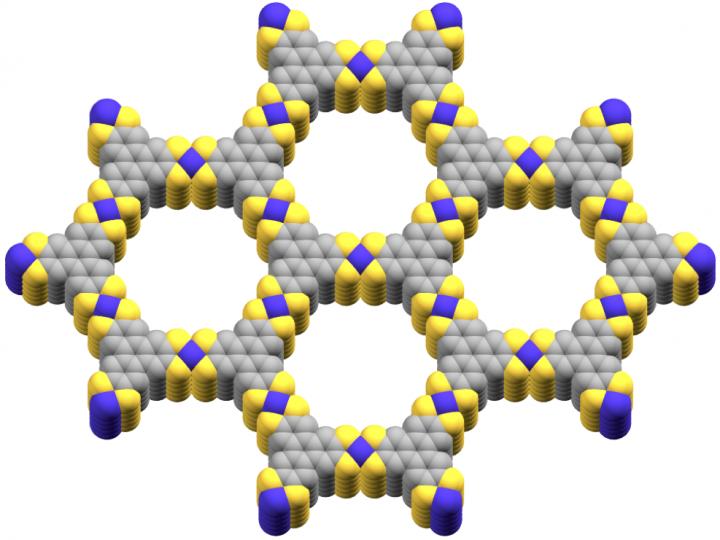
The cobalt-based metal-organic framework used by the USC scientists, with purple representing cobalt, yellow representing sulfur and gray representing carbon. Credit: Smaranda Marinescu

Scientists have long searched for the next generation of materials that can catalyze a revolution in renewable energy harvesting and storage.

One candidate appears to be metal-organic frameworks. Scientists have used these very small, flexible, ultra-thin, super-porous crystalline structures to do everything from capturing and converting carbon into fuels to storing hydrogen and other gases. Their biggest drawback has been their lack of conductivity.

Now, according to USC scientists, it turns out that metal-organic frameworks can conduct electricity in the same way metals do.

This opens the door for metal organic-frameworks to one day efficiently store renewable energy at a very large, almost unthinkable scale.

“For the first time ever, we have demonstrated a metal-organic framework that exhibits conductivity like that of a metal. The natural porosity of the metal-organic framework makes it ideal for reducing the mass of material, allowing for lighter, more compact devices” said Brent Melot, assistant professor of chemistry at the USC Dornsife College of Letters, Arts & Sciences.

“Metallic conductivity in tandem with other catalytic properties would add to its potential for renewable energy production and storage” said Smaranda Marinescu, assistant professor of chemistry at the USC Dornsife College.

Their findings were published July 13 in the Journal of the American Chemical Society.

An emerging catalyst for long-term renewable energy storage

Metal-organic frameworks are so porous that they are well-suited for absorbing and storing gases like hydrogen and carbon dioxide. Their storage is highly concentrated: 1 gram of surface area provides the equivalent of thousands of square feet in storage.

Solar has not yet been maximized as an energy source. The earth receives more energy from one hour of sunlight than is consumed in one year by the entire planet, but there is currently no way to use this energy because there is no way to conserve all of it. This intermittency is intrinsic to nearly all renewable power sources, making it impossible to harvest and store energy unless, say, the sun is shining or the wind is blowing.

If scientists and industries could one day regularly reproduce the capability demonstrated by Marinescu, it would go a long way to reducing intermittency, allowing us to finally make solar energy an enduring and more permanent resource.

Metal or semiconductor: why not both?

Metal-organic frameworks are two-dimensional structures that contain cobalt, sulfur, and carbon atoms. In many ways, they very broadly resemble something like graphene, which is also a very thin layer of two-dimensional, transparent material.

As temperature goes down, metals become more conductive. Conversely, as the temperature goes up, it is semiconductors that become more conductive.

In the experiments run by Marinescu’s group, they used a cobalt-based metal-organic framework that mimicked the conductivity of both a metal and semiconductor at different temperatures. The metal-organic framework designed by the scientists demonstrated its greatest conductivity at both very low and very high temperatures.


Related Articles Read More >

As U.S. power demand surges, Brookhaven taps AWS in aim to drive 20-100x faster power grid decision-making with GridSearch AI
DOE announces first selections for nuclear energy DOME program
Five key trends that defined the show floor at Interphex 2026 
NANO Nuclear could have a reactor on the Moon by 2030 CEO says
rd newsletter
EXPAND YOUR KNOWLEDGE AND STAY CONNECTED
Get the latest info on technologies, trends, and strategies in Research & Development.

R&D World Digital Issues

Fall 2025 issue

Browse the most current issue of R&D World and back issues in an easy to use high quality format. Clip, share and download with the leading R&D magazine today.

R&D 100 Awards
Research & Development World
  • Subscribe to R&D World Magazine
  • Sign up for R&D World’s newsletter
  • Contact Us
  • About Us
  • Drug Discovery & Development
  • Pharmaceutical Processing
  • Global Funding Forecast

Copyright © 2026 Arrowfly LLC. All Rights Reserved. The material on this site may not be reproduced, distributed, transmitted, cached or otherwise used, except with the prior written permission of Arrowfly
Privacy Policy | Advertising | About Us

Search R&D World

  • R&D World Home
  • Topics
    • Aerospace
    • Automotive
    • Biotech
    • Careers
    • Chemistry
    • Environment
    • Energy
    • Life Science
    • Material Science
    • R&D Management
    • Physics
  • Technology
    • 3D Printing
    • A.I./Robotics
    • Software
    • Battery Technology
    • Controlled Environments
      • Cleanrooms
      • Graphene
      • Lasers
      • Regulations/Standards
      • Sensors
    • Imaging
    • Nanotechnology
    • Scientific Computing
      • Big Data
      • HPC/Supercomputing
      • Informatics
      • Security
    • Semiconductors
  • R&D Market Pulse
  • R&D 100
    • 2025 R&D 100 Award Winners
    • 2025 Professional Award Winners
    • 2025 Special Recognition Winners
    • R&D 100 Awards Event
    • R&D 100 Submissions
    • Winner Archive
  • Resources
    • Research Reports
    • Digital Issues
    • Educational Assets
    • Subscribe
    • Video
    • Webinars
    • PharmSci360
    • Content submission guidelines for R&D World
  • Global Funding Forecast
  • Top Labs
  • Advertise
  • SUBSCRIBE